


Talk:Expected value
Add topicArchived discussion to mid 2009
 | This  level-4 vital article is rated C-class on Wikipedia's content assessment scale. level-4 vital article is rated C-class on Wikipedia's content assessment scale.It is of interest to the following WikiProjects: | ||||||||||||||||||||
| |||||||||||||||||||||


Equity
[edit]In games of chance, such as poker or backgammon, the "expected value" is commonly referred to as the "equity" or "fair market value" of a position. For instance this definition:
- Equity: The value of a position to one of the players. Equity is the sum of the values of the possible outcomes from a given position with each value multiplied by its probability of occurrence. It is the same as the fair settlement value of the position. Your equity is the negative of your opponent's equity.
But I'm not seeing the term used in this article. There is a section about equity in the poker strategy article, but it's unsourced and could otherwise stand some improvement. It links to this article, but this article has little follow up for those readers. Other than that, I'm not seeing a good treatment of equity (or expected value) in simple games of chance anywhere on Wikipedia, although many articles such as craps, casino, and board game link to this article. I think that's an omission that should be corrected.
Is this article the best place for it? Does it belong somewhere else? This article is fairly technical and seems to assume that the reader is familiar with calculus, perhaps even measure theory, so maybe somewhere else would make more sense.
Seems to me that a simple exposition on expected value for finite sample spaces, along with its interpretation as "equity" or "fair market value" and three or four simple examples would improve things. This simple exposition could be accomplished with only arithmetic (addition, multiplication, division) which would make it more accessible to the general reader. BTW, in the current two examples, a single die roll and roulette, the sample space has equal probability for all outcomes. It would be more illustrative to have an example where the probabilities were different to demonstrate weighted average. Mr. Swordfish (talk) 15:23, 4 April 2023 (UTC)
Too much about density functions
[edit]The two subsections
of the section Definition currently deal with many details on density functions and absolutely continuous random variables. However, the appropriate places for these are the two articles Random variable and Probability density function. I therefore suggest deleting a lot of details on density and absolute continuity here or moving it there. Rigormath (talk) 11:37, 18 May 2024 (UTC)
- As a mathematician, I would agree with you if the purpose were to efficiently define the expected value in the greatest generality. But the expected value via densities is absolutely ubiquitous in standard sources, so it has to be given its due weight. Gumshoe2 (talk) 13:39, 18 May 2024 (UTC)
- The following red excerpt, for example, would be helpful in the article Probability density function, but does not contribute to the understanding of the present definition and its "due weight":
- However, the Lebesgue theory clarifies the scope of the theory of probability density functions. A random variable X is said to be absolutely continuous if any of the following conditions are satisfied:
- there is a nonnegative measurable function f on the real line such that
- for any Borel set A, in which the integral is Lebesgue.
- the cumulative distribution function of X is absolutely continuous.
- for any Borel set A of real numbers with Lebesgue measure equal to zero, the probability of X being valued in A is also equal to zero
- for any positive number ε there is a positive number δ such that: if A is a Borel set with Lebesgue measure less than δ, then the probability of X being valued in A is less than ε.
- These conditions are all equivalent, although this is nontrivial to establish.[20] In this definition, f is called the probability density function of X (relative to Lebesgue measure).
- However, the Lebesgue theory clarifies the scope of the theory of probability density functions. A random variable X is said to be absolutely continuous if any of the following conditions are satisfied:
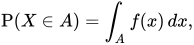
- By the way, don't underestimate the readers' ability to klick a link to another article. Rigormath (talk) 15:17, 19 May 2024 (UTC)
Removal of citation needed rationale
[edit]I tried and failed to find citations supporting for Pascal's state of mind:
Pascal, being a mathematician, was provoked and determined to solve the problem once and for all.
I decided to change it to a more straightforward assertion:
Pascal, being a mathematician, decided to work on a solution to the problem
I did not add a citation to the paragraph as the subsequent paragraph, which recounts his work on the problem, is sourced.
Should someone track down sourcing for Pascal state of mind feel free to restore the original statement with a citation. S Philbrick(Talk) 14:58, 1 October 2025 (UTC)
- Pascal and Gombaud had a heated philosophical discussion about the meaning and usefulness of mathematics in general and about some mathematical concepts in particular. Later in Pascal's letters to Fermat it shows how unhappy, to say the least, Pascal was about Monsieur Gombauds philosophical stance about mathematics. He talked about Gombaud in a derogative manner saying things like "Monsieur Gombaud is very clever but not a mathematician which, as you know, is a big flaw." The two problems Gombaud brought up when they met was not just two randomly chosen problems, but two problems he thought was showing exactly why his philosophical stance on the matter was correct. Pascal didn't share his views at all. On the contrary it was very important for Pascal that the world could be described using mathematics. To claim, as Gombaud did, that mathematics is poorly connected to reality, and even self-contradictory, was very provoking for Pascal. As it would have been to almost any mathematician, both then and now. Pascals urge to win this philosophical dispute, or at least show that the arguments Gombaud had put forth for his stance wasn't valid arguments, he decided to show that these two problems indeed could be solved mathematically, without contradictions. This was the reason he started to write letters to Fermat about this. These letters (those that remain) can be found online if you want to read them. Fermat viewed the two problems more like two randomly chosen exercises that he solved with ease, while for Pascal it was much more emotional. He was a deeply religious person (even for his time) and that his solution of the problem of points coincided with Fermat's result made a huge emotional impact on him. He interpreted his and Fermat's result as the formula to use as a moral guide in life in general. Later in one of his religious books he turned the formula into his famous argument for why one should believe in a god, today called Pascal's Wager. So to say that Pascal got PROVOKED by the philosophical views Monsieur Gombaud expressed, regarding the utility of mathematics, is hardly an overstatement. 'Anger' or 'holy rage' would probably be closer to the truth. iNic (talk) 23:58, 6 February 2026 (UTC)
Cauchy mean - undefined or indeterminate
[edit]I was initially jarred when I saw the expected value of the Cauchy distribution was stated to be "undefined". (See the table of expected values of common distributions). I see the formula for the expected value (which I haven't tried to corroborate), which in my view is a definition. However the formula doesn't converge nicely, so I've always thought of the expected value as being "indeterminate". My view was bolstered by the fact that the term "undefined" is wiki linked and brings you to Indeterminate form.
I did some superficial research on the distinction between indeterminate and undefined, especially in the context of the Cauchy distribution, and it appears my view is not supported by a preponderance of sources, so I have chosen not to change "undefined" to "indeterminate", but am leaving this comment in case someone with more bandwidth is willing to explore it in more detail. S Philbrick(Talk) 15:18, 1 October 2025 (UTC)
Inconsistent etymolgy section
[edit]I'm a bit confused by the paragraph on etymology stating that Huygens never used the word expectation in its modern sense, immediately followed by a quotation with the word expectation used to describe what today we would also call expectation. Perhaps the writer meant that expectation was not explicitly defined by Huygens as Σ p(x) x...
Also, someone with access to the book quoting Laplace should check the original French behind mathematical hope. If it is espérance (rather than espoir), then this is better translated as expectation than as hope. Æolus (talk) 18:23, 17 September 2026 (UTC)
- @Æolus I agree that this is very confusing and should be fixed. Here are a few elements:
- First, I think Huygens uses the word "expectatio", and I think that "expectation" is a good literal translation for this.
- That said, it's true that Huygens seems to define the expectation as , which is much more restrictive than the modern definition. So I don't know what to do.
- Regarding Laplace, he does indeed use the word espérance. The problem is that it is not clear what's the best way to translate this word: in most contexts, it means "the confident awaiting of something that one desires". The main difference with "expectation" in English is that you can expect something bad to happen, whereas you can't espérer that. So in most contexts (outside of probability theory), I'd argue that "hope" is indeed a much better translation that expectation.
- In fact, Laplace himself addresses that point. He writes:
La probabilité des événements sert à déterminer l’espérance et la crainte des personnes intéressées à leur existence. Le mot espérance a diverses acceptions ; il exprime généralement l’avantage de celui qui attend un bien quelconque, dans une supposition qui n’est que vraisemblable. Dans la théorie des hasards, cet avantage est le produit de la somme espérée par la probabilité de l’obtenir [...] Nous nommerons cet avantage espérance mathématique, pour le distinguer de l’espérance morale qui dépend, comme lui, du bien espéré et de la probabilité de l’obtenir, mais qui se règle encore sur mille circonstances variables qu’il est presque toujours impossible de définir, et plus encore d’assujettir au calcul.
- note that he stresses the positive connotation of the word espérance (by opposing it to crainte and by saying that it expresses the advantage). As a result, I don't know what to do either. On the one hand, I'd probably translate l'espérance et la crainte by "the hopes and fears"; and la somme espérée by the sum hoped for... But then why suddenly use a different word in l'espérance mathématique? But on the other hand, "mathematical hope" seems very weird and the correct translation of espérance mathématique is definitely "mathematical expectation".
- Malparti (talk) 11:09, 18 September 2026 (UTC)
- @Malparti Thank you for your detailed reply! I don't have a good answer to your second point, but as regards the third, I would say the following: while you make a good case that espérance is contrasted with crainte and so should be translated hope, at least in this context, I think this is one of those cases where there is just no lossless translation. My personal sensibility would be to keep espérance as expectation, because the mathematical term should definitely be translated that way, and it's the one that's most relevant in this text. I would then translate espérances et craintes as expectation, both positive and negative or similar, and then put a (foot)note after The word expectation has several meanings; [...] to clarify that, in lay French, espérance is usually used for an outcome hoped for, so a positive one. But that's just my taste. Æolus (talk) 17:20, 18 September 2026 (UTC)
