


Talk:Dym equation
Add topicLatest comment: 6 years ago by 67.198.37.16 in topic Harry-Dym equation
 | This article is rated Start-class on Wikipedia's content assessment scale. It is of interest to the following WikiProjects: | ||||||||||
| |||||||||||

Alternative formulation?
[edit]The Dym equation

appears to be written in many places as
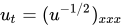
and it is claimed for example in
- Olver, Peter J. (1993). Applications of Lie groups to differential equations, 2nd ed. New York, NY; London: Springer-Verlag. ISBN 0387940073.
that the two forms are equivalent. Can an expert confirm that? Oleg Alexandrov (talk) 04:10, 26 January 2007 (UTC)
- Well, Peter Olver is an überexpert so his word is law, but for your edification: Substitute in to get and do the differentiation with respect to t to get . Finally, do some rescaling to get rid of the factor ; for instance, set . Any mistakes in my computations are left as an exercise for the reader. -- Jitse Niesen (talk) 08:40, 26 January 2007 (UTC)






- Thanks! Frankly I was not expecting an answer to the above, it was more of a note to myself. (but big brother Jitse is watching. :)
- I added the alternative formulation in the article (that one, is actually used much more often from what I saw in my google books search). If you have more to add to the article, you are more than welcome to. Oleg Alexandrov (talk) 16:47, 26 January 2007 (UTC)
Harry-Dym equation
[edit]Is this the same thing as the Harry-Dym equation, or is that something else? 67.198.37.16 (talk) 22:48, 16 September 2020 (UTC)