


Talk:Doppler effect
Add topic
| This is the talk page for discussing improvements to the Doppler effect article. This is not a forum for general discussion of the subject of the article. |
Article policies
|
| Find sources: Google (books · news · scholar · free images · WP refs) · FENS · JSTOR · TWL |
Archives: 1Auto-archiving period: 3 months  |
 | This  level-4 vital article is rated B-class on Wikipedia's content assessment scale. level-4 vital article is rated B-class on Wikipedia's content assessment scale.It is of interest to the following WikiProjects: | ||||||||||||||||||||
| |||||||||||||||||||||
.jpg)

.jpg)

 | The content of Inverse Doppler effect was merged into Doppler effect on 2014-03-18. The former page's history now serves to provide attribution for that content in the latter page, and it must not be deleted as long as the latter page exists. For the discussion at that location, see its talk page. |
How to interpret the wavelength shown in a formula in the Section "General"?
[edit]In the section "General", there is the below part (quoted) showing the wavelength . How to interpret it? I thought it it the wavelength observed by the receiver, but it is not when I consider a case that the source is stationary and the receiver is moving toward the source. In this case, the observed wavelength by the receiver should be shorter than the wavelength observed when the receiver is also stationary, but this formula shows the wavelength not shortened , so I'm confusing what this is. It needs to be clarified.


"Equivalently, under the assumption that the source is either directly approaching or receding from the observer:
where
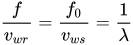
- is the wave's speed relative to the receiver;
- is the wave's speed relative to the source;
- is the wavelength."


Goodphy (talk) 08:57, 21 September 2025 (UTC)
- The paragraph had no sources. I deleted it. Johnjbarton (talk) 14:07, 21 September 2025 (UTC)
An approximation in the Section "General" may not be an approximation
[edit]Hi.
In the Section "General", there is the below description (quoted with ""), that is mentioned as an approximation. However, if the frame of the reference is fixed to the wave Source, then I think it is not the approximation anymore; it is exact because in becomes 0, resulting in the formula of the below description.


Thus, I would like to confirm if the description is an approximation or or exact. I think it is exact as long as the special relativity is not concerned.
"If the speeds and are small compared to the speed of the wave, the relationship between observed frequency and emitted frequency is approximately[1]


| Observed frequency | Change in frequency |
|---|---|
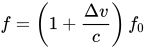

where
- is positive when the source and the receiver are moving towards each other. The interpretation of it is easy when we consider and as vectors here; they are positive when they are travel along the right direction and opposite for the left direction travel, and the source is left to the receiver.
- This proof below is for a case where the receiver is moving toward the source and the source is moving away from it, but proofs for other cases can be similarly derived."



Goodphy (talk) 07:28, 29 September 2025 (UTC)
- I agree and I deleted that content. The starting formula in that section already neglects relativity. The source does not mention this bit. Johnjbarton (talk) 18:16, 29 September 2025 (UTC)
- Hi. Thank you to recognize my point of view and your effort of clarifying this article, but I think deleting the whole description in this topic seems too strong. I thought modifying the first sentence "If the speeds and are..." and simplifying the description of seems enough. Let me consider a possible good change, and implement it if needed. Let you know the change. Goodphy (talk) 06:35, 30 September 2025 (UTC)
- The change has been made by me. @Johnjbarton Could you review my change? Goodphy (talk) 07:24, 30 September 2025 (UTC)
- @Goodphy The problem I have with this paragraph is "why?" What is the point? What physical situation is modeled by these equations? The content is not sourced so we have no way to improve it without guessing. Johnjbarton (talk) 15:14, 30 September 2025 (UTC)
- Hi. This is not about physics but these formulas as a simpler form is useful for calculation. In essence, we don't need it as it can be derived. I think it is good to have rather than what it must be.
- If you remove it with your own reason, then I will not resist it. 39.7.15.211 (talk) 15:37, 30 September 2025 (UTC)
- Calculation of what? In what case would the Doppler shift in the frame of the source be useful? Johnjbarton (talk) 16:26, 30 September 2025 (UTC)
- Hi @Johnjbarton.
- I have thought about the usefulness of the reference frame fixed to the wave source, as you mentioned, than today I decided to remove (removal done) the contents about this frame, because, in this frame, the medium of wave propagation moves, and that makes situation not simple. (Light, which speed is constant regardless of which reference frames are used in vacuum, seems more simple.)
- Instead, in my vision, the approximation that you have removed on 2025-09-29 by this page TALK, seems useful for practical cases inc. engineering fields. I think there was a reference cited in the removed contents. I will try to find and review this reference to check its validity regarding the contents. Goodphy (talk) 06:12, 7 October 2025 (UTC)
- Revived contents about small velocity approximation that has been removed on 2025-09-29, because similar contents can be found in different sources, even Google AI shows this contents based on different sources. This approximation formula seems widely accepted and would give an insight of how doppler shift frequency can be calculated. Goodphy (talk) 06:51, 8 October 2025 (UTC)
- Calculation of what? In what case would the Doppler shift in the frame of the source be useful? Johnjbarton (talk) 16:26, 30 September 2025 (UTC)
- @Goodphy The problem I have with this paragraph is "why?" What is the point? What physical situation is modeled by these equations? The content is not sourced so we have no way to improve it without guessing. Johnjbarton (talk) 15:14, 30 September 2025 (UTC)
- The change has been made by me. @Johnjbarton Could you review my change? Goodphy (talk) 07:24, 30 September 2025 (UTC)
- Hi. Thank you to recognize my point of view and your effort of clarifying this article, but I think deleting the whole description in this topic seems too strong. I thought modifying the first sentence "If the speeds and are..." and simplifying the description of seems enough. Let me consider a possible good change, and implement it if needed. Let you know the change. Goodphy (talk) 06:35, 30 September 2025 (UTC)

References
- ↑ Walker, Jearl; Resnick, Robert; Halliday, David (2007). Halliday & Resnick Fundamentals of Physics (8th ed.). Wiley. ISBN 9781118233764. OCLC 436030602.
- B-Class level-4 vital articles
- Wikipedia level-4 vital articles in Physical sciences
- B-Class vital articles in Physical sciences
- B-Class physics articles
- Top-importance physics articles
- B-Class physics articles of Top-importance
- B-Class Astronomy articles
- High-importance Astronomy articles
- B-Class Astronomy articles of High-importance