Cloudflare fetched the original article and streamed it through HTMLRewriter to apply an entirely new visual system without rebuilding the source page.
// request.cf · coarse context
A page that knows where it met you.
Only coarse request metadata is shown. This demo does not display or persist visitor IP addresses.
This article is within the scope of WikiProject Tree of Life, a collaborative effort to improve the coverage of taxonomy and the phylogenetictree of life on Wikipedia. If you would like to participate, please visit the project page, where you can join the discussion and see a list of open tasks.Tree of LifeWikipedia:WikiProject Tree of LifeTemplate:WikiProject Tree of Lifetaxonomic
This article is within the scope of WikiProject Protista, a collaborative effort to improve the coverage of protists and protistology on Wikipedia. If you would like to participate, please visit the project page, where you can join the discussion and see a list of open tasks.ProtistaWikipedia:WikiProject ProtistaTemplate:WikiProject ProtistaProtista
This article is part of WikiProject Algae, which aims to improve Wikipedia's coverage of the photosynthetic organisms commonly called algae and related topics. If you would like to participate, visit the project page.AlgaeWikipedia:WikiProject AlgaeTemplate:WikiProject AlgaeAlgae
This article is within the scope of WikiProject Plants, a collaborative effort to improve the coverage of plants and botany on Wikipedia. If you would like to participate, please visit the project page, where you can join the discussion and see a list of open tasks.PlantsWikipedia:WikiProject PlantsTemplate:WikiProject Plantsplant
A fact from Diaphoretickes appeared on Wikipedia's Main Page in the Did you know column on 26 August2025(check views). The text of the entry was as follows:
Did you know... that the name of Diaphoretickes, a group containing a huge diversity of organisms including plants and kelps, is derived from a Greek word meaning diverse?
Latest comment: 8 years ago1 comment1 person in discussion
Can Bikonts, Diaphoretickes, Corticata, Cabozoa, etc. PLEASE all be merged into a single page?
I think theyre separate because they are notable as ideas, even if t hey cannot all simultaneously exist. e.g. we have a page for Pancrustacea even though not everybody believes in it. —Soap—19:30, 28 July 2018 (UTC)Reply
Latest comment: 7 years ago3 comments1 person in discussion
Is there reference for the unusual pronunc of the diap word? It's not used in the source linked, so no help there. —Soap—19:30, 28 July 2018 (UTC)Reply
Couldnt find a source for the pronunciation, but it seems that it is sometimes spelled without the c. And that it may come from a Greek word for "diverse". But the name may also be a pun between that word and another one meaning "sweating" ... as all plants are known for pushing water through their body. I'll look into this when I get a chance to see if the variant spelling is acceptable. —Soap—23:39, 18 October 2018 (UTC)Reply
Latest comment: 4 years ago1 comment1 person in discussion
Hemimastigophora was removed from the list of subtaxa earlier. I'm putting it back (with question mark) for two reasons:
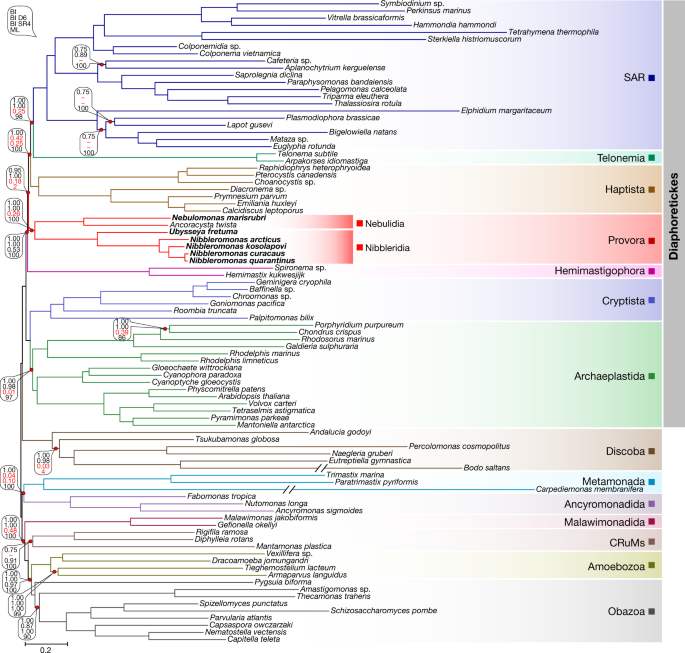
1) Some recent studies found Hemimastigophora nests among the sub-clades of Diaphoretickes. The Lax et al. 2018 paper that described Hemimastix kukwesjijk also mentions this is a (less likely) possibility.
2) Moreover, if the Lax paper's preferred placement of Hemimastigophora is correct, the Hemimastigophora still falls within Diaphoretickes, by definition.
The paper itself suggests this, although there some of the language is equivocal. Some statements do indeed imply that Hemimastigophora is outside the clade: "They instead comprise an independent supra-kingdom-level lineage that most likely forms a sister clade to the ‘Diaphoretickes’ half of eukaryote diversity" (in the abstract), and "Hemimastigophora outside of and sister to Diaphoretickes" (p.3). But there is also wording that implies membership within Diaphoretickes: "actually branched sister to all of the other Diaphoretickes" (p.2) and "Their consensus tree shows Hemimastigophora as sister to (other) Diaphoretickes with maximal support" (in Methods section). [Emphasis added in all of these.]
This equivocation makes some sense if we think only of the clades originally considered members of Diaphoretickes. But the definition of Diaphoretickes is clear: if a taxon is closer to Rhizarians, Alveolates, Stramenopiles, and Archaeplastida, than it is to Opisthokonts, Amoebozoans, or Excavates, then it belongs in Diaphoretickes.
In this diagram, the Diaphoretickes is defined as the branch marked "Y", even though sometimes people refer to the clade as if it were the node marked "Z":
It might be reasonable to redefine Diaphoretickes as clade "Z" to better match the original membership, but as far as I know no one as done so. Cephal-odd (talk) 04:43, 4 October 2022 (UTC)Reply
The following discussion is closed. Please do not modify it. Subsequent comments should be made on the appropriate discussion page. No further edits should be made to this discussion.
"At some point" in the lead is a bit vague, please indicate the date. You could say something like "In 1999, Tom Cavalier-Smith called the group photokaryotes." for example.
I removed that wording and made it more similar to the main text.
We should probably attribute "Corticates" to Cavalier-Smith as well. Or possibly Lankester, but the discussion would need to change for that.
Not sure I understand this, do you mean as a taxon in the taxobox synonyms section? Would you say the footnote is not enough?
The discussion is spread over multiple places, and is sufficient.
The cladogram, and much of the discussion around it, centres on the root of the eukaryotes rather than on the Diaphoretickes as such, so it borders on being off-topic. The lower part of the cladogram in particular is basically just a list of basal groups and says nothing about the Diaphoretickes.
Totally agree, I removed all that fuzz and centered it more on Diaphoretickes.
The cladogram would in any case be much improved by showing where familiar groups fit in. You could say "Archaeplastida (inc. plants)", "Amorphea (inc. fungi, animals)", for example.
Agreed. I removed Amorphea but did include plants and green and red algae as more familiar groups.
I suggest that the cladogram should be illustrated with small thumbnails of members of the various clades. Happy to add these if you like.
Done.
Since you mention heliozoa and radiolaria in the lead, they must be important enough to have on the cladogram, too.
Done, marked with asterisks.
It would be helpful, too, to give a bit more detail in the tree on the Archaeplastida, since you have a whole paragraph in "Diversity" on them.
Done.
The lead needs to reflect the structure of the article, with coverage for each chapter.
Done, let me know if you see it lacking more coverage.
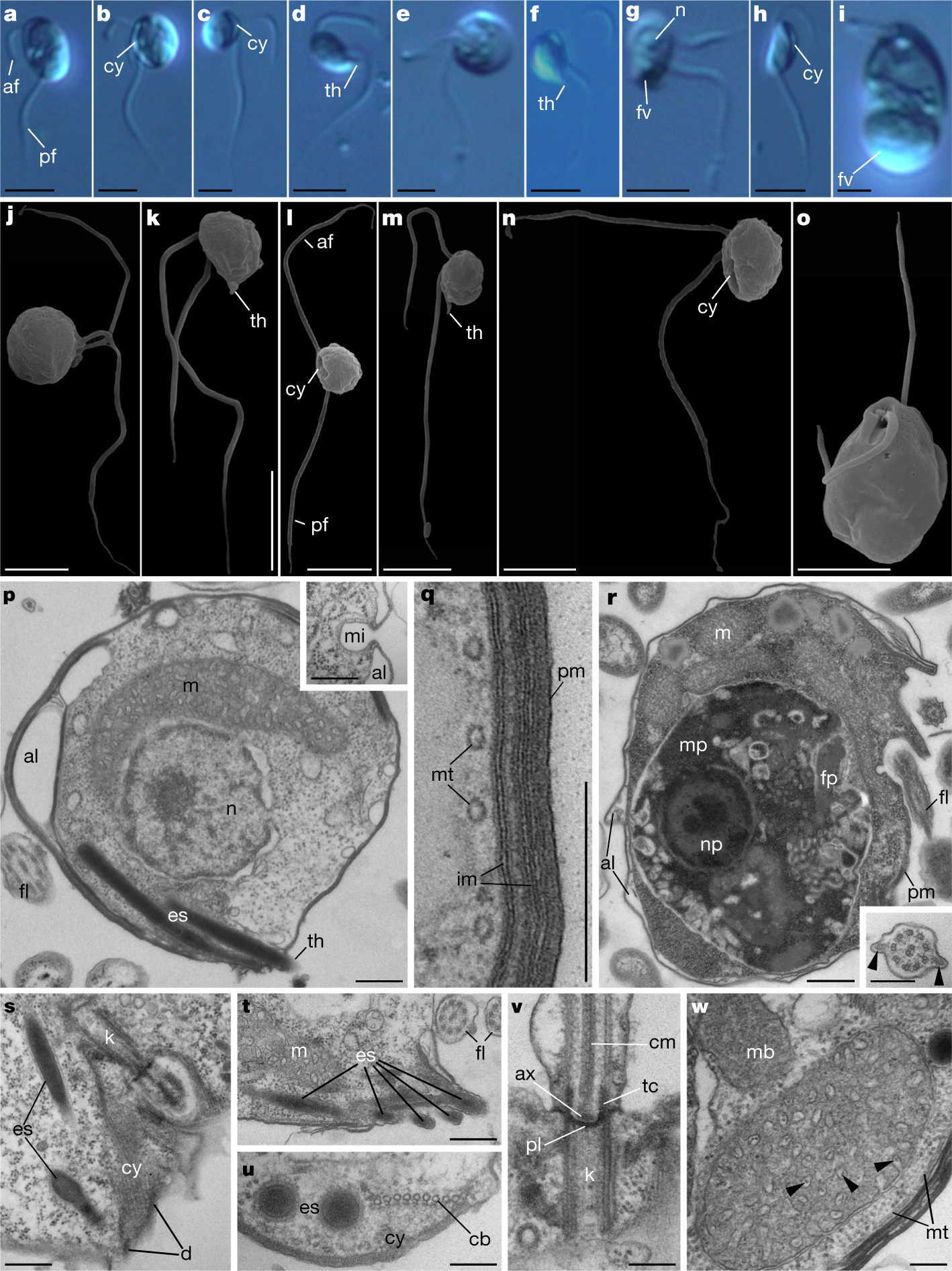
Colponema vietnamica is the only Commons image that currently comes at all close to showing the 2 flagella and the distinctive groove of the Diaphoretickes.
We are missing a (simple) diagram of the supposed Diaphoretickes ancestor. The traits of this organism are discussed in the article but are not easy to visualise. It should be straightforward to locate or draw such an image, which would certainly assist the general reader. Alternatively you might use an actual micrograph of a suitably representative species, suitably captioned.
I did this with Colponema, using the image you suggested below. Unfortunately, I could not get a good (and free) image of any basal corticate where both the ventral groove and flagella are clearly visible; electron microscopy images are overly detailed, harder to understand, or out of scope. I did however come across an image of Neocolponema that could be an improvement, but I'll have to try to upload it through a different rout as it is non-free. I'm currently in touch with Kaonashia's author, I hope I'm able to get her to upload good images of it to show the cortical alveoli as well.
The rather uneven, rather unreadable composite image in the infobox is currently the only illustration. It is not very satisfactory, not least because its 10 component images have all to be viewed as a single thumbnail on whatever (often small) screen the reader is using. For instance, the whole image is 45mm wide on my mobile, while the individual Paramecium at lower left are no more than 5mm long. I know that some editors like composites for groups, but this image does not work at all well. There are two smudgy green squares in the second row; apparently the second one is a "water mold", an unidentified Oomycete. It isn't one of the four images used in the lead of Oomycete, by the way. And, the thing doesn't even have a caption! So it's not clear what the ordinary reader could make of it: not much, I suspect. In short, I think we could do a lot better than this, by having bigger and better-selected images to accompany the text, and then something a lot more legible, possibly a single image, possibly a clearer composite, for the lead.
Let me know if this new composite image is more satisfying.
It's certainly more readable; as you imply above, the composite still fails to convey the defining features of the group. Its name, "Diverse", does suggest why there is an issue here, which doesn't occur with groups that people can form an intuitive picture of (like "Animals", say). The Colponema image is definitely better, and (I agree) still not ideal as the groove is not terribly visible. If you can get hold of a clearer micrograph that would be the right answer.
Specifically, I suggest we have images of (at least) Archaeoplastida, Haptista, Cryptista, and SAR in "Diversity".
Done.
I suggest we might use this image of Colponema which you describe as an "early-branching species", to accompany the text in "Ancestral traits". The caption can label the pair of flagella and the ventral feeding groove.
(See above)
"Convergent traits" describes the ways that different groups acquired plastids from varied sources. This would be well worth illustrating with a simple diagram (it could readily be made in PowerPoint and saved from there as an SVG, for instance).
Done, I hope the image is satisfactory!
Wonderful. Readers will find it enlightening about the group, and about Endosymbiosis, where that image and a cited section explaining it is needed.
All the sources are appropriate for the subject. Most are primary research papers, which does lay the article open to the charge of WP:PRIMARY rather than being unquestionable WP:RS, pace the text's careful discussion of the relative merits of the differing hypotheses about the group's composition and phylogeny.
I suggest we add |display-authors=5 (or near offer) for all many-authored papers. "Adl-2005" has 28 authors, for instance.
The main text of this article covers the territory well, and is robustly cited. The main improvements needed are to the lead, which needs to reflect the main text, and the images, which need to illustrate the various parts of the main text, the current single composite image not being terribly satisfactory. Chiswick Chap (talk) 12:26, 30 June 2025 (UTC)Reply
The discussion above is closed. Please do not modify it. Subsequent comments should be made on the appropriate discussion page. No further edits should be made to this discussion.
Latest comment: 1 year ago7 comments4 people in discussion
The following is an archived discussion of the DYK nomination of the article below. Please do not modify this page. Subsequent comments should be made on the appropriate discussion page (such as this nomination's talk page, the article's talk page or Wikipedia talk:Did you know), unless there is consensus to re-open the discussion at this page. No further edits should be made to this page.
... that Diaphoretickes, a group containing an enormous diversity of eukaryotes including plants, ciliates, and kelps (pictured), derives from a Greek word meaning "diverse"?
@Snoteleks: Article expansion new enough, GA new enough, Issues raised during and just after Ga have been resolved. Article is fully sourced and neutrally worded. AI detection came back as human, no copyvios are close paraphrasing identified in the prose. The hook is confirmed and verified in article and source. The hook itself could used some work though, right now its very clunky and a general "rule to live by" is the less extra links in a hook the better. could we reword the center to maybe just listing two or three example taxa, say "...including giant redwoods, ciliates, and kelps (pictured)..." with an image of one of the taxa to draw readers in more.--Kevmin§01:44, 9 July 2025 (UTC)Reply
Apologies for the delay, yes the updated wording flows much better, and the image adds well. We look good to go.--Kevmin§16:31, 11 July 2025 (UTC)Reply
Latest comment: 1 year ago7 comments2 people in discussion
The first paragraph of the section Convergent traits is false, the image in is misleading (and its description also false). Since the death of the chromalveolate hypothesis (~ 2012) the origin of all "red" plastids is not a secondary endosymbiosis of a red alga. This is probably true only for the cryptophyte plastids (maybe also for the haptophytes). Myzozoans and ochrophytes have their plastids not from an endosymbiosis of a red alga, but of a cryptophyte or another "chromist" algae. The section and the image description need rewording, to present the correct view ofthe consecutive endosymbiosis of "red" plastids and especially to clarify the misleading red discontinuous arrows in the image. Petr Karel (talk) 08:07, 7 July 2025 (UTC)Reply
@Petr Karel This is entirely a subjective wording matter, since the statement "the origin of all red plastids is a secondary endosymbiosis of a red alga" is completely true: that is their origin, with "secondary" meaning "after the fact" in the context of evolution. Even if you went ahead and placed a specific order of secondary endosymbioses (of which there is no consensus except(?) for cryptophytes being the first, and neither the text nor the image refuse to support one hypothesis over the other, which would be misleading), that would not make it any less true that ultimately they all derived from a red alga. I can see a different wording being helpful and I will try to implement that, but the statement itself is not misleading, the scope is just narrow. I can also just add more information (something like what we see at Algae#Consecutive endosymbioses) if that suits you better. — Snoteleks (talk)11:47, 7 July 2025 (UTC)Reply
@Petr Karel I have re-worded both the section and image description. Since you were the one to post the warning, I think you should review it to see if it's satisfactory now. — Snoteleks (talk)16:30, 7 July 2025 (UTC)Reply
Thank you. It was not subjective wording matter, secondary endosymbiosis is a specific term which shall be applied correctly in a "good article". The wording "plastids acquired in the secondary endosymbiosis of red alga" was not correct, the new "plastids originating from a secondary endosymbiosis" completed with the explanation is OK, I am deleting the "disputed" template. Petr Karel (talk) 17:02, 7 July 2025 (UTC)Reply
@Petr Karel I think I see what you mean now. I see that the wording is indeed misleading for someone that does not already know the theory in-depth, or at the very least it's easy to misinterpret. Thank you for reaching out about that.
On another note, your comment made me wonder, would it be more clear for the reader if I used this image instead? It's the same as the original but following the 2024 hypothesis (with hypothesized acquisitons marked '?'). Perhaps with the right caption it would avoid misleading the reader more easily than the original image. — Snoteleks (talk)17:10, 7 July 2025 (UTC)Reply
Well, it is not easy to find a balance between corectness and clearness of the formulation or a scheme. I like the new image, showing that the red plastid is not "preserved" in all lineages from one act of a secondary endosymbiosis (chromalveolate hypotesis) neither is originated in many independent acts of secondary endosymbiosis of red alga. But the explanation to the previous version of the image was also satisfactory. Petr Karel (talk) 17:48, 7 July 2025 (UTC)Reply
I'm glad you like the explanation, but I think I also like the new image better. I might update the image so that the explanation does not have to be so lengthy. — Snoteleks (talk)19:46, 7 July 2025 (UTC)Reply
Latest comment: 1 year ago2 comments2 people in discussion
'The name Diaphoretickes derives from Greek διαφορετικές (diaforetikés) meaning diverse, dissimilar, referring to the wide morphological and cellular diversity among members of this clade.'
That's fine, but what needs to be explained is:
1. Why on Earth it is derived from Modern Greek and not from Ancient Greek. The adjective doesn't exist in Ancient Greek, and also the form -ικές for the feminine plural only exists in Modern Greek (in Ancient Greek it would have been -ικαί). They might as well have derived the term from, say, an Albanian word. On the other hand, if it's supposed to be from Modern Greek, it should have been spelt with F - diaforetikes - and not with PH.
2. Why on Earth it is spelt with a CK, which is utterly abnormal for borrowings from either Ancient or Modern Greek - and typical of native English words instead. Might as well have spelt it Dyuhferettickeese. It should have been either just a K, which is used for borrowings from Modern Greek and sometimes from Ancient Greek too (diaforetikes), or, more reasonably, a standard Latinisation of the Ancient Greek with a C: -icae.
I don't get what part of this is some weird expression of cultural pseudo-radicalism and what part is just linguistic illiteracy. With about 20 co-authors, I would have imagined that there must have been at least one who knows how neoclassical terms are formed, or that they would have been able to consult someone who knew that. Now this pathetic linguistic monstrosity is codified forever. 62.73.72.101 (talk) 01:27, 26 August 2025 (UTC)Reply


 level-5 vital article is rated GA-class on Wikipedia's content assessment scale.


 @Snoteleks: Article expansion new enough, GA new enough, Issues raised during and just after Ga have been resolved. Article is fully sourced and neutrally worded. AI detection came back as human, no copyvios are close paraphrasing identified in the prose. The hook is confirmed and verified in article and source. The hook itself could used some work though, right now its very clunky and a general "rule to live by" is the less extra links in a hook the better. could we reword the center to maybe just listing two or three example taxa, say "...including giant redwoods, ciliates, and kelps (pictured)..." with an image of one of the taxa to draw readers in more.--Kevmin § 01:44, 9 July 2025 (UTC)
 Apologies for the delay, yes the updated wording flows much better, and the image adds well. We look good to go.--Kevmin § 16:31, 11 July 2025 (UTC)


 The redirect TSAR supergroup has been listed at redirects for discussion to determine whether its use and function meets the redirect guidelines. Readers of this page are welcome to comment on this redirect at Wikipedia:Redirects for discussion/Log/2026 September 11 § TSAR until a consensus is reached. –LaundryPizza03 (dc̄) 11:13, 11 September 2026 (UTC)