


Talk:Deviance information criterion
Add topic | This article is rated Start-class on Wikipedia's content assessment scale. It is of interest to the following WikiProjects: | ||||||||||
| |||||||||||

Bayesian Predictive Information Criterion
[edit]As a statistician working with Bayesian models, I have not come across BPIC before. While T. Ando's 2007 paper has been cited 180 times, I see no evidence that it has reached any particular popularity, and somewhat suspect Wikipedia:PROMO . Perhaps modifying the article to cover a range of different modelling criteria, rather than singling out BPIC? — Preceding unsigned comment added by 62.31.58.3 (talk) 11:05, 7 November 2017 (UTC)
Interpreting differences
[edit]Are there any formal or informal guidelines for interpreting differences in DIC scores for two models? Say, for example, what constitutes weak, strong, or overwhelming evidence?
No, there's no such guidelines, because the DIC involves the likelihood, and the absolute value of the likelihood is only relevant in the context of a particular model. — Preceding unsigned comment added by 129.215.5.251 (talk) 15:44, 5 June 2014 (UTC)
How do the two methods for calculating p_D compare?
[edit]Why are there two? What advantages or disadvantages might there be to either? — Preceding unsigned comment added by 174.62.218.233 (talk) 18:09, 18 July 2014 (UTC)
Results when plugging in p_D
[edit]If I plug into the two forms for the DIC, then I get


and in the second form:

This leaves two questions:
- What not write :?
- Both equations can only be uncontradictionary, if , right?
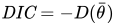

Greetings, --Qaswed (talk) 16:12, 6 April 2017 (UTC)
- You made a mistake in your first calculation. It should be
- which agrees with the second form whether or not
- Bakovich (talk) 18:53, 7 June 2018 (UTC)
