


Talk:Determinant
Add topic| This is the talk page for discussing improvements to the Determinant article. This is not a forum for general discussion of the subject of the article. |
Article policies
|
| Find sources: Google (books · news · scholar · free images · WP refs) · FENS · JSTOR · TWL |
Archives: 1, 2, 3Auto-archiving period: 2 months  |
 | This  level-4 vital article is rated B-class on Wikipedia's content assessment scale. level-4 vital article is rated B-class on Wikipedia's content assessment scale.It is of interest to the following WikiProjects: | ||||||||||
| |||||||||||


Possible to do/see also items
[edit]linear algebra/analytic geometry
[edit]linear independence/collinearity, Gram determinant, tensor, positive definite matrix (Sylvester's criterion), defining a plane, Line-line intersection, Cayley–Hamilton_theorem, cross product, Matrix representation of conic sections, adjugate matrix, similar matrix have same det (Similarity invariance), Cauchy–Binet formula, Trilinear_coordinates, Trace diagram, Pfaffian
types of matrices
[edit]special linear group, special orthogonal group, special unitary group, indefinite special orthogonal group, modular group,
unimodular matrix, matrices with multidimensional indices
number theory/algebra
[edit]Pell's equation/continued fraction?, discriminant, Minkowski's theorem/lattice, Partition_(number_theory), resultant, field norm, Dirichlet's_unit_theorem, discriminant of an algebraic number field
geometry, analysis
[edit]conformal map?, Gauss curvature, orientability, Integration by substitution, Wronskian, invariant theory, Monge–Ampère equation, Brascamp–Lieb_inequality, Liouville's formula, absolute value of cx numbers and quaternions (see 3-sphere), distance geometry (Cayley–Menger determinant), Delaunay_triangulation
open questions
[edit]algorithms
[edit]polar decomposition, QR decomposition, Dodgson_condensation, Matrix_determinant_lemma, eigendecomposition
a few papers: Monte carlo for sparse matrices, approximation of det of large matrices, The Permutation Algorithm for Non-Sparse Matrix Determinant in Symbolic Computation, DETERMINANT APPROXIMATIONS
examples
[edit]reflection matrix, Rotation matrix, Vandermonde matrix, Circulant matrix, Hessian matrix (Blob_detection#The_determinant_of_the_Hessian), block matrix, Gram determinant, Elementary_matrix, Orr–Sommerfeld_equation, det of Cartan matrix
generalizations
[edit]Hyperdeterminant, Quasideterminant, Continuant (mathematics),
Immanant of a matrix, permanent, Pseudo-determinant, det's of infinite matrices / regularized det / functional determinant (see also operator theory), Fredholm determinant, superdeterminant
other
[edit]books
[edit]Geometric proof of formula
[edit]
@D.Lazard: reverted my addition of this visual proof with this message "Not useful: a professional mathematician needs several minutes for understanding what is meant". I think a visual explanation complements the algebraic interpretation. How can the diagram be improved to be clearer? Thanks, cmɢʟee τaʟκ (please add {{ping|cmglee}} to your reply) 18:31, 28 July 2026 (UTC)
- To editor Cmglee: Sorry, a figure that requires several minutes for being understood by a professional mathematician cannot be called a "visual explanation". IMO, there is no hope to improve the figure for getting something acceptable. In any case, without any similar figure in most common textbooks dealing with determinants, there is no hope to not fall under the policy WP:No original research. D.Lazard (talk) 20:58, 28 July 2026 (UTC)
- It might work as a 2-panel illustration, showing first the pieces in place in the parallelogram, and second their rearrangement, united by the visual equation at the bottom. Then leave the curved arrows out -- the colors take care of showing where the pieces go. (The "no original research" argument is nonsense; this is illustration, not research. Extending NOR to situations like this would require eliminating most of the math diagrams on WP.) -- Elphion (talk) 21:13, 28 July 2026 (UTC)
- Thanks for your feedback, @D.Lazard: and @Elphion:.
- It's based on http://i.sstatic.net/gCaz3.png by Solomon W. Golomb (appeared in Mathematics Magazine, March 1985), simplified to avoid overlapping areas.
- I'll update it to two panels and remove the curved arrows. I'll ping you when it's ready.
- Cheers, cmɢʟee τaʟκ (please add
{{ping|cmglee}}to your reply) 22:17, 28 July 2026 (UTC)- I find the original easier to follow, though still pretty confusing, among the less obvious of "proofs without words" I've seen. I think all of the arrows and extra labels in the new versions are more distracting than helpful. –jacobolus (t) 00:54, 29 July 2026 (UTC)
- Thanks, @Jacobolus: I've split it into two panels as suggested by @Elphion: How does it look?
- I think having the labels clarifies where the dimensions come from, but can remove them if it makes it clearer. Cheers, cmɢʟee τaʟκ (please add
{{ping|cmglee}}to your reply) 23:42, 1 August 2026 (UTC)- That's a big improvement. –jacobolus (t) 04:25, 2 August 2026 (UTC)
- Nice work. Keep the labels -- they're essential to understanding the visual equation at the bottom. -- Elphion (talk) 16:43, 3 August 2026 (UTC)
- I like this diagram and think it should be added to the article. If Wikipedia were to cite a source showing it is a well established fact that the signed size of the parallelogram is , then I do not think it would be necessary to prove it in the article. But in any case it would be good to have a persuasive illustration. The existing text does show the fact is true, although I find its explanation with "the cosine of the complementary angle to a perpendicular vector" quite hard to follow. JonH (talk) 03:07, 16 August 2026 (UTC)
- I copied the information about Golomb's diagram to the Commons description of the image. -- Elphion (talk) 20:26, 16 August 2026 (UTC)
- Many thanks, JonH and Elphion. I've readded it with a more descriptive caption. Please feel free to update it. Cheers, cmɢʟee τaʟκ (please add
{{ping|cmglee}}to your reply) 15:31, 19 August 2026 (UTC)
- Many thanks, JonH and Elphion. I've readded it with a more descriptive caption. Please feel free to update it. Cheers, cmɢʟee τaʟκ (please add
- I copied the information about Golomb's diagram to the Commons description of the image. -- Elphion (talk) 20:26, 16 August 2026 (UTC)
- I like this diagram and think it should be added to the article. If Wikipedia were to cite a source showing it is a well established fact that the signed size of the parallelogram is , then I do not think it would be necessary to prove it in the article. But in any case it would be good to have a persuasive illustration. The existing text does show the fact is true, although I find its explanation with "the cosine of the complementary angle to a perpendicular vector" quite hard to follow. JonH (talk) 03:07, 16 August 2026 (UTC)
- Nice work. Keep the labels -- they're essential to understanding the visual equation at the bottom. -- Elphion (talk) 16:43, 3 August 2026 (UTC)
- That's a big improvement. –jacobolus (t) 04:25, 2 August 2026 (UTC)
- I find the original easier to follow, though still pretty confusing, among the less obvious of "proofs without words" I've seen. I think all of the arrows and extra labels in the new versions are more distracting than helpful. –jacobolus (t) 00:54, 29 July 2026 (UTC)
- It might work as a 2-panel illustration, showing first the pieces in place in the parallelogram, and second their rearrangement, united by the visual equation at the bottom. Then leave the curved arrows out -- the colors take care of showing where the pieces go. (The "no original research" argument is nonsense; this is illustration, not research. Extending NOR to situations like this would require eliminating most of the math diagrams on WP.) -- Elphion (talk) 21:13, 28 July 2026 (UTC)

Exterior algebra
[edit]Recently, a definition using exterior algebra has been added to this article. The Definition section now has a mention of "the unique function depending on the entries of the matrix satisfying certain properties" (the actual properties are given in the article lead), followed by the new definition using exterior algebra, followed by a section about the Leibniz formula which expresses the determinant in terms of permutations of the matrix elements.
I wondered "In mathematics, how does the number of people who know about exterior algebra compare with the number who know about permutations?" and Google AI tells me that "Permutations are taught in basic school math and learned by millions of students worldwide. Exterior algebra is an advanced university topic in linear algebra studied by a much smaller group of math, physics, and engineering majors. Therefore, far more people know about permutations than exterior algebra."
If that is true, would it be better to change the order to cover the Leibniz formula before the exterior algebra definition? I also note that the section about the Leibniz formula now uses a wedge product, although the linked article Leibniz formula for determinants manages to do without it. JonH (talk) 03:58, 16 August 2026 (UTC)
- The article on Leibniz formula is not exactly a model of accessibility though, so the extent to which it manages to do without wedge products is debatable. I think the exterior algebra is probably a useful addition here, but it is noq dealt with twice in the article at different levels of abstraction. It is doing useful work in the definition section, because is "explains" the Leibniz formula. That formula is only sometimes shown to undergraduates (and usually as an example of how not to do it), only appearing later in advanced combinatorics courses. The exterior algebra definition, by contrast, is broadly important in analysis and geometry, and is much more conceptual. So "who has heard of permutations" seems to me the wrong question. Sławomir Biały (talk) 06:12, 16 August 2026 (UTC)
- IMO, the article is conceptually confusing by mixing methods of computation and definitions, and, in definitions, not distinguishing between existence and uniqueness. The definition by properties 1-4 of the lead seems the simplest and the less technical, and all methods of computation (Gaussian elimination, Laplace expansion, Leibniz formula, ...) can easily be deduced from these 4 properties. However neither the existence nor the uniqueness of a function satisfying 1 to 4 are evident. The simplest way of proving the existence seems Leibniz formula, and IMO, this is the only useful usage of Leibniz formula. It remains to prove the uniqueness and the fact the determinant of a product of matrices is a product of determinants. For uniqueness, exterior algebra seems the best approach. For the product property, the simplest method seems to use 1-4 to prove it when the first matrix is an elementary matrix, and, then, using the fact that any matrix ia a product of elementary matrix (and associativity of matrix product) to prove the general case.
- I suggest to restructure the article this way. We need not to give all proofs, but we must give hints for allowing readers to fill the details by themselve. This is what is lacking in the present state of the article. D.Lazard (talk) 09:59, 16 August 2026 (UTC)
- Yes, that makes sense. Sławomir Biały (talk) 10:32, 16 August 2026 (UTC)
Thanks for these comments. I think I now understand the subject better.
I have been bold and split the first paragraph of the lead into two paragraphs, one about determinants of matrices, and the second about determinants of linear maps. I think this is correct (I reference a source) and that it will help readers understand why parts of this article refer to matrices and other parts refer to maps. Also, in the History section, I have started a subsection on determinants of linear maps. Please modify or revert these changes if you think I have got them wrong. JonH (talk) 11:37, 18 August 2026 (UTC)
- I have rewritten the lead independently of JonH edit. The subject is too wide for allowing to mention in the lead every significant result and usage of determinants. So, I rewrote the lead to focus on the most important properties, and to structure their relationships for avoiding the style "indiscriminate list". This allows mentioning the determinant of an endomorphism in only a few words. Clearly, upgrading the body of the article accordingly to the new lead requires a large work.
- To editor JonH: Sorry, I do not know what is the determinant of a linear map, and I suspect that your section § Determinants of linear maps should be merged into § Determinant of an endomorphism. D.Lazard (talk) 14:29, 18 August 2026 (UTC)
- The current lead section is now very overstuffed and too long, while simultaneously being too vague. The first couple sentences need to give a concrete idea of what the determinant is conceptually about. Stating that it has "many properties which make it fundamental" is not good enough. The middle ~50% of the section should be removed to some other section.
- We probably shouldn't use jargon like "linear endomorphisms" at all in the lead section, let alone in the first sentence; many expected readers will find it unfamiliar and intimidating. (Feel free to use such terms further down in the body of the article, but define them in place, at the very least with a parenthetical gloss.) –jacobolus (t) 16:43, 18 August 2026 (UTC)
- I'm not sure of the best phrasing, but we should immediately say something about how the determinant describes the way a linear transformation scales volume. Anyone working on this may want to watch Grant Sanderson's video about determinants. Notice the most upvoted comment: "That's what determinant is? Seriously? Why don't they just say that in the textbook? I spent days of my life wrestling with the idea that they wanted me to compute a magical number using an arbitrary formula." –jacobolus (t) 16:56, 18 August 2026 (UTC)
- I've added the scale factor back to the lead. -- Elphion (talk) 17:25, 18 August 2026 (UTC)
- There is a lot of work done here! I like the new lead for the reasons given above and for the way that the structure explains why each thing is mentioned (exterior algebra for uniqueness, Leibniz formula for existence, etc).
- The lead is quite long, but I think that is OK until the rest of the article structure can be improved. Then the lead can be shortened.
- I also do not like the word "endomorphism". I copied the wording "linear map from a vector space to itself" from an AI source, but perhaps that is not precise enough. I do not feel strongly about this.
- I have read about new developments in the subject: a book claiming to be "determinant-free", coordinate-free approaches, the loss of traditional practical applications (solving systems of equations, testing matrix singularity), volume scale factors (which are now in some school syllabuses as well as Grant Sanderson's video). My favourite new application is testing vectors for linear dependence (which is the same as testing for a zero scale factor). But our history section has no developments since 1933. That is why I added a new subsection with a single sentence and "needs expansion". I will change the title of that subsection to "Recent history" and hope that someone with time and knowledge will be able to expand it. JonH (talk) 23:18, 18 August 2026 (UTC)
- I've added the scale factor back to the lead. -- Elphion (talk) 17:25, 18 August 2026 (UTC)
- I agree that linear endomorphism must be changed into linear transformation (both phrases redirect to Linear map, but, before my recent edit, they were not defined in the lead of the target article).
- I agree also that the current lead is too long. Also, the fundamental property of compatibility with products is not sufficiently emphasized in my version of the lead. I have some ideas to resolve these issues. For saving time, I'll implement them directly in the article, and keep my first version as an invisible comment for helping a future rewrite of the body. D.Lazard (talk) 09:20, 19 August 2026 (UTC)
- I changed the definition given in the lead for emphasizing the fundamental (foundational?) multiplicative property. I shortened the lead by leaving the "several definitions" to the body.
- I kept the explicit formulas for low dimension. Imo, they deserve to be moved to an explicit first section of the body, but this desrves to be discussed.
- If this move of the cases of low dimendion is accepted, this would give a section with 6 shorts paragraphs, which seems correct for such an important article. D.Lazard (talk) 10:07, 19 August 2026 (UTC)
- Instead of
I think we should begin with something likethe determinant is a scalar-valued function of the entries of a square matrix that has many properties which make it fundamental for the study of square matrices and linear transformations represented by them.
–jacobolus (t) 16:57, 19 August 2026 (UTC)the determinant is a single scalar (number) associated with a square matrix which describes the way the linear transformation represented by the matrix scales volume.
- The first part of this suggested first sentence is fine and better thann that of my version. On the other hand, the second part is misleading, as suggesting wrongly that the main use of determinants is for computing scale factors in geometry. So, I suggest to merge the two versions into
D.Lazard (talk) 13:25, 20 August 2026 (UTC)the determinant is a single scalar (number) associated with a square matrix which is fundamental for the study of square matrices and linear transformations represented by them.
- I don't think it "suggests" what the use should be of determinants to explain in a few words what they are.
- Us stating that something is "fundamental" is a vacuous argument from authority that people should care about this because we say so, without giving any reason why (cf. Show, don't tell).
- Saying that a quantity describes the way volume is transformed is concrete and evocative, and gives the reader something to hold on to. We can follow-up by explaining why such a quantity is used in practice, e.g. noting that various kinds of operations on matrices/transformations leave the determinant unchanged, and that when the determinant vanishes the transformation is degenerate.
- As to your point about geometry though: linear algebra is the study of a certain class of geometric transformations. It is useful because of the way it relates numbers with shapes; there are many situations (including, perhaps surprisingly to newcomers, many which do not initially appear geometrical, such as solving systems of equations) to which we can apply geometrical tools and insights, and in the other direction we can use numerical methods to solve geometrical problems. –jacobolus (t) 19:12, 20 August 2026 (UTC)
- It would be fine to move the examples down, though we could also leave the case if it seems helpful. We might try a few versions to see how they look.
- The article could use some re-organization and pruning; a lot of the material is repeated several times, and I don't think the structure flows very well, or is very friendly to non-technical readers. I think I'd title the first section after the lead something like "computation" (though it could be "definition" or the like, as "computation" might be better reserved for a section about handling big matrices) and keep it concrete and as concise as possible; its starting paragraph could say how the determinant of a 1 by 1 matrix is just the single entry itself, then it could have sub-sections for , , and matrices, the last of which would try to briefly (and as accessibly as possible, without jargon – we want a high school student to understand this) describe the Leibniz formula and Laplace expansion, perhaps pointing further down the page for more detailed treatment of those topics. The material about the geometric interpretation could either come immediately after this section, or we could try to integrate the two topics. I'm not sure which would be easier for readers. –jacobolus (t) 17:18, 19 August 2026 (UTC)
- This is good. Some British readers would expect the definition/computation section to use Laplace expansion along the first row for the 3x3 case. JonH (talk) 22:49, 19 August 2026 (UTC)
- I mostly agree with Jacobolus. I suggest the following structure:
- ==top==
- == Low dimenssion ==
- Must include the explicit expressions for , and possibly the use for scale factors, colinearity, coplanarity and implicit equations of lines and planes passing through given points. `These uses may also be described later in section ==In geometry==
- == Basic properties ==
- This section should be the most useful for people who have a vague notion of the concept but do not know how using it.
- For example:
- the determinant is zero if a line or a column contains only zero entries
- exchanging two rows or colums multiplies the determinant by
- determinant of triangular matrices
- invariance by elementary transformations
- etc.
- ===Multilinearity===
- Possibly a section of first level
- It here that Laplace expansion would be better placed
- == Definitions ==
- === By multiplicative property ===
- Already given in the lead
- === By elementary transformations===
- Condition 1, 2, 3 in previous version of the lead, kept in an invisible comment
- ===By Leibniz formula===
- === By exterior algebra ===
- As this definition is more technical, it should be discussed whether this section be placed later in the article
- === By multiplicative property ===
- == Computation ==
- Methods; computational complexity equivalent with that of matrix multiplication
- == Use in geometry ==
- Possibly a subsection of == Lowdimension ==
- == Use in algebra ==
- Resultants, discriminant and characteristic polynomials are determinants
- == Use in analysis ==
- the Jacobian determinant is used for changes of variables in multiple integrals, and in the statement of the theorem of implicit functions
- Hessian determinant may be mentioned here.
- This structuration is certainly incomplete, and deserves to be improved while implementing it, but it seems a good framework for starting to improve the article. D.Lazard (talk) 14:41, 20 August 2026 (UTC)
- One possibility would be to put a dedicated section about exterior products separately from a "definition" section. I think it's worth being explicit that the exterior product of two vectors is a bivector, the (signed and oriented) object representing the parallelogram with those vectors as sides, and likewise the exterior product of more than two vectors is a (simple) -vector, the object representing the parallelepiped with those vectors as sides emanating from a common vertex.
- We should be very explicit in stating that the determinant of an matrix is the ratio of the exterior product of the column-vectors of a matrix to the exterior product of the basis vectors; as a ratio of two -vectors with the same orientation and dimension, it becomes a single dimensionless scalar number, without orientation. But we might explain that the determinant is sometimes taken as a proxy for the -vector-valued exterior product of the columns, a concept which applies to general matrices and linear maps (not only square ones). –jacobolus (t) 19:30, 20 August 2026 (UTC)
- Instead of
- I'm not sure of the best phrasing, but we should immediately say something about how the determinant describes the way a linear transformation scales volume. Anyone working on this may want to watch Grant Sanderson's video about determinants. Notice the most upvoted comment: "That's what determinant is? Seriously? Why don't they just say that in the textbook? I spent days of my life wrestling with the idea that they wanted me to compute a magical number using an arbitrary formula." –jacobolus (t) 16:56, 18 August 2026 (UTC)


Judging from feedback we've received in the past, readers encounter determinant described both as a number and as a function. We need to address that head on (especially since farther on we talk about how the determinant function can be defined). Something like:
The determinant of a square matrix is a single scalar (number) associated with the matrix. Determinants are fundamental for the study of square matrices and linear transformations represented by them. The term determinant is also used for the function that assigns each square matrix its determinant.
-- Elphion (talk) 17:47, 20 August 2026 (UTC)
- Fine. D.Lazard (talk) 17:56, 20 August 2026 (UTC)
- I think I would call the determinant a scalar (number), and perhaps also call out in bold the determinant function. –jacobolus (t) 19:15, 20 August 2026 (UTC)
Apologies for repeating some things that I have said before. I hope I am now explaining them better. None of this is a criticism of recent changes. The article is being improved.
Probably many of our readers are learning about determinants, and others learnt about them previously and now want to know more. In both cases, it would be good for the early parts of the article to include familiar ideas. Some British readers will be familiar with the 3x3 formula as
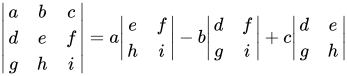
I have been slowly collecting examples of sources that use the idea of determinants representing area or volume.
- 1970: Nering, Linear Algebra and Matrix Theory, second edition. Has an exercise for the reader to show that the area of a parallelogram equals a 2x2 determinant.
- 1970: Lang, Linear Algebra, second edition. The chapter on determinants has 11 sections, the LAST of which is "Determinants as area and volume".
- 1979: Bostock and Chandler, Pure Maths II, a British Further Mathematics textbook that was being reprinted in 1995. Chapter 1 is "Transformations, Matrices and Determinants" and within that chapter the FIRST page about determinants essentially says: the transformation matrix maps 1 square unit to an area of (ad-bc) square units and the factor (ad-bc) is called the "determinant" of M.
- 1985: Golum, magazine article. Visual demonstration (used in our article) that the area of a parallelogram corresponds to the absolute value of its 2x2 determinant.
- 2008: Princeton Companion to Mathematics "Determinants have many useful properties, which become obvious once one knows the ... representation in terms of volumes ... the determinant is better thought of as a property of linear maps rather than of matrices".
- 2016: Grant Sanderson video "One thing that turns out to be pretty useful for understanding [a linear transformation] is to measure exactly how much it stretches or squishes things ... the factor by which [it] changes any area, is called the determinant of that transformation".
- 2021: Delft University of Technology An interactive open access linear algebra book for engineering students. Chapter 5 starts "by introducing determinants as a way to compute areas (in the plane) and volumes (in the space R3)".
- 2022: PMTEducation, British maths tutors, Cheat sheet with two examples of answering a question on determinants, and these include area and volume.

As far as I know, none of these authors refer to "exterior products".
My suggestions for the article: Follow the 2x2 matrices section by one on 3x3 matrices, which would include both and and something about the volume scale factor with the image of a parallelepiped. Then in the definition section, have a subsection called something like Determinants as areas/volumes, which starts with a definition in words, followed by a statement that this can be formalised using the language of exterior algebra. JonH (talk) 06:18, 27 August 2026 (UTC)

- I'd like to caution against going too far in emphasizing area and volume here, for several reasons. First, the deteeminant of a real matrix records not only volume, but also orientation. Second, areas and volumes only make sense for real matrices (or, via a reduced norm, over the complexes/quaternions), and many applications of determinants do not involve the reals. For example, the discriminant of a number field is defined as the determinant of the trace form. I don't think area/volume is appropriate for a definition section, but rather a "geometric interpretation" section. Sławomir Biały (talk) 06:29, 27 August 2026 (UTC)
Merge proposal
[edit]The article Leibniz formula for determinants is essentially a redundant fork of § By Leibniz formula:
The only content of Leibniz formula for determinants that does not belong to Determinant is a proof that contains so complicate formulas that nobody would read them. MOS:MATH#Proofs says Use your judgment; as a rule of thumb, include proofs when they expose or illuminate the concept or idea; don't include them when they serve only to establish the correctness of a result
. So this proof does not belong t Wikipedia. Also, (Determinant contains a sketched proof that does not contains other formulas than the Leibniz formula itself. Except for this proof, the article is a stub and does not contain anything that does not belong to Determinant.
Moreover, the two topics are so related that they cannot be described separately: Leibniz formula is one of the most common definitions of the determinant, and the only one for which the existence proof is easy. There is nothing to say about Leibniz formula that does not belong to Determinant.
So, I propose to merge Leibniz formula for determinants to Determinant, by redirecting it to Determinant#By Leibniz formula D.Lazard (talk) 16:52, 5 September 2026 (UTC)
- I support this (but no one knows whether informal merge discussions are still officially ok). One thing missing from the article, on a quick scan, is that despite promises to the contrary, some proof of uniqueness of a function with the specified properties. There is a nice way of proving uniqueness using row-linearity: write the determinant of a matrix as the sum of the determinants of all n^n matrices having a single nonzero entry in each row. Only n! Of these are potentially non-zero, and it gives exactly the Leibniz formula. Sławomir Biały (talk) 17:07, 5 September 2026 (UTC)
- Actually, I take it back. There was a proof of uniqueness already, but it was a little hard to understand how it proved what it claimed. I have attempted to make the logical status of that proof more explicit. Sławomir Biały (talk) 08:37, 6 September 2026 (UTC)
- I think this kind of thing can conceivably be a separate page, if we have more to say about it (e.g. it could discuss history, various proofs, generalizations, ...). I agree the material currently there doesn't seem particularly useful though. Also: how relevant a proof is depends on the context; for a page directly about a specific theorem, I think we can give a bit more leeway to proofs. In the context of a higher-level topic, any proof included has to be directly relevant and illuminating per se. So I agree, if it is decided that the title Leibniz formula for determinants should be redirected to here, the proof currently at that article should not be moved over. –jacobolus (t) 17:10, 5 September 2026 (UTC)
Laplace expansion as definition
[edit]I believe that Laplace expansion is one to the equivalent definitions of a determinant. It is used as such in many applied mathematics textbooks. It would not be necessary to move all of the current Laplace expansion subsection from Properties to Definitions. Some details could be left to the Laplace expansion article, and the paragraph about calculating determinants could move to the Calculation section. JonH (talk) 01:38, 6 September 2026 (UTC)
- Laplace expansion is a nice definition because it is a good example of recursion, although its mathematical applications are quite limited. I would probably not roll it in to the definitions section, however. The reason is narrative. The current definition section tells a story: the determinant is first characterized in a way that is (numerically) useful for computation and shows uniqueness but not existence; the Leibniz formula supplies existence; and the alternating forms establishes that the Leibniz formula actually works. Laplace expansions are, by contrast, not as natural to fit into that narrative. Sławomir Biały (talk) 08:45, 6 September 2026 (UTC)
- Laplace expansion is a property that can hardly be viewed as a definition: firstly it would define the determinaant of a matrix of dimension in terms of determinants of dimension . Moreover, a determinant of dimension has Laplace expansions (one for each row and one for each column). Which one should be taken as a definition? So, its use in textbooks is more as a method of (recursive) computation than as a definition. As this is a very inefficient method of computation (except in very special cases), the main interest of Laplace expansion is to provide an explicit form of the fact that a determinant is a linear combination of the elements of each row or column.
- My project is to rewrite (soon) section § Properties, and this includes the rewrite of § Laplace expansion for making these things clearer. D.Lazard (talk) 09:14, 6 September 2026 (UTC)
- My impression is that the recursive "expansion by minors" is relatively routinely presented as a definition. But I agree that this isn't a great definition. It's easily proven equivalent to the Leibniz formula, which is a bit simpler to write down and explain. –jacobolus (t) 22:15, 6 September 2026 (UTC)
- Saying that something can be proven equivalent is not an argument for excluding it from a list of equivalent definitions, and having looked at Laplace expansion#Proof I am not sure that it is easy. The textbooks that I mentioned usually start with expansion along the first row, and that is well defined. As commented above, the fact that each row and column give the same result should stay in Properties. By the way, I have only just realised that the old "Definition by exterior algebra" subsection was renamed and then deleted, so I am happy that the more straightforward ways are no longer obscured below difficult abstract algebra. JonH (talk) 22:55, 7 September 2026 (UTC)
- My impression is that the recursive "expansion by minors" is relatively routinely presented as a definition. But I agree that this isn't a great definition. It's easily proven equivalent to the Leibniz formula, which is a bit simpler to write down and explain. –jacobolus (t) 22:15, 6 September 2026 (UTC)


Determinants on a commutative ring
[edit]I reverted partially Sławomir Biały's edits on commutative rings vs. fields. Indeed, everything works on integral domains, if one replaces Gaussian elimination with Bareiss algorithm. For general commutative rings, we have maybe to add the invariance under ring homomophism () to the definitions by multiplicative property and by elementary transformations. This should be verified, but the case of the integral domains is sufficiently important for not being excluded explicitly. D.Lazard (talk) 10:35, 6 September 2026 (UTC)

- A counterexample, at least to the elimination matrix variant, over an integral domain is the matrix over where k is a field. This cannot be written as a product of elementary/triangular matrices . There do exist reducbile matrices such that is triangular and non-singular, so evaluating the determinant this way produces a right-hand side requiring a scalar cancellation. For general commutative rings, the definition via multiplicativity fails; zero divisors can produce extra multiplicative characters. I think your proposed determinant as a "functor" does work, however: one can simply go up to the ring over Z that has the entries of a matrix as polynomial variables, and then obtain any other ring by specialization. Sławomir Biały (talk) 11:21, 6 September 2026 (UTC)

![{\displaystyle k[x,y]}](https://wikimedia.org/api/rest_v1/media/math/render/svg/e8462ca2b7942a5b5d38beed97662788b27b568a)


unclear paragraph: Are determinants unique?
[edit]As a non-mathematician, does the following paragraph mean that the determinant for a square matrix (greater than 3x3?) is not unique? That would seem very strange, or does it just mean there are various ways to determine the determinant, all with the same result?
<quote> There are various equivalent ways to define the determinant of a square matrix A, and it depends on authors which definition is chosen as the primary one, as well as the level of generality. In this article, the definition by the multiplicative property has been chosen as the primary one, because it is simple and does not require specific background. </quote>
Rhkramer (talk) 14:50, 15 September 2026 (UTC)
- In
There are various equivalent ways to define the determinant of a square matrix
, the word "equivalent" means that all these ways define the same determinant. D.Lazard (talk) 15:16, 15 September 2026 (UTC)
Revision of the article
[edit]I have begun a major restructuration of the article. Most sections after § Other determinants stil require a major revision, but, for the moment, the structure of the article seems logical and understandable, which was absolutely not the case before.
I kept § Berezin integral and § Block matrices and matrix sums. They are not completely out of scope, but I find that their inclusion in the article does not make sense. For the former and the subsection § Sylvester's determinant theorem of the latter, I have replaced the section with an entry in § See also. For what remains in the latter section, most of the content is "sum and block matrices do not work well with determinant", which does makes an encyclopedic content. I do not see how transform what remains into a decent section. So, I incline to remove § Block matrices and matrix sums. Some thoughts? D.Lazard (talk) 14:26, 28 September 2026 (UTC)