


Talk:Debye sheath
Add topic | This article is rated Start-class on Wikipedia's content assessment scale. It is of interest to the following WikiProjects: | ||||||||||
| |||||||||||
.jpg)

Formula
[edit]In this formula,
,

should not the last
actually be a ??


- Looks like it to me. I'll change it. Now I'm worried that the following equation
![{\displaystyle {\frac {1}{2}}\chi '^{2}={\mathfrak {M}}^{2}\left[\left(1+{\frac {2\chi }{{\mathfrak {M}}^{2}}}\right)^{1/2}-1\right]+e^{-\chi }-1}](https://wikimedia.org/api/rest_v1/media/math/render/svg/6b425a22a603de5fdaab3d5088ce0ac1e3142c15)
- should actually be
![{\displaystyle {\frac {1}{2}}\chi '^{2}={\mathfrak {M}}^{2}\left[\left(1-{\frac {2\chi }{{\mathfrak {M}}^{2}}}\right)^{1/2}-1\right]+e^{-\chi }-1}](https://wikimedia.org/api/rest_v1/media/math/render/svg/f51d86f2c99dccb4a46d4a96253f2562e9c18c65)
- Am I missing something? --Art Carlson 14:01, 27 November 2006 (UTC)
- I decided the problem was not here but in the previous equations. χ is defined to have the opposite sign from φ. Changed accordingly, but would appreciate it if somebody would check up on me. --Art Carlson 14:21, 27 November 2006 (UTC)
Image
[edit]
You are right, Ian, that this article could use a sketch, and I appreciate the effort you have made, but this image, while it may represent a double layer, doesn't look much like a Debye sheath. I wish there were a wiki-way to generate sketches, but let me at least make a couple comments:
- Toward the surface, the electric field rises monotonically. At the surface it does not vanish but takes on its maximum value.
- Toward the plasma, the electric field decreases smoothly, without changing curvature. There is therefore only one region and one sign of space charge.
An approximate analytic form is derived in the article:
,
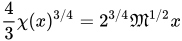
or
,

, and

.
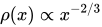
x = 0 is the "entrance" to the Deye sheath from the plasma, and the approximations break down there, but they are good toward the wall.
--Art Carlson 13:01, 16 May 2006 (UTC)
- OK, I've tried another. --Iantresman 18:18, 17 May 2006 (UTC)
Article title
[edit]Do you think that "Debye sheath" is the best title for the article? I wonder if "Plasma sheath" or "Electrostatic sheath" is better; the latter seems to outnumber the others dramatically. --Iantresman 18:18, 17 May 2006 (UTC)
- In fusion research Debye sheath is the most common term, although I sometimes see and use the name electrostatic sheath as well. Obviously I favor the current name since I started the article, but as long as there is a redirect from Deye sheath, I wouldn't get hot about calling it electrostatic sheath. --Art Carlson 19:09, 17 May 2006 (UTC)
- OK. So I've created redirects to Debye sheath, from Electrostatic sheath, Plasma sheath, and Space charge sheath. --Iantresman 21:39, 17 May 2006 (UTC)
Child vs. Langmuir
[edit]Child developed his equation for PLANAR diodes (1911), while Langmuir developed his equation for CYLINDRICAL diodes (1913), but both equations established the 3/2-power relationship between voltage and thermionic current in vacuum tubes, ie: I = G*(V)^(3/2). —Preceding unsigned comment added by 97.112.203.145 (talk) 18:06, 27 December 2008 (UTC)
Sources
[edit]It looks like the derivation of the Bohm criterion and the Child-Langmuir law is taken from "An Introduction to Plasma Physics and Controlled Fusion" by Francis. F. Chen. since the notation is identical. It might be worthwhile adding this as a source.