


Talk:Continued fraction
Add topic | This  level-5 vital article is rated B-class on Wikipedia's content assessment scale. level-5 vital article is rated B-class on Wikipedia's content assessment scale.It is of interest to the following WikiProjects: | ||||||||||
| |||||||||||

 | Text or other creative content from Fundamental recurrence formulas was copied or moved into Generalized_continued_fraction#Fundamental_recurrence_formulas with this edit. The former page's history now serves to provide attribution for that content in the latter page, and it must not be deleted as long as the latter page exists. |
| Text or other creative content from Convergent (continued fraction) was copied or moved into Generalized continued fraction with this edit. The former page's history now serves to provide attribution for that content in the latter page, and it must not be deleted as long as the latter page exists. |

Convergence of Nth roots
[edit]Looking at them I don't think the Nth root continued fractions converge. The partial numerators go up as squares whereas the denominators go up linearly. It doesn't seem like a good combination to me. Dmcq (talk) 17:15, 21 November 2009 (UTC)
- Oh sorry I see, it's like the expansion for π just above. I'll have to work out for myself what it actually means in convergence terms. Dmcq (talk) 17:28, 21 November 2009 (UTC)
- The secret is choosing x and y so that xn > |y|, if possible. Using Pogson's ratio, for example,
- but the first expression converges much more quickly since 97.65625 >> 2.34375, while 32 < 68.
- Nevertheless, the second expression does converge. It just takes longer.---Glenn L (talk) 03:21, 22 November 2009 (UTC)
- The secret is choosing x and y so that xn > |y|, if possible. Using Pogson's ratio, for example,
![{\displaystyle {\sqrt[{5}]{100}}={\sqrt[{5}]{2.5^{5}+{\frac {75}{32}}}}={\sqrt[{5}]{2^{5}+68}},}](https://wikimedia.org/api/rest_v1/media/math/render/svg/d70c31f7a43609b36c4c9cc431c925640cd3216c)
Can someone review the second example for cuberoot(2)? It says to use x = 5 and y = 3, which doesn't satisfy x^n + y = z . Nor does it lead to " 2z-y = 253 " . And the next line seems to show that x = 5/4 as the lead term in the continued fraction. What are the correct values of x and y intended here? — Preceding unsigned comment added by Cellocgw (talk • contribs) 18:48, 9 April 2022 (UTC) Update: This approach calculates the cuberoot of 128 and adjusts accordingly. A detailed derivation is given at https://math.stackexchange.com/questions/4423981/ . Cellocgw (talk) 13:00, 15 April 2022 (UTC)
External links
[edit]¿How many external links does wiki accept? [User:Mirificium|Mirificium]] (talk) 22:32, 20 March 2010 (UTC)
Merge discussion
[edit]The article on Fundamental recurrence formulas discusses a term that may not be widely used and has content that would be better presented in context here. I propose merging it into this article. RockMagnetist (talk) 17:20, 14 January 2013 (UTC)
- Support or at least rename Fundamental recurrence formulas: Who, seeing the name of this article can imagine that it is not about the theory of recurrence but about continued fractions? D.Lazard (talk) 17:58, 14 January 2013 (UTC)
Particular equivalence transformations
[edit]Partial numerators
[edit]Is it worth making it explicit that a transformation that makes the partial numerators equal to 1 does not make the continued fraction regular or in canonical form, since the partial denominators will not in general, perhaps ever, be integers? Ian S (talk) 14:09, 12 January 2014 (UTC)
Partial denominators
[edit]No references are cited and it is far from obvious that the sequence {di} where d1 = 1/b1 and otherwise dn+1 = 1/(bnbn+1) makes the partial denominators equal to 1. Ian S (talk) 14:09, 12 January 2014 (UTC)
Question about the 3rd CF for Pi
[edit]Does anyone have a reference for it? I'd like to know who invented it, and if there are any faster converging series Muu9 (talk) 14:23, 13 September 2022 (UTC)
the golden ratio
[edit]- Since all the partial numerators in this example are equal to one, the determinant formula assures us that the absolute value of the difference between successive convergents approaches zero quite rapidly.
The golden number is a funny choice of example for this; it has been called "the most irrational number" because its convergence is the slowest possible! —Tamfang (talk) 03:08, 7 June 2023 (UTC)
Should be moved to continued fraction
[edit]See https://en.wikipedia.org/wiki/Talk:Continued_fraction#Proposal:_move_this_to_%22Simple_continued_fraction%22,_so_that_the_current_lemma_can_be_used_for_generalized_continued_fraction for a proposal to get the lemmata right. If you agree then please express your support over there. -- Dyspophyr (talk) 15:26, 23 October 2024 (UTC)
- Just FYI it is appropriate to post notifications of relevant discussions but per WP:CANVASSING they should be
neutrally worded with a neutral title
, which this was obviously not. 100.36.106.199 (talk) 15:11, 1 November 2024 (UTC)
How about non-integer elements?
[edit]We must make a distinction between continued fractions where all elements (i.e., the numerators, and the things in the denominators added to other fractions) are integers, and those where that is not required. In most cases (but not all, I think), mathematicians only consider the ones with integers, and it may even be part of the definition of "simple continued fraction" - but we fail to mention this in the lead; we just say "numbers". I don't see an elegant solution - perhaps it would be to stipulate from the start that all those elements must be integers, but then to mention afterwards that in some contexts, continued fractions are considered where that is not the case? Nø (talk) 12:06, 8 November 2025 (UTC)
- Hi @Nø,
- This is related to the (quite substantial) discussion that took place when "generalized continued fraction" was renamed "continued fraction" and "continued fraction" was renamed "simple continued fraction". I believed you've already seen this discussion, since I remember tagging you; but please see this section regarding the statement "In most cases (but not all, I think), mathematicians only consider the ones with integers".
- The case where the numerators and denominators are positive integers corresponds to simple continued fractions. In other words, there seems to be one main distinction in the literature: the case where the numerator/denominators are arbitrary vs the case where the numerators are equal to 1 and the denominators are positive integers — at least that is the impression I got by trying to look at the literature in an unbiased way. This is why we have two articles. There was then some debate regarding the terminology: should it be generalized continued fraction vs continued fraction or continued fraction vs simple continued fraction? Both options had merits. To me the second made more sense. It also seemed to better reflect the use of the terms in the literature, especially if we zoom out of number theory.
- Is this context helpful, or have I completely misunderstood your question/suggestion?
- Cheers, Malparti (talk) 13:36, 8 November 2025 (UTC)
- If your impression (if I may call it that) is correct, we should simply add “and elements are positive integers” when introducing simple cf’s. Except we have not introduced the term “element”. Nø (talk) 15:56, 8 November 2025 (UTC)
- "denominators" would be better suited than "elements", although I agree that the term hasn't been defined at this point.
- In addition to this problem of not using undefined terms, I see minor two issues with this:
- this extra precision makes the sentence a bit clunky — maybe not ideal for the lead.
- the terminology is not consistent, and if you look at the table I compiled, you will see that some influential sources — not the majority — do not require the denominators to be integers in a simple continued fraction.
- In my opinion, the goal of this lead should be to (1) convey an idea of what a continued fraction is (2) acknowledge that the terminology is not consistent and (3) quickly redirect readers interested in number theory to Simple continued fraction.
- I think that the sentence "A continued fraction is a mathematical expression written as a fraction whose denominator contains a sum involving another fraction, which may itself be a simple or a continued fraction" does a decent job at (1);
- the paragraph "Different areas of mathematics use different terminology and notation for continued fractions. In number theory, the unqualified term continued fraction usually refers to simple continued fractions, whereas the general case is referred to as generalized continued fractions. In complex analysis and numerical analysis, the general case is usually referred to by the unqualified term continued fraction." does a good job at (2);
- I'm not sure how well (3) is addressed, but at least there is a link.
- As a result, I think the lead is mostly OK and I fear that trying to make it more precise might make it least easy to read, for no real benefit. Of course, that just my opinion, feel free to disagree and rewrite the lead if you feel that is necessary. Just keep in mind that the terminology varies a lot between authors (again, see the table I compiled). Malparti (talk) 17:25, 8 November 2025 (UTC)
- We have the formula with a_i's and b_i's to the right. If we refer to these, it is easier to give a correct brief definition of simple cfs, but would that be appropriate? (I'm inclined to answer: Yes). Nø (talk) 12:25, 9 November 2025 (UTC)
- Feel free to have a go at it. Malparti (talk) 12:43, 9 November 2025 (UTC)
- We have the formula with a_i's and b_i's to the right. If we refer to these, it is easier to give a correct brief definition of simple cfs, but would that be appropriate? (I'm inclined to answer: Yes). Nø (talk) 12:25, 9 November 2025 (UTC)
- If your impression (if I may call it that) is correct, we should simply add “and elements are positive integers” when introducing simple cf’s. Except we have not introduced the term “element”. Nø (talk) 15:56, 8 November 2025 (UTC)
illo
[edit]How can the box at the top of the page be made narrow enough that more than one word fit beside it? —Antonissimo (talk) 04:14, 21 March 2026 (UTC)
Image caption failing to wrap
[edit]{{thumb}} is used at the top of the page, but the frame is way too wide. It looks like the problem is that its caption is not wrapping.
Copied here:
An infinite continued fraction is defined by the sequences , for , with .
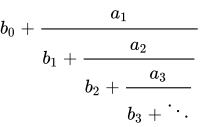



Why is it doing that?
If I add a manual line break <br /> after "sequences", then it looks better:
, for , with .
In the source code, it has style=max-width:220px;, which I would think would prevent this sort of problem, no? Is this a problem with the template {{thumb}}?
Just in case other folks aren't seeing the same thing, I can post a screenshot.
This problem was already brought up above in § illo, but the title and description was unclear.
— W.andrea (talk) 22:15, 2 April 2026 (UTC)
- I reverted the change from a few months ago which apparently broke this. –jacobolus (t) 22:57, 2 April 2026 (UTC)
- Thanks! I noticed that the same editor (@Waddie96) also added a note to the template documentation that contradicted how the template works. That was part of my confusion. I reverted that too. — W.andrea (talk) 01:22, 3 April 2026 (UTC)
- It's not really an image: it's a mathematics formula masquerading as an image. Therefore, it doesn't scale to fit the frame the way an image can. I think it may also have a size that varies according to the font size preferences of whoever views it, as the mathematics formulas in other contexts do. Therefore, a fixed frame width is a bad choice: it will be too large for people with small font sizes (creating excessively wide margins) and too small for people with large font sizes (creating an annoying side-scrolling scrollbar). Can we find some way of getting this to look good without specifying its width? —David Eppstein (talk) 03:27, 3 April 2026 (UTC)
- FWIW, excessively wide margins could be fine for the time being. Above, where I put a manual line break, it ends up having about 50% whitespace on each side, and I think that looks fine. though I'm on desktop. — W.andrea (talk) 22:10, 3 April 2026 (UTC)
- It's probably worth either (a) making an image, or (b) making this an ordinary block math expression instead of a floating box. –jacobolus (t) 04:20, 4 April 2026 (UTC)
- The div tags generated by {{thumb}} (i.e. {{image frame}}) is also problematic now, like how the outermost style attribute is incomplete, and nowhere is the
|style=max-width:220px;used:
- It's not really an image: it's a mathematics formula masquerading as an image. Therefore, it doesn't scale to fit the frame the way an image can. I think it may also have a size that varies according to the font size preferences of whoever views it, as the mathematics formulas in other contexts do. Therefore, a fixed frame width is a bad choice: it will be too large for people with small font sizes (creating excessively wide margins) and too small for people with large font sizes (creating an annoying side-scrolling scrollbar). Can we find some way of getting this to look good without specifying its width? —David Eppstein (talk) 03:27, 3 April 2026 (UTC)
- Thanks! I noticed that the same editor (@Waddie96) also added a note to the template documentation that contradicted how the template works. That was part of my confusion. I reverted that too. — W.andrea (talk) 01:22, 3 April 2026 (UTC)
{{image frame|style=max-width:220px;
|content=<math>b_0 + \cfrac{a_1}{b_1 + \cfrac{a_2}{b_2 + \cfrac{a_3}{b_3 + \ddots}}}</math>
|caption=An infinite continued fraction is defined by the seq[cropped]
}}
{{image frame}}
<div class= "thumb floatright" style = "><div class = "thumbinner" style = "width: fit-content;"><div class="thumbimage noresize" style="width: auto; ">
'"`UNIQ--math-0000003B-QINU`"' </div><div class = "thumbcaption">An infinite continued fraction is defined by the seq[cropped]</div></div></div>
<div class= "thumb floatright" style = "><div class = "thumbinner" style = "width: fit-content;"><div class="thumbimage noresize" style="width: auto; ">
'"`UNIQ--math-0000003C-QINU`"' </div><div class = "thumbcaption">An infinite continued fraction is defined by the seq[cropped]</div></div></div>