Talk:Collision frequency
Add topicLatest comment: 9 years ago by PAR
 | This  level-5 vital article is rated Start-class on Wikipedia's content assessment scale. level-5 vital article is rated Start-class on Wikipedia's content assessment scale.It is of interest to the following WikiProjects: | ||||||||||
| |||||||||||

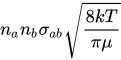
"NA is the number of atoms B" is quite a strange way of expressing things. NA is normally reserved for the Avogadro constant and NB (not NA) would be the number of atoms B.
"number of atoms B" is also rather unintelligible. Perhaps "number of atoms of type B"?
- The expression here contradicts the one in collision theory, linked to in this article. Which is correct? AstroDave (talk) 14:57, 11 September 2008 (UTC)
- The latter, I believe. 'NA' is an unfortunately ambiguous variable name, but I think that the formula that was intended here was supposed to have a "per moles" in its units, which would resolve the issue in that direction. (In any, case the "per meters cubed" introduced by a recent edit certainly didn't match the prose.) 206.222.216.213 (talk) 18:10, 24 January 2015 (UTC)
- Actually, shouldn't it be "…per moles squared", since the reaction is bimolecular? 206.222.216.213 (talk) 18:19, 24 January 2015 (UTC)
I think it should be where na and nb are the number densities of the two reactants. This results in collisions per unit volume per unit time. PAR (talk) 11:03, 19 February 2017 (UTC)