


Talk:Chain rule (probability)
Add topic | This article is rated Start-class on Wikipedia's content assessment scale. It is of interest to the following WikiProjects: | ||||||||||
| |||||||||||

Math error
[edit]I am not sure, but I think the numbers in the arithmetic simple example are wrong. I think the conditional probability is 2/5 and P(A) is 1/2. Waterpie (talk) 10:22, 18 October 2009 (UTC)
 Fixed ---- CharlesGillingham (talk) 17:21, 27 October 2009 (UTC)

Proof?
[edit]it lacks a proof .. man ... — Preceding unsigned comment added by 79.115.179.128 (talk) 23:35, 24 May 2011 (UTC)
- It does have a proof -- it uses the definition of conditional probability and the induction is obvious. ---- CharlesGillingham (talk) 02:02, 8 April 2013 (UTC)
Poor example
[edit]I don't like the example. Two variables can't illustrate the chain rule, it can only illustrate the definition of conditional probability. Need an example with more variables. ---- CharlesGillingham (talk) 7 April 2013
Chain rule for multiple events
[edit]It looks to me like the induction formula for multiple events relies on the following convention for when k=1 and hence the intersection is taken over an empty collection of events (where we have the case B=Ak in the article):
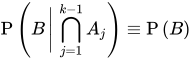
If so, I think it would be helpful to state this explicitly.
NeilOnWiki (talk) 09:38, 10 September 2020 (UTC)
Hi, in the page as is, there is a section on the chain rule for random variables. This section is basically copy pasted from the section above, with some letters changed around. Even worse, this section is COMPLETE NONSENSE. The term P(X,Y) is MEANINGLESS when X and Y are random variables instead of events. It looks like from the edit history that someone already, pointed this out, with the exact same objection, and removed the section. However, the section was quickly added back and the editor, who rightfully improved the page by making it more correct, was penalized for it. This is EMBARRASSING for wikipedia. — Preceding unsigned comment added by 2600:1700:100:BE40:51B4:C0A9:47BE:B36E (talk) 11:06, 29 April 2022 (UTC)