


Talk:Camarasaurus
Add topic | This article is currently a featured article candidate. A featured article should exemplify Wikipedia's best work, and is therefore expected to meet the criteria. Please feel free to After one of the FAC coordinators promotes the article or archives the nomination, a bot will update the nomination page and article talk page. Do not manually update the {{Article history}} template when the FAC closes. |
 | Camarasaurus has been listed as one of the Natural sciences good articles under the good article criteria. If you can improve it further, please do so. If it no longer meets these criteria, you can reassess it. | |||||||||
| ||||||||||
 | A fact from this article appeared on Wikipedia's Main Page in the "Did you know?" column on August 10, 2026. The text of the entry was: Did you know ... that the first reconstruction of Camarasaurus was drawn on sheets of linen and measured 21 m (68 ft) in length? | |||||||||
 | This article is written in American English, which has its own spelling conventions (center, color, defense, realize, traveled) and some terms may be different or absent from other varieties of English. According to the relevant style guide, this should not be changed without broad consensus. |
| This  level-5 vital article is rated GA-class on Wikipedia's content assessment scale. level-5 vital article is rated GA-class on Wikipedia's content assessment scale.It is of interest to the following WikiProjects: | ||||||||||||||||||||
| |||||||||||||||||||||


Merge proposal
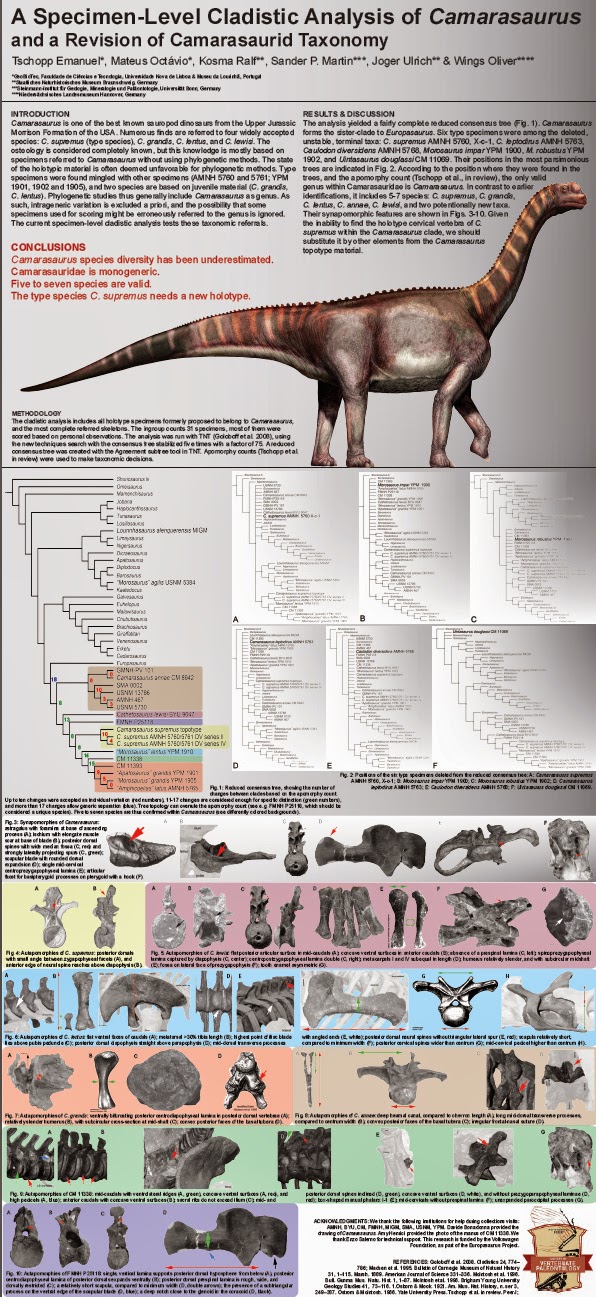
[edit]I would like to propose merging the articles Camarasaurus supremus, Camarasaurus grandis, and Camarasaurus lentus into this one. Seeing that there are really no other dinosaur articles with separate articles for each species, even those with many, very different species like Psittacosaurus or Allosaurus, I do not see why each species of Camarasaurus deserves its own article. Additionally, the taxonomy of Camarasaurus is convoluted and is undergoing revision (see the Tschopp abstract attached below), meaning that the scope of these pages is unclear due to lack of confirmable material for each species. This is why these pages should be merged into the genus' page.
https://www.researchgate.net/publication/277140075_A_specimen-level_cladistic_analysis_of_Camarasaurus_Dinosauria_Sauropoda_and_a_revision_of_camarasaurid_taxonomy AFH (talk) 17:38, 25 June 2025 (UTC)
- Have you reviewed the previous merge suggestion from 3 years ago? It's in the archive here. The Morrison Man (talk) 19:51, 25 June 2025 (UTC)
- Like last time, I tend to agree, I don't see much that justifies their separation lengthwise at this time, compared to other multispecific genus articles. FunkMonk (talk) 07:39, 26 June 2025 (UTC)
- Oppose. As I have said many times, I consider the guideline that fossil species do not merit separate articles to be arbitrary and counterproductive, and I think all of the other multi-species dinosaur genus articles should have species-level articles split out of them as well. As far as this particular case goes: as was brought up in a previous discussion, the Tschopp abstract is an unpublished study and the conclusions actually presented at the conference differ significantly from the preliminary results in the abstract. Furthermore, Wikipedia is not a crystal ball and the existence of an unpublished study that may affect the scopes of the articles does not mean we can't have articles that cover them as they are understood now. I also believe that all four species of Camarasaurus should be treated the same: if C. lewisi merits a separate article, the three better-known species of Camarasaurus do as well; if the other three species articles are merged, I think the article on C. lewisi should be as well. Ornithopsis (talk) 01:54, 27 June 2025 (UTC)
- The only reason Camarasaurus lewisi should have a separate article is because it may be its own genus still. There is a lack of consensus on that, which is discussed by Tschopp. AFH (talk) 00:15, 2 July 2025 (UTC)
- I'm repeating myself here, but I think giving Camarasaurus lewisi special treatment based on a decade-old abstract reporting preliminary results from an unpublished study is a violation of due weight. Furthermore, we know the results Tschopp actually presented differ from those reported in the abstract, so even if you insist on making this decision based on prognostications of what future taxonomic revisions will say, there still isn't good reason to treat C. lewisi differently from the other species of Camarasaurus. Ornithopsis (talk) 13:58, 24 July 2025 (UTC)
- As was suggested on the Discord server, Taxonomy of Allosaurus has set a good precedent and better solution than splitting off species stubs left and right, by covering them in one, comprehensive article. Plans are to do the same here, as far as I gather. FunkMonk (talk) 14:18, 15 August 2025 (UTC)
- We also got some consensus for a Taxonomy of Camarasaurus article on the WikiProject talk. @Ornithopsis: would you agree or oppose such an article? One advantage would be that an "taxonomy" article would be restricted to just taxonomy, excluding paleobiology, which does naturally fall within the scope of a species article, creating much redundancy. Another advantage is that we are able to cover all relevant taxonomic names in list form, including synonyms that are not connected to any particular species. Finally, we would end up with just two articles (Camarasaurus and Taxonomy of Camarasaurus) rather than five, making the overall topic easier to navigate. And of course, no single information will be lost in the process; it's merely about organizing the stuff in an optimal way. We recently started an initiative to bring Camarasaurus up to FA level, so we need to do this right and your input here would be much appreciated. --Jens Lallensack (talk) 15:35, 15 August 2025 (UTC)
- Having "taxonomy of X" articles on taxa with particularly complex taxonomic histories makes a lot of sense to me. However, I don't think it is a substitute for species-level articles; they serve different purposes, as our coverage of a valid species cannot and should not be reduced to its taxonomic history. To me, having separate articles on each valid species is the most intuitive, optimal-seeming way to organize things. My preference is to retain separate articles on all four valid species of Camarasaurus; I am not opposed to a "Taxonomy of Camarasaurus" article being created in addition to the five existing articles if other editors think that's necessary. That said, it seems like there's some irreconcilable difference in our philosophies of Wikipedia here, so I don't see how further discussion will change anyone's minds and I'm more or less resigned to the fact that I'm not going to get what I want here. Ornithopsis (talk) 21:11, 17 August 2025 (UTC)
- Well, you are not the only one arguing for the Camarasaurus species articles, and I am quite unsure myself at the moment. We might just develop the main Camarasaurus article first, and then see how to best organize things. My main issue is that I am reluctant to restate most of the paleobiology in those species articles, because paleobiology is obviously within their scope. Covering the topic in-depth in just two rather than five articles and with less repetition should be in the spirit of WP:CFORK. But it also depends on how much of the information is specific to the individual species. --Jens Lallensack (talk) 22:42, 17 August 2025 (UTC)
- Yeah this is one of the cases for a Taxonomy article I am least confident is needed, and so I would oppose its implementation until we can at least see what finished products look like and how well they function. Multiple other old FAs like Stegosaurus and Triceratops are probably more deserving of one than Camarasaurus. IJReid {{T - C - D - R}} 03:42, 18 August 2025 (UTC)
- I'm inclined to agree that a "taxonomy of Camarasaurus" article isn't needed, but I don't want to give the impression that I think that just because I want to keep the species articles; I think the two issues are separate. Camarasaurus has a fairly stable taxonomic scope, most of its invalid species are Bone Wars taxa now synonymized with C. supremus or C. lentus, and most of its genus-level synonyms don't have particularly interesting taxonomic histories in their own right. It's certainly possible that the section will eventually become long enough to necessitate a WP:SPINOFF article, but until that point comes, I don't really see it as a priority. Cetiosaurus, on the other hand, might benefit from such an article, as there's a lot of history to its taxonomy beyond how the genus is used today. Ornithopsis (talk) 03:02, 22 August 2025 (UTC)
- Yeah this is one of the cases for a Taxonomy article I am least confident is needed, and so I would oppose its implementation until we can at least see what finished products look like and how well they function. Multiple other old FAs like Stegosaurus and Triceratops are probably more deserving of one than Camarasaurus. IJReid {{T - C - D - R}} 03:42, 18 August 2025 (UTC)
- Well, you are not the only one arguing for the Camarasaurus species articles, and I am quite unsure myself at the moment. We might just develop the main Camarasaurus article first, and then see how to best organize things. My main issue is that I am reluctant to restate most of the paleobiology in those species articles, because paleobiology is obviously within their scope. Covering the topic in-depth in just two rather than five articles and with less repetition should be in the spirit of WP:CFORK. But it also depends on how much of the information is specific to the individual species. --Jens Lallensack (talk) 22:42, 17 August 2025 (UTC)
- Having "taxonomy of X" articles on taxa with particularly complex taxonomic histories makes a lot of sense to me. However, I don't think it is a substitute for species-level articles; they serve different purposes, as our coverage of a valid species cannot and should not be reduced to its taxonomic history. To me, having separate articles on each valid species is the most intuitive, optimal-seeming way to organize things. My preference is to retain separate articles on all four valid species of Camarasaurus; I am not opposed to a "Taxonomy of Camarasaurus" article being created in addition to the five existing articles if other editors think that's necessary. That said, it seems like there's some irreconcilable difference in our philosophies of Wikipedia here, so I don't see how further discussion will change anyone's minds and I'm more or less resigned to the fact that I'm not going to get what I want here. Ornithopsis (talk) 21:11, 17 August 2025 (UTC)
- We also got some consensus for a Taxonomy of Camarasaurus article on the WikiProject talk. @Ornithopsis: would you agree or oppose such an article? One advantage would be that an "taxonomy" article would be restricted to just taxonomy, excluding paleobiology, which does naturally fall within the scope of a species article, creating much redundancy. Another advantage is that we are able to cover all relevant taxonomic names in list form, including synonyms that are not connected to any particular species. Finally, we would end up with just two articles (Camarasaurus and Taxonomy of Camarasaurus) rather than five, making the overall topic easier to navigate. And of course, no single information will be lost in the process; it's merely about organizing the stuff in an optimal way. We recently started an initiative to bring Camarasaurus up to FA level, so we need to do this right and your input here would be much appreciated. --Jens Lallensack (talk) 15:35, 15 August 2025 (UTC)
- As was suggested on the Discord server, Taxonomy of Allosaurus has set a good precedent and better solution than splitting off species stubs left and right, by covering them in one, comprehensive article. Plans are to do the same here, as far as I gather. FunkMonk (talk) 14:18, 15 August 2025 (UTC)
- I'm repeating myself here, but I think giving Camarasaurus lewisi special treatment based on a decade-old abstract reporting preliminary results from an unpublished study is a violation of due weight. Furthermore, we know the results Tschopp actually presented differ from those reported in the abstract, so even if you insist on making this decision based on prognostications of what future taxonomic revisions will say, there still isn't good reason to treat C. lewisi differently from the other species of Camarasaurus. Ornithopsis (talk) 13:58, 24 July 2025 (UTC)
- The only reason Camarasaurus lewisi should have a separate article is because it may be its own genus still. There is a lack of consensus on that, which is discussed by Tschopp. AFH (talk) 00:15, 2 July 2025 (UTC)
GA review
[edit]| GA toolbox |
|---|
| Reviewing |
- This review is transcluded from Talk:Camarasaurus/GA1. The edit link for this section can be used to add comments to the review.
Nominator: Jens Lallensack (talk · contribs) 08:43, 30 June 2026 (UTC)
Reviewer: FunkMonk (talk · contribs) 18:33, 16 July 2026 (UTC)
- Finally freed up to review!I'll add comments as I read along. FunkMonk (talk) 18:33, 16 July 2026 (UTC)
- Thanks! Will respond to those over the next days, expect me to be a bit slow. Also pinging co-nominator @Augustios Paleo:. --Jens Lallensack (talk) 15:54, 17 July 2026 (UTC)
- I will be sure to implement the suggestions below. AFH (talk) 02:36, 18 July 2026 (UTC)
- This confused me a bit: "The first Camarasaurus bones were discovered by Marsh's fossil collector David Baldwin" then "Neither Baldwin nor Marsh were interested in collecting the dinosaur bones. Shortly after, the same bones were discovered by" and then "The first fossil that Cope received from Lucas was the jaw of a theropod". There was no indication that there were other taxa along with those first Camarasaurus bones, could this somehow be made clearer?
- The large bones that were initially discovered were certainly those of Camarasaurus. But the theropod jaw happened to be the first fossil sent to Cope. Anyways, I reworded the part, as no identification has been made at that point. Does that solve it? --Jens Lallensack (talk) 15:54, 17 July 2026 (UTC)
- Yeah, less confusing. FunkMonk (talk) 05:31, 19 July 2026 (UTC)
- The large bones that were initially discovered were certainly those of Camarasaurus. But the theropod jaw happened to be the first fossil sent to Cope. Anyways, I reworded the part, as no identification has been made at that point. Does that solve it? --Jens Lallensack (talk) 15:54, 17 July 2026 (UTC)
- "Baldwin found the bones while visiting the discovery site of an alleged fossil bird that he had acquired in a local shop (Marsh would later describe the fossil as Hallopus, a crocodylomorph)." I'm myself guilty of going into longer tangents when writing articles, but in an article about a subject with so much to write about that may be pressed for space, this seems a tad too detailed for something that doesn't say much about the subject itself? Perhaps it could be a footnote? Or perhaps "visiting the discovery site of an alleged fossil bird that he had acquired in a local shop (Marsh would later describe the fossil as Hallopus, a crocodylomorph)" could just be "visiting the discovery site of another fossil"?
- Moved to footnote, even though I found this bit so interesting. --Jens Lallensack (talk) 15:54, 17 July 2026 (UTC)
- "Neither Baldwin nor Marsh were interested in collecting the dinosaur bones" why weren't they interested? Because of their fragmentary nature?
- Not sure. But Marsh was not focused on dinosaurs at this time. It was one of the first finds from the Morrison Formation. Even in Como Bluff a few months later, he got into dinosaurs mostly because he feared "rival collectors". --Jens Lallensack (talk) 15:54, 17 July 2026 (UTC)
- "contained one cervical (neck vertebra), three dorsals (trunk vertebrae), and four caudals (tail vertebrae)" Link these bones?
- done
- "Field photograph of the first Camarasaurus specimen to be found in 1877, which was collected by Oramel W. Lucas[1]" Specify species? Also, I don't think the full genus name needs to be spelled out after the first caption that includes the full name if the abbreviated binomial can be used.
- done
- Specify species in other captions where it isn't mentioned where possible?
- done
- "alluding to the internal chambers of the vertebrae that" could this perhaps link to Skeletal pneumaticity?
- done
- "After Cope's death" Give year?
- done
- "and more extensively figured sauropods" Link sauropod here at first mention.
- done
- "Figures of the cervical (neck) vertebrae (top), a composite skull reconstruction (right), and ribs (left) of C. supremus from Osborn and Mook (1921)" are these the type elements? Could be mentioned then.
- No because the lectotype is the CV. These are topotype remains though
- Could this be mentioned in the caption, then? I also wonder if the image of Cope with the S. supremus vertebra wouldn't make more sense in that position in the history section, as a lot of it is about him and that species? Perhaps the image positions could be swapped? FunkMonk (talk) 05:31, 19 July 2026 (UTC)
- Good idea with the swap; did that. Also mentioned topotype in the caption (hope it's not too technical). --Jens Lallensack (talk) 09:44, 19 July 2026 (UTC)
- Could this be mentioned in the caption, then? I also wonder if the image of Cope with the S. supremus vertebra wouldn't make more sense in that position in the history section, as a lot of it is about him and that species? Perhaps the image positions could be swapped? FunkMonk (talk) 05:31, 19 July 2026 (UTC)
- "although it was only published by paleontologist Charles Craig Mook in 1914," What was the purpose of making this life-sized drawing in the first place?
- done
- Actually we don't know. Cope probably presented it somewhere. It was not presented at that Philadelphia meeting though; I added a footnote to avoid this confusion in the future. --Jens Lallensack (talk) 09:16, 19 July 2026 (UTC)
- done
- "had identified the bones of those of the ground sloth" As those of?
- done
- I assume you've probably kept it at the species articles, but one is still missing the meanings of the species names, perhaps those that are known could be included in footnotes?
- Added etymology of "supremus". For "grandis" and "lentus", the meaning seems obvious, but I haven't seen a source stating it. --Jens Lallensack (talk) 21:37, 19 July 2026 (UTC)
- I have no idea what lentus means, but yeah, if no source can be found... FunkMonk (talk) 02:41, 21 July 2026 (UTC)
- Link ilium at first mention.
- done
- "CM 11338, a nearly complete skeleton of Camarasaurus lentus" state it is a juvenile?
- done
- Not seeing it in the caption? FunkMonk (talk) 05:31, 19 July 2026 (UTC)
- Shpuld be fixed now AFH (talk) 05:56, 19 July 2026 (UTC)
- Perhaps some of the empty space in the first ever restoration could be cropped?
- Cropped, and also perfectly rotated. --Jens Lallensack (talk) 13:17, 20 July 2026 (UTC)
- The borders of this image could be cropped, and links to the online source for this and others added to the description? Perhaps it could also be left-aligned so that it faces the text.
- done, will need cropping
- "C. supremus skull" add museum to caption?
- done
- We have a photo of the Smithsonian skeleton remounted which is discussed in some detail here, not a great photo, so not sure if it would really work as for example a double image with the old mount, but I've added it to the C. lentus species article for now.
- "Life restoration of C. supremus" perhaps specify "a C. supremus group"?
- done
- "including the first complete skull of Camarasaurus" is this related to the Brontosaurus skull model shown? Could be mentioned, as now there is no mention or elaboration of this issue outside an image caption.
- No afaik. I believe many are based on the AMNH's skull model which is mostly plaster or the bizarre YPM skull used for "Brontosaurus" which used Brachiosaurus material. I will look into this further.
- It is: Osborn (1906) writes that the skull of his Brontosaurus mount was partly restored after an incomplete Brontosaurus skull and partly after that Camarasaurus skull. But we now show the Carnegie Brontosaurus instead, which is just a cast of a Camarasaurus skull on a apatosaurine skeleton. --Jens Lallensack (talk) 09:34, 19 July 2026 (UTC)
- No afaik. I believe many are based on the AMNH's skull model which is mostly plaster or the bizarre YPM skull used for "Brontosaurus" which used Brachiosaurus material. I will look into this further.
- "In 1934, the cast of another Camarasaurus skull found at Carnegie Quarry (CM 12020) was used to complete the previously headless mount of the Apatosaurus louisiae type skeleton at the Carnegie Museum. This error was only corrected in 1979 after the actual skull of Apatosaurus was identified." if the same is the case for the AMNH mount, perhaps it should be mentioned there too? The Field Museum Apatosaurus also had a Camarasaurus skull, so I wonder if all these should be discussed together instead of somewhat arbitrarily only mentioning one example: perhaps the story is that its skull became the general standard sauropod skull until others were found? Which is interesting in itself.
- Will add more
- I haven't found a source that meets WP:RS and that really makes this point (i.e., that it was standard to mount Camarasaurus skulls on Apatosaurus/Brontosaurus skeletons). Still looking for a good source here. The Carnegie mount (now pictured) was the first that had an actual Camarasaurus skull on it. Discussing the older ones (AMNH mount, etc) in detail could go a little off-topic, as those were only partly based on Camarasaurus. --Jens Lallensack (talk) 21:37, 19 July 2026 (UTC)
- Will add more
- If "perhaps the story is that its skull became the general standard sauropod skull until others were found?", then I think that part is not off-topic, then it would further establish the importance of this genus? FunkMonk (talk) 02:41, 21 July 2026 (UTC)
- Yeah, if we would only had a good source for this statement! Augustios added it originally, citing this (very nice) blog post , but I removed it as I was unsure if it holds to the strict sourcing standards at FAC (the author of the blog does not seem to have a publication record as far as I can see). Will do another search for a better source here. --Jens Lallensack (talk) 19:00, 21 July 2026 (UTC)
- I added a bit, but it's a bit more complicated/nuanced. It was never the general standard sauropod skull (the skull of Diplodocus had been known all along). Also, the Carnegie mount did not necessarily set the standard, as Marsh and Osborn had already used Camarasaurus-like skulls in their Brontosauruses. --Jens Lallensack (talk) 21:19, 21 July 2026 (UTC)
- Yeah, if we would only had a good source for this statement! Augustios added it originally, citing this (very nice) blog post , but I removed it as I was unsure if it holds to the strict sourcing standards at FAC (the author of the blog does not seem to have a publication record as far as I can see). Will do another search for a better source here. --Jens Lallensack (talk) 19:00, 21 July 2026 (UTC)
- If "perhaps the story is that its skull became the general standard sauropod skull until others were found?", then I think that part is not off-topic, then it would further establish the importance of this genus? FunkMonk (talk) 02:41, 21 July 2026 (UTC)
- Link Brontosaurus in caption.
- Where is Brontosaurus in a caption?
- Removed when you removed the AMNH Bronto image. FunkMonk (talk) 05:31, 19 July 2026 (UTC)
- "six skulls of Camarasaurus were found in this quarry" Could be simplified to "were found there"?
- Done
- "The original skeleton has been put on display" was put in display?
- Done
- "he skeleton (SMA 002, nicknamed "E.T.") is almost complete and articulated" wasn't it at some point assigned to C. lewisi? Could warrant a mention then? And if it doesn't belong to that species, what is it, then?
- Done. The species-level taxonomy of Camarasaurus is a nightmare so many specimens are in limbo. I have access to the Tschopp et al study which goes over this more and concludes there are actually more species than now thought. At the moment, C. sp. is usually the best we can do.
- Do we have any source that specifically says something like "the species level taxonomy still needs work" so that could be added for now? FunkMonk (talk) 05:31, 19 July 2026 (UTC)
- I added this sentence: In 2021, Cary Woodruff and colleagues stated that Camarasaurus is "in desperate need of revision". @Augustios Paleo: You added Some studies have assigned it to C. lewisi,[39], but I can't find that in the cited source; could you point me to the page? Also, do we indeed have several (not just one) papers assigning it to lewisi, as the sentence implies? Thanks. --Jens Lallensack (talk) 10:12, 19 July 2026 (UTC)
- This 2013 conference abstract argues it belongs to C. lewisi, but I cannot find my other source that supported this. I must've cited the wrong source during the course of writing.https://docentes.fct.unl.pt/omateus/publications/cathetosaurus-valid-sauropod-genus-and-comparisons-camarasaurus
- There is also this abstract that goes over a new taxonomic view of Camarasaurus that we could reference for the lack of revision for the genus, though it is an abstract and there are limitations to using those. AFH (talk) 02:41, 20 July 2026
- But now you removed the source for the previous sentence: skin impressions have been found in the skull and hind limb, no unsourced? Anyways, I don't think we should cite a conference abstract for taxonomical opinions at all. It is unpublished research; it is not as relevant as published papers are; and if we do, we would have to cover all of them. Maybe an exception could be if the conference abstract is widely cited for a particular claim; but this claim here (SMA 0002 is C. lewisi) is not. The abstract does not even explicitly assign it to C. lewisi. I would either remove the sentence entirely, or plainly state that the specimen has not been assigned to a species. --Jens Lallensack (talk) 05:46, 20 July 2026 (UTC)
- Perhaps the abstract could be used to say that the issue is under study but remains unpublished? FunkMonk (talk) 02:41, 21 July 2026 (UTC)
- We state this regarding Cathetosaurus, citing the abstract here: Some researchers have suggested that Cathetosaurus might be reinstated as a distinct genus. Whether or not E.T. belongs to Cathetosaurus (or C. lewisi), I'm a bit reluctant to state this because the claim is only made in that abstract, without any other paper I know of even picking it up. --Jens Lallensack (talk) 19:00, 21 July 2026 (UTC)
- Perhaps the abstract could be used to say that the issue is under study but remains unpublished? FunkMonk (talk) 02:41, 21 July 2026 (UTC)
- But now you removed the source for the previous sentence: skin impressions have been found in the skull and hind limb, no unsourced? Anyways, I don't think we should cite a conference abstract for taxonomical opinions at all. It is unpublished research; it is not as relevant as published papers are; and if we do, we would have to cover all of them. Maybe an exception could be if the conference abstract is widely cited for a particular claim; but this claim here (SMA 0002 is C. lewisi) is not. The abstract does not even explicitly assign it to C. lewisi. I would either remove the sentence entirely, or plainly state that the specimen has not been assigned to a species. --Jens Lallensack (talk) 05:46, 20 July 2026 (UTC)
- I added this sentence: In 2021, Cary Woodruff and colleagues stated that Camarasaurus is "in desperate need of revision". @Augustios Paleo: You added Some studies have assigned it to C. lewisi,[39], but I can't find that in the cited source; could you point me to the page? Also, do we indeed have several (not just one) papers assigning it to lewisi, as the sentence implies? Thanks. --Jens Lallensack (talk) 10:12, 19 July 2026 (UTC)
- Do we have any source that specifically says something like "the species level taxonomy still needs work" so that could be added for now? FunkMonk (talk) 05:31, 19 July 2026 (UTC)
- "extremely lightly build" "that were in stark contrast to" wording seems a bit hyperbolic? "Very" and "strong" could do the trick.
- Done
- "stated that the latest species, C. supremus, had bones about 50% longer than those of the smaller species" is latest or largest meant here?
- Done
- I was thinking readers would like to see a size diagram in the section talking about size, but I see it's a bit tough to get images to fit, so here's a suggestion: the life restoration under description could be swapped with the skeletal/size diagram of the largest species now under classification, with that image fitting better if the unnecessary text was cropped from the image (and added to the description instead), making it less vertical? Then the description section would begin with a good overview of the skeleton, a comparison of the largest species with a human, and a restoration would come soon after at the start of classification (I've left restorations there in a couple of articles where other images were more important in the description sections and left no more room). I know the artist likes to add text to his skeletals, so perhaps it could be uploaded as a separate version.
- Done
- For FAC, the user made images will probably be demanded to include some citations that support what they show.
- That's a problem, and I'm not sure what to do here. I don't know what sources the artists used. For example, this one implies that C. grandis was larger than C. lentus, but I don't remember any source stating this. In the article, we state they are about the same size. Maybe we just have to remove such images. --Jens Lallensack (talk) 19:00, 21 July 2026 (UTC)
- Generally, it was agreed at one FAC discussion ethat even if we don't know what specific images the artists used, we can add references to skeletals or studies that support what's shown. So that could solve most of these, but if the size diagram you mention contradicts published sources you know, then we have a problem, and either it should be fixed, replaced, or we could contact the author and ask what's up. FunkMonk (talk) 16:19, 25 July 2026 (UTC)
- Pinging artist @PaleoGeekSquared:, but not sure if they are active at the moment. The other life restorations have the problem that they are all labelled "S. supremus", but that species is poorly known. It would be no problem to cite if it was, e.g., C. grandis. Should we just remove the species names from the file descriptions? I do not know about any difference that would be externally visible anyways. --Jens Lallensack (talk) 17:02, 25 July 2026 (UTC)
- Yeah, if there would be no external differences between the species, I think you can use whatever reference that supports the shown morphology and setting. PGS was actually on Discord a few weeks ago, so might still be checking here once in a while. FunkMonk (talk) 17:13, 25 July 2026 (UTC)
- Pinging artist @PaleoGeekSquared:, but not sure if they are active at the moment. The other life restorations have the problem that they are all labelled "S. supremus", but that species is poorly known. It would be no problem to cite if it was, e.g., C. grandis. Should we just remove the species names from the file descriptions? I do not know about any difference that would be externally visible anyways. --Jens Lallensack (talk) 17:02, 25 July 2026 (UTC)
- Generally, it was agreed at one FAC discussion ethat even if we don't know what specific images the artists used, we can add references to skeletals or studies that support what's shown. So that could solve most of these, but if the size diagram you mention contradicts published sources you know, then we have a problem, and either it should be fixed, replaced, or we could contact the author and ask what's up. FunkMonk (talk) 16:19, 25 July 2026 (UTC)
- Link Brachiosaurus and Haplocanthosaurus at first mention, check for other unlinked taxa, those were just the ones that popped up at a cursory glance.
- Done
- "Known specimens had" as opposed to what, unknown specimens?
- Done
- Link quadrate and maxilla.
- Done
- Explain dentary.
- Done
- "The teeth increased in length, and became more symmetric, towards the tip of the snout." not sure all or any of these commas are needed.
- Done
- You have three sentences in a row beginning with "The teeth", could be shaken up.
- Done
- I wonder if Witmer or someone else said anything about the placement of the fleshy nostrils considering the huge openings, which could be added.
- Will look
- "Postcranium" is less understandable as a title for most people than for example "Postcranial skeleton" or such.
- Done
- "In the hip region, the neural spines were not split, short, and fan-shaped when viewed from the front or back." does "not" refer to everything after, or is this two statements mashed together? As in they were fan-shaped etc.?
- Changed to mention the bifurcation of neural spines
- Explain coracoids.
- Done
- Do we have any idea how many specimens or more or less complete skeletons are known? The article covers relatively few, but it seems it could be broadly mentioned that there are quite a lot more?
- Not for me at last. Could be mentioned but I will need a source.
- Tschopp et al. (2015) state that there are at least five nearly complete skeletons. However, one of the included skeletons is actually only 60% complete, so I didn't put this statement into the article. --Jens Lallensack (talk) 21:37, 19 July 2026 (UTC)
- Not for me at last. Could be mentioned but I will need a source.
- Any word on what sets apart the species? Could just be something broad like "the species are mainly distinguished by subtle features in their skulls" or whatever it is.
- Extremely subtle features do. Where do you think this info would fit best?
- Skull features could be grouped last in the skull section, postcranial features under that section? I now see some differences are discussed under classification in the species section, which is of course better than no such info at all. Personally I'd put it under description, but perhaps the two of you have reasons for it being there instead? FunkMonk (talk) 05:31, 19 July 2026 (UTC)
- I thought it makes most sense to discuss differences between species in the section about the species. Those features are more relevant to the taxonomy of the genus than to its general anatomy. --Jens Lallensack (talk) 09:16, 19 July 2026 (UTC)
- Is this section not good? : "The two most common species, C. grandis and C. lentus, can be distinguished based on the neural arches of the frontmost dorsal vertebrae, which are wider in C. lentus, and the tips of the neural spines of the frontmost caudal vertebrae, which are broader in C. grandis. C. supremus shows wide neural arches as C. lentus but broad neural spine tips as C. grandis; this species is also substantially larger. In C. lewisi, the bifurcation of the neural spines was not restricted to the shoulder region but occurred from the third cervical to the twelfth dorsal vertebra.[1][2]: 48 " AFH (talk) 02:27, 21 July 2026 (UTC)
- As I understood, the question was whether this paragraph should appear in the species section or in the description section (I am in favor of the former, where it is currently). --Jens Lallensack (talk) 19:03, 21 July 2026 (UTC)
- I also support having this in the main article AFH (talk) 03:55, 22 July 2026 (UTC)
- It currently is, so should be fine. FunkMonk (talk) 16:19, 25 July 2026 (UTC)
- I also support having this in the main article AFH (talk) 03:55, 22 July 2026 (UTC)
- As I understood, the question was whether this paragraph should appear in the species section or in the description section (I am in favor of the former, where it is currently). --Jens Lallensack (talk) 19:03, 21 July 2026 (UTC)
- Is this section not good? : "The two most common species, C. grandis and C. lentus, can be distinguished based on the neural arches of the frontmost dorsal vertebrae, which are wider in C. lentus, and the tips of the neural spines of the frontmost caudal vertebrae, which are broader in C. grandis. C. supremus shows wide neural arches as C. lentus but broad neural spine tips as C. grandis; this species is also substantially larger. In C. lewisi, the bifurcation of the neural spines was not restricted to the shoulder region but occurred from the third cervical to the twelfth dorsal vertebra.[1][2]: 48 " AFH (talk) 02:27, 21 July 2026 (UTC)
- I thought it makes most sense to discuss differences between species in the section about the species. Those features are more relevant to the taxonomy of the genus than to its general anatomy. --Jens Lallensack (talk) 09:16, 19 July 2026 (UTC)
- Skull features could be grouped last in the skull section, postcranial features under that section? I now see some differences are discussed under classification in the species section, which is of course better than no such info at all. Personally I'd put it under description, but perhaps the two of you have reasons for it being there instead? FunkMonk (talk) 05:31, 19 July 2026 (UTC)
- "including a claw that was slanted sidewards" could we get some description of the shape of the claw itself? It looks pretty dramatic, but is kind of ignored.
- Done
- "In the ankle of the hind foot" why does this need to be specified? Where else could the ankle be?
- Done
- "fleshy pad akin to that of elephants" you mention elephants earlier, where they should be linked instead of here.
- Done
- Does "SMA 0002 ("E.T.")" need to be spelled out so many times after first mention? I think you can just stick to E.T. after the first full mention, but now it's a bit random.
- Done
- The text about footprints feels misplaced under description, especially since it ends by saying they aren't even known for the genus. I think it would fit better under palaeobiology, as it's more about movement in life and gauge.
- Done
- The skeleton section seems oddly over represented by foot images, though much of it is about vertebrae. Could we get a vertebra image art the top of the section, and then maybe the two E.T. foot images could be grouped together in a multiple image template, or the track image even be moved to the palaeobiology section if the accompanying text is moved there?
- Done, added image of C. grandis vert as it is quite underrepresented in the article
- "Alternatively, the name Camarasauromorpha has been used to unite Camarasaurus and Titanosauriformes." Coined by who and when?
- done
- I see some image pixel size forcing, which, as we discussed in the Rebbachisaurus GAN, is discouraged.
- All removed now. --Jens Lallensack (talk) 21:37, 19 July 2026 (UTC)
- "which is opposed to another major group of sauropods" What does this mean?
- Removed it; it seems to confuse more than it helps. --Jens Lallensack (talk) 21:37, 19 July 2026 (UTC)
- Some of the footnotes need citations.
- Added. --Jens Lallensack (talk) 13:47, 20 July 2026 (UTC)
- Looks good with the vert under description, but could its position be swapped with that of the feet so it matches the order they're discussed in the text?
- Seems already fixed. --Jens Lallensack (talk) 21:37, 19 July 2026 (UTC)
- Can the footprint image be moved down to the right in the footprint section where it's discussed? The skull image below could then be left aligned so they don't clash.
- Done. --Jens Lallensack (talk) 21:37, 19 July 2026 (UTC)
- I think the skin impression image that was removed could still fit under the soft tissue section.
- Re-added. --Jens Lallensack (talk) 21:37, 19 July 2026 (UTC)
- The life restoration of a group with a juvenile under Feeding could replace skeleton under Life history, as it illustrates the text better.
- Ok, did that. --Jens Lallensack (talk) 21:37, 19 July 2026 (UTC)
- Perhaps a photo of a rearing mount could then work better in the feeding section than the group, as rearing is mentioned a few times in the article, but never shown. I found this Flickr image of the Naturalis rearing mount, better than the ones already on Commons:
- Uploaded, cropped, and added. --Jens Lallensack (talk) 21:37, 19 July 2026 (UTC)
- Then perhaps move the "modern skeletal mount" at the start of the posture section at the bottom of the the image template with the two older skeletals to show a sequence?
- I had the same idea and already did it, hehe. --Jens Lallensack (talk) 21:37, 19 July 2026 (UTC)
- Then the Asturias and/or Royal Tyrell mount could be moved up to the start of the Posture section, illustrating either the elevated or downwards inclined postures discussed there. Now both images are in kind of random sections, when they could instead be used to illustrate something discussed in the text.
- Moved the Asturias one there. --Jens Lallensack (talk) 21:37, 19 July 2026 (UTC)
- Link bite force.
- We don't seem to have an article specifically on that; I also hope that it's self-explanatory. --Jens Lallensack (talk) 13:17, 20 July 2026 (UTC)
- "scratches on teeth" specify if it was sauropod teeth overall they studied. Just saying teeth is rather vague.
- Swapped the sentence parts to solve this. --Jens Lallensack (talk) 13:17, 20 July 2026 (UTC)
- "Such gums may explain why sauropod tooth rows are often found intact even when isolated from the jaws." I'm not sure I follow the reasoning?
- It is often the case that we find isolated sauropod tooth rows (the teeth are still in their original position side-by-side, but no jaw). The gums might explain why the teeth did not separate. Will think about how to explain that more clearly. --Jens Lallensack (talk) 21:37, 19 July 2026 (UTC)
- I now wrote: Such gums may have held the tooth row together even when the teeth of a carcass separated from the jaw, explaining why isolated tooth rows of sauropods are often found. Hope that makes it clearer. --Jens Lallensack (talk) 13:17, 20 July 2026 (UTC)
- It is often the case that we find isolated sauropod tooth rows (the teeth are still in their original position side-by-side, but no jaw). The gums might explain why the teeth did not separate. Will think about how to explain that more clearly. --Jens Lallensack (talk) 21:37, 19 July 2026 (UTC)
- Ah, yes, what I needed was something stating they were held together in sequence. FunkMonk (talk) 02:41, 21 July 2026 (UTC)
- "An even older Triassic example of inflammatory arthritis has since been reported" Could state in what kind of animal?
- added. --Jens Lallensack (talk) 13:17, 20 July 2026 (UTC)
- As I mentioned elsewhere, looks a bit odd that the other taxa in the cladogram have full binomials and not Camarasaurus, could be removed.
- done
- "Historical reconstructions by Osborn and Mook, 1921 (top) and Gilmore, 1924" link their names.
- done
- It feels like the aquatic hypothesis is given undue weight by being the first section in the paleobiology section, perhaps move it further down or even to the bottom?
- Not sure about this point. I think it should be discussed first, because it is the oldest and most fundamental of the paleobiological questions. It is also discussed first in Brachiosaurus and Apatosaurus. I don't see why this is necessarily undue weight; that Camarasaurus was terrestrial is an important point to make, isn't it? --Jens Lallensack (talk) 15:53, 21 July 2026 (UTC)
- Is there more to add to this point specifically about Camarasaurus? Or in general how we can see on the skeletons/where they were found that they were terrestrial? Now it goes into much detail about the reasons why they were once thought to be aquatic, but no reasons are given for why we now know they weren't, which I think would be necessary to not give the outdated ideas undue weight. FunkMonk (talk) 16:19, 25 July 2026 (UTC)
- I rewrote the section, how does it look now? --Jens Lallensack (talk) 22:08, 25 July 2026 (UTC)
- Perfect with the added context specific to Camarasaurus! I'll return to the sources when I've fixed more of the issues in the owl GAN. But I think the article text here is ready now. FunkMonk (talk) 23:03, 25 July 2026 (UTC)
- I rewrote the section, how does it look now? --Jens Lallensack (talk) 22:08, 25 July 2026 (UTC)
- Is there more to add to this point specifically about Camarasaurus? Or in general how we can see on the skeletons/where they were found that they were terrestrial? Now it goes into much detail about the reasons why they were once thought to be aquatic, but no reasons are given for why we now know they weren't, which I think would be necessary to not give the outdated ideas undue weight. FunkMonk (talk) 16:19, 25 July 2026 (UTC)
- You spell out complete names after first instance some times, though you seem to otherwise generally go for only lastname after first mention. For example Takehito Ikejiriname and Bruce Rothschild, probably others.
- Intention was to always provide full names at first mention. Will revise (or Augustios, if he beats me on it). --Jens Lallensack (talk) 15:53, 21 July 2026 (UTC)
- done afaik
- "colleagues identified these pathologies the oldest fossil" as the?
- done
- "This injury involved parts of the bone to be fractured or torn off" being torn off?
- done
- "Bony shelves extending above the front articular surfaces of the phalanges of the hind feet and were interpreted" I don't think "and" is neede.
- done
- Define ossification, it also seems to be duplinked.
- done
- Are the listed diagnostic features for the species all or are there also diagnostic skull features?
- Those are all. As now mentioned in the article, the genus needs revision … --Jens Lallensack (talk) 15:53, 21 July 2026 (UTC)
- Link growth rings?
- done. Only article I could find is on trees though.
- "are amongst the oldest dinosaur individuals identified, even though representing relatively small individuals" any reason given for how they were smaller when they were so old?
- Now added According to Waskow and Sander, the small size of "E.T." suggest that it could have belonged to a new species that was particularly small. --Jens Lallensack (talk) 20:23, 21 July 2026 (UTC)
- "C. supremus, and especially C. lewisi, is much rarer" are?
- done
- Is Camarasaurus found in all the subunits of the Morrison Formation?
- Added According to Foster, the genus is found in Zones 2 to 6 of the formation, meaning that it is absent in the lowermost (oldest) portion. --Jens Lallensack (talk) 21:19, 21 July 2026 (UTC)
- "that fed at a height of 2 to 5 m" fed at heights of might sound better? Also since you give a range.
- done
- Personally I find it a bit off that the order of subjects in the intro is so drastically different from that of the article body.
- WP:LEAD says that the lead gives the basics in a nutshell, introduces the article, and cultivates interest in reading on, which I was trying to do; it does not say that the content has to follow the order in the article, and I don't yet see any reason why it necessarily should. Cherry-throated tanager also has a lead in a completely different order than the body; I was asked to switch to that order during the FAC review if I remember correctly. --Jens Lallensack (talk) 15:53, 21 July 2026 (UTC)
- That should be all for now, will check sources next.
- Feel free to list any sentences you like, and I am happy to provide the respective quotes, to save you some time. --Jens Lallensack (talk) 17:02, 25 July 2026 (UTC)
- I noticed a lot of the historical images don't have source links, should be possible to add?
- Will do.
- There is inconsistency in whether first names are abbreviated or not in the citations.
- According to the last consensus, it is OK if they are inconsistent (e.g., when full names are missing because we cannot find them). They should be consistent within a citation though. Will go through all of them still to see what I can do. --Jens Lallensack (talk) 17:02, 25 July 2026 (UTC)
- I can help out with this if you’d like @Jens Lallensack
- @Augustios Paleo: I just finished ref formatting, and added all missing full names! What we still need to do is the image pages (e.g., adding sources to the life reconstructions and historical images, the two points by FunkMonk above). --Jens Lallensack (talk) 21:30, 26 July 2026 (UTC)
- If this mural is truly PD, it could be nice juxtaposed with the now sizeable aquatic section, as it shows a modern restoration of two individuals near water, but on the ground (reinforcing the point that they were terrestrial). Otherwise, we should probably nominate it for deletion.
- Nice one! Added. I think it is indeed PD; the National Park Service clearly marks it as such, and the mural seems to be exhibited at Dinosaur National Monument, which itself is managed by the National Park Service. --Jens Lallensack (talk) 18:28, 26 July 2026 (UTC)
- Looks good, I wonder if that ornithopod is actually Dryosaurus, though, looks exactly like the Carnegie mount... Adding that would of course be OR, a workaround could be to remove the name of the other dinosaurs and just say "alongside contemporary animals" or similar. FunkMonk (talk) 01:15, 27 July 2026 (UTC)
- You are correct, see . That page seems to have more free paleoart and other images too, if you click on the different dinosaur accounts at the bottom. Everything attributed to the NPS should be public domain. --Jens Lallensack (talk) 07:15, 27 July 2026 (UTC)
- Cool, seems like a few of them are a bit dated (nostrils at the top of the head of sauropods, pronating Camptosaurus, but that's difficult to see in the panorama where they're so small anyway. It also has a Camarasaurus lentus resoration with no background which might be useful somewhere: FunkMonk (talk) 15:51, 27 July 2026 (UTC)
- That Camarasaurus lentus without background looks a bit off to me as well (should be slightly taller at the shoulder than at the hips, and legs seem a little short). But yeah, for a mural it's fine I think. We don't have many paleoenvironmental reconstructions yet, so this is nice to have. --Jens Lallensack (talk) 16:21, 27 July 2026 (UTC)
- Cool, seems like a few of them are a bit dated (nostrils at the top of the head of sauropods, pronating Camptosaurus, but that's difficult to see in the panorama where they're so small anyway. It also has a Camarasaurus lentus resoration with no background which might be useful somewhere: FunkMonk (talk) 15:51, 27 July 2026 (UTC)
- You are correct, see . That page seems to have more free paleoart and other images too, if you click on the different dinosaur accounts at the bottom. Everything attributed to the NPS should be public domain. --Jens Lallensack (talk) 07:15, 27 July 2026 (UTC)
- Looks good, I wonder if that ornithopod is actually Dryosaurus, though, looks exactly like the Carnegie mount... Adding that would of course be OR, a workaround could be to remove the name of the other dinosaurs and just say "alongside contemporary animals" or similar. FunkMonk (talk) 01:15, 27 July 2026 (UTC)
- While looking at the footprint paper for source check, I saw some images that could be useful. The quarry map pf the E.T. specimen (fig. 3) could perhaps be useful as a double image next to the skin impression photo as it shows where they are on the body, and it will also make the image "box" more horizontal so it doesn't protrude so far down as it does now.
- It doesn't look like the quarry maps are freely licensed though (one is copyright by the museum, the other reproduced from another paper). --Jens Lallensack (talk) 05:44, 27 July 2026 (UTC)
- Likewise, fig. 7 or 21 (or both) which labels the individual footbones could look nice as a double image of the feet in the skeleton section?
- I tried, but looks ugly. Any suggestion? --Jens Lallensack (talk) 20:23, 27 July 2026 (UTC)
- I'd instead align them horizontally, if it becomes too long, maybe add just one of the diagrams. FunkMonk (talk) 20:28, 27 July 2026 (UTC)
- Now compiled my own version. Hope this is what you had in mind? --Jens Lallensack (talk) 21:32, 27 July 2026 (UTC)
- I'd instead align them horizontally, if it becomes too long, maybe add just one of the diagrams. FunkMonk (talk) 20:28, 27 July 2026 (UTC)
- Do we know wchich specimens are considered the robust or gracile morphs? Could maybe make the image under Sexual dimorphism more relevant to the section if it was labelled as either.
- Not this specimen but another one. Swapped those images, done. --Jens Lallensack (talk) 18:49, 27 July 2026 (UTC)
- That's great! Now all images seem to match the adjacent text perfectly. FunkMonk (talk) 20:28, 27 July 2026 (UTC)
Source check
- Some citations give month and day in the date field, others do not; should be consistent, and I don't think the full date is necessary.
- It hasn't been a problem with other FACs as far as I remember. They can be useful in some cases, especially when papers are published the same year and you need to know which one was first. Such cases exist in this article (the competing 1877 papers, for example), but I admit that we don't provide precise dates in those cases. So yes, I'm just going to remove them. --Jens Lallensack (talk) 05:44, 27 July 2026 (UTC)
- "by a Swiss commercial collecting team" I don't see the source states it was commercial?
- removed. Apparently, the sources do not consider this worth mentioning so neither should we I guess. --Jens Lallensack (talk) 18:24, 27 July 2026 (UTC)
- "No fossil footprints have been confidently assigned to Camarasaurus" the source seems more optimistic: "it therefore seems that although some potential Camarasaurus prints exist, none of the described ichnospecies would fit the combined manual and pedal morphol-ogy of this genus. A more detailed study of poten-tial camarasaurid tracks is thus needed, in particular of the occurrences in the Morrison For-mation." Would it be worth mentining that there are contenders? For example: "While there are potential Camarasaurus footprints, none have been confidently assigned".
- Implying that there are "potential Camarasaurus footprints" is a bit much though I think, and that the tracks in question are made by a similar sauropod such as Brachiosaurus is equally likely. They seem to list two "contenders", one an isolated manus impression, and the other from Portugal where Camarasaurus is not recognised. I added a "so far", to hint at a future possibility to confidently identify such a trackway. --Jens Lallensack (talk) 05:22, 27 July 2026 (UTC)
- Citation 59 checks out, but also says "although morphological differences between specimens suggest that the genus may have been over-lumped", which I think warrants a mention.
- Added
- Yeah but needs paraphrasing and "over-lumped" is technical jargon. I copy-edited accordingly. --Jens Lallensack (talk) 18:24, 27 July 2026 (UTC)
- Added
- Is Taxonsearch by itself a reliable/adequate source? Why not just cite the studies that the site uses?
- It is to cite Sereno's opinion on the validity/current use of the respective names. A technical site by Paul Sereno should count as reliable? --Jens Lallensack (talk) 05:44, 27 July 2026 (UTC)
- I found a source that shows the two as synonyms. Feel free to remove/add if you can find a better option.
- It is to cite Sereno's opinion on the validity/current use of the respective names. A technical site by Paul Sereno should count as reliable? --Jens Lallensack (talk) 05:44, 27 July 2026 (UTC)
- Sure, it's also a matter of whether it is necessary in cases where the actual sources he cites can be added instead. FunkMonk (talk) 15:51, 27 July 2026 (UTC)
- I reinstated the taxonsearch source. In my opinion, it is much better than giving a random old paper that does not state the synonymy directly and does not give justification. I do not yet see what's wrong with the taxonsearch source. Let's see if it's going to be picked up at FAC. --Jens Lallensack (talk) 18:24, 27 July 2026 (UTC)
- Sure, it's also a matter of whether it is necessary in cases where the actual sources he cites can be added instead. FunkMonk (talk) 15:51, 27 July 2026 (UTC)
- Citation 31 checks out, but it also says this, which I think would be very interesting to cover here: "However, a significant question is whether or not C. supremus is an adult form of C. lentus so that they are the same species. Four growth stages are established in Camarasaurus based on a number of morphologi-cal features (Ikejiri, 2003, 2004a, b; Ikejiri et al., in press), and body size of individuals of relatively similar ontogenetic age can be directly compared. Based on one of the largest individuals of C. grandis and C. lentus, belonging to the oldest ontogenetic stage (stage 4; see Ikejiri et al., in press), exhibits about the same body size, and C. supremus is, at least, 20 % larger than C. grandis and C. lentus (see also Morphological Variation and Its Relation-ship to Stratigraphic Position in DISCUSSION). Therefore, the possibility that C. lentus and C. grandis are the ontogenetically younger forms of C. supremus is rejected."
- Added
- Thanks, but again, that was close paraphrasing (see WP:CLOP). I rewrote parts of the species section now, including this but much more concisely. --Jens Lallensack (talk) 18:24, 27 July 2026 (UTC)
- Added
- The citations vary in what kind of capitalisation is used in their titles (see for example the outliers 9, 62, 66, 132, among others), should be consistent.
- We always use sentence case for paper and chapter titles, and title case for book titles. I went through the citations yesterday and I thought I fixed all of them; did I miss any? --Jens Lallensack (talk) 05:44, 27 July 2026 (UTC)
- Looks like they were all fixed in the meantime or something. FunkMonk (talk) 15:51, 27 July 2026 (UTC)
- @FunkMonk: I think we addressed everything now; let me know if I missed any point that is still open. Many thanks for the review so far, especially the "semiaquatic" and "species" sections are much better now. --Jens Lallensack (talk) 21:52, 27 July 2026 (UTC)
- Yes, I think this looks great and ready for FAC, will promote now. FunkMonk (talk) 22:30, 27 July 2026 (UTC)
Did you know nomination
[edit]- The following is an archived discussion of the DYK nomination of the article below. Please do not modify this page. Subsequent comments should be made on the appropriate discussion page (such as this nomination's talk page, the article's talk page or Wikipedia talk:Did you know), unless there is consensus to re-open the discussion at this page. Track your hook after promotion. No further edits should be made to this page.
The result was: promoted by NewAccount7295 (talk) 18:13, 2 August 2026 (UTC)

- ... that the first reconstruction of Camarasaurus (pictured) was drawn on sheets of linen and measured 21 m (68 ft) in length?
- Source: 1)
McIntosh, John Stanton (1998). "New information about the Cope collection of sauropods from Garden Park, Colorado". Modern Geology. 23: 481–506. https://web.archive.org/web/20230830150346/https://doc.rero.ch/record/14348/files/PAL_E1574.pdf
Quotes: "No mention is made of the 68 foot long drawing" "The reconstruction was probably drawn early in 1879 and remains the first skeletal reconstruction of a sauropod."
2) Osborn, Henry Fairfield (1906). "The skeleton of Brontosaurus and skull of Morosaurus". Nature. 73 (1890): 282–284. doi:10.1038/073282a0.
Quote: "It was restored life-size by Ryder on large sheets of linen"Jens Lallensack (talk) 09:47, 28 July 2026 (UTC).
 The article is thorough, well-sourced, no copyvio, and full of great images. Well done on getting it to GA status! The hook is punchy but absolutely begging for one of the public domain images of Camarasaurus to go alongside it, if you'd like to edit one in. RabidTuberculosis (talk) 17:59, 31 July 2026 (UTC)
- Cool, thanks! I added the very reconstruction that the hook is talking about. The aspect ratio is a bit unfortunate, but other Camarasaurus fossils like this one would be nice too. Jens Lallensack (talk) 22:18, 31 July 2026 (UTC)



.jpg)


- Wikipedia featured article candidates
- Wikipedia good articles
- Natural sciences good articles
- Wikipedia Did you know articles that are good articles
- Wikipedia articles that use American English
- GA-Class level-5 vital articles
- Wikipedia level-5 vital articles in Biology and health sciences
- GA-Class vital articles in Biology and health sciences
- GA-Class dinosaurs articles
- High-importance dinosaurs articles
- WikiProject Dinosaurs articles
- GA-Class Palaeontology articles
- High-importance Palaeontology articles
- GA-Class Palaeontology articles of High-importance
- WikiProject Palaeontology articles