


Talk:Binary Golay code
Add topicLatest comment: 10 years ago by Scott Tillinghast, Houston TX in topic What do the read and blue bubbles mean? How does the encoding table look like?
 | This article is rated Start-class on Wikipedia's content assessment scale. It is of interest to the following WikiProjects: | ||||||||||
| |||||||||||

Constructions 1 and 5 are essentially the same. Likewise for constructions 2 and 3. RJChapman 09:45, 4 April 2007 (UTC)
Relation between binary and ternary codes.
[edit]Does anyone know, is there any relation between binary and ternary Golay codes, except for being introduced by the same person? --Burivykh (talk) 10:32, 20 May 2010 (UTC)
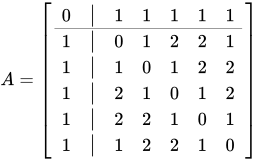
- Both extended Golay code's generator matrix is where is an identity of size 12 (binary) or 6 (ternary) and where is a constructed from a circulant matrix with a row and columns of all 1s added except at which is set to 0. Specifically, for ternary Golay code is
![{\displaystyle [I|A]}](https://wikimedia.org/api/rest_v1/media/math/render/svg/3f607888ea2eb50baa568e3f995d79e07b4a0721)


![{\displaystyle [1,1]}](https://wikimedia.org/api/rest_v1/media/math/render/svg/7a93c33bf544dd008f34d152345c97525bda7fe8)
and you can also see it's similar for the binary Golay code. Mochan Shrestha (talk) 16:53, 4 November 2011 (UTC)
What do the read and blue bubbles mean? How does the encoding table look like?
[edit]I'd like to see the answers in the article. ;-) --RokerHRO (talk) 10:42, 11 April 2014 (UTC)
The code is symmetric under complementation. Therefore the red and blue bubbles can represent either 1's and 0's or 0's and 1's.
Encoding table? Not sure what you mean. Scott Tillinghast, Houston TX (talk) 20:04, 28 December 2015 (UTC)