Talk:Alpha recursion theory
Add topic | This article is rated Start-class on Wikipedia's content assessment scale. It is of interest to the following WikiProjects: | ||||||||||
| |||||||||||

What is 'L'
[edit]I'm assuming L_sub_alpha is the alpha-th level of the constructible universe, can someone confirm this and if so, it should be lnked to Constructible_universe Zero sharp (talk) 23:44, 3 June 2008 (UTC)
- Yes, it is, linking C7XWiki (talk) 20:29, 25 April 2021 (UTC)
"Admissible ordinals are models of Kripke–Platek set theory."
[edit]This is probably supposed to mean either that admissible SETS are models of KP or that for an admissible ordinal, the corresponding L-level is a model of KP? As it stands, it is certainly false. — Preceding unsigned comment added by 79.235.170.206 (talk) 21:00, 12 January 2015 (UTC)
"An admissible set is closed under functions"
[edit]
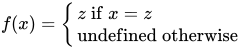
As it currently reads I think this claim is false, since for any admissible set , if we take some and define , is on but is not closed under (i.e. "" is false, in fact "" is false.) The closest I can find to this in "The fine structure of the constructible hierarchy" is in the proof of lemma 2.13, where it says "but is closed under since is in . So I am not sure that there's a source for this claim. C7XWiki (talk) 07:01, 6 July 2023 (UTC)