


Talk:Absorption law
Add topic | This article is rated Stub-class on Wikipedia's content assessment scale. It is of interest to the following WikiProjects: | ||||||||||
| |||||||||||

Categories
[edit]Does this page really belong in both the Algebra and Abstract algebra categories? Especially when it belongs to the Boolean algebra category which in turn belongs to both of the above categories? I'm all for a certain amount of well-judged redundancy in category inclusions, but this seems to wildly stretch the line. ---- Charles Stewart 09:06, 13 Oct 2004 (UTC)
I've cut out 'algebra'. Charles Matthews 10:28, 13 Oct 2004 (UTC)
- Good edit; I've spiced up the relation to various logics a bit. ---- Charles Stewart 11:18, 13 Oct 2004 (UTC)
I've rewritten this entry to meet my standard of clarity and usage. I am not qualified to judge the content of the last paragraph, because nonclassical logic is not my forte. What I've written is my best guess as to what was intended. I invite others to edit and correct what I wrote.132.181.160.42 05:07, 14 February 2006 (UTC)
Commutativity
[edit]Should we specify that the operations must be commutative, or that this is a 'left absorption law'? 152.1.137.158 (talk) 15:27, 24 April 2018 (UTC)
WikiProject class rating
[edit]This article was automatically assessed because at least one WikiProject had rated the article as stub, and the rating on other projects was brought up to Stub class. BetacommandBot 03:42, 10 November 2007 (UTC)
In set theory
[edit]


Proof:
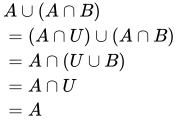
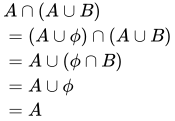
Note: Proving implies and vice verse as a result of the distributive property. Shubhrajit Sadhukhan (talk) 11:25, 29 June 2021 (UTC)
- Yes, as the article already says, the sets with union and intersection form a lattice and therefore obey the absorption law. --Macrakis (talk) 19:02, 29 June 2021 (UTC)