


Symplectic spinor bundle
In differential geometry, given a metaplectic structure on a -dimensional symplectic manifold the symplectic spinor bundle is the Hilbert space bundle associated to the metaplectic structure via the metaplectic representation. The metaplectic representation of the metaplectic group — the two-fold covering of the symplectic group — gives rise to an infinite rank vector bundle; this is the symplectic spinor construction due to Bertram Kostant.[1]


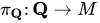
A section of the symplectic spinor bundle is called a symplectic spinor field.

Formal definition
[edit]Let be a metaplectic structure on a symplectic manifold that is, an equivariant lift of the symplectic frame bundle with respect to the double covering

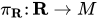

The symplectic spinor bundle is defined [2] to be the Hilbert space bundle

associated to the metaplectic structure via the metaplectic representation also called the Segal–Shale–Weil [3][4][5] representation of Here, the notation denotes the group of unitary operators acting on a Hilbert space




The Segal–Shale–Weil representation [6] is an infinite dimensional unitary representation of the metaplectic group on the space of all complex valued square Lebesgue integrable square-integrable functions Because of the infinite dimension, the Segal–Shale–Weil representation is not so easy to handle.


Notes
[edit]- ↑ Kostant, B. (1974). "Symplectic Spinors". Symposia Mathematica. XIV. Academic Press: 139–152.
- ↑ Habermann, Katharina; Habermann, Lutz (2006), Introduction to Symplectic Dirac Operators, Springer-Verlag, ISBN 978-3-540-33420-0 page 37
- ↑ Segal, I.E (1962), Lectures at the 1960 Boulder Summer Seminar, AMS, Providence, RI
- ↑ Shale, D. (1962). "Linear symmetries of free boson fields". Trans. Amer. Math. Soc. 103: 149–167. doi:10.1090/s0002-9947-1962-0137504-6.
- ↑ Weil, A. (1964). "Sur certains groupes d'opérateurs unitaires". Acta Math. 111: 143–211. doi:10.1007/BF02391012.
- ↑ Kashiwara, M; Vergne, M. (1978). "On the Segal–Shale–Weil representation and harmonic polynomials". Inventiones Mathematicae. 44: 1–47. doi:10.1007/BF01389900.
Further reading
[edit]- Habermann, Katharina; Habermann, Lutz (2006), Introduction to Symplectic Dirac Operators, Springer-Verlag, ISBN 978-3-540-33420-0