


Sverdrup wave
A Sverdrup wave (also known as Poincaré wave, or rotational gravity wave[1]) is a wave in the ocean, or large lakes, which is affected by gravity and Earth's rotation (see Coriolis effect).
For a non-rotating fluid, shallow water waves are affected only by gravity (see Gravity wave), where the phase velocity of shallow water gravity wave (c) can be noted as

and the group velocity (cg) of shallow water gravity wave can be noted as
- i.e.


where g is gravity, λ is the wavelength and H is the total depth.
Derivation
[edit]When the fluid is rotating, gravity waves with a long enough wavelength (discussed below) will also be affected by rotational forces. The linearized, shallow-water equations with a constant rotation rate, f0, are[2]
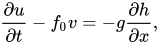
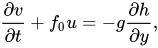
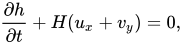
where u and v are the horizontal velocities and h is the instantaneous height of the free surface. Using Fourier analysis, these equations can be combined to find the dispersion relation for Sverdrup waves:

where k and l are the wavenumbers associated with the horizontal and vertical directions, and is the frequency of oscillation.

Limiting Cases
[edit]There are two primary modes of interest when considering Poincaré waves:[1][2]
- Short wave limit where is the Rossby radius of deformation. In this limit, the dispersion relation reduces to the solution for a non-rotating gravity wave.
- Long wave limit which looks like inertial oscillations driven purely by rotational forces.


Solution for the one-dimensional case
[edit]For a wave traveling in one direction (), the horizontal velocities are found to be equal to


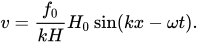
This shows that the inclusion of rotation will cause the wave to develop oscillations at 90° to the wave propagation at the opposite phase. In general, these are elliptical orbits that depend on the relative strength of gravity and rotation. In the long wave limit, these are circular orbits characterized by inertial oscillations.