


Surface force
 | This article needs more citations. (June 2023) |

Surface force denoted fs is the force that acts across an internal or external surface element in a material body. Normal forces and shear forces between objects are types of surface force. All cohesive forces and contact forces between objects are considered as surface forces. Surface force can be decomposed into two perpendicular components: normal forces and shear forces. A normal force acts normally over an area and a shear force acts tangentially over an area.
Equations for surface force
[edit]Surface force due to pressure
[edit]- , where f = force, p = pressure, and A = area on which a uniform pressure acts

Examples
[edit]Pressure related surface force
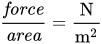
[edit]Since pressure is ,[1] and area is a ,

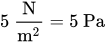
- a pressure of over an area of will produce a surface force of .


See also
[edit]References
[edit]- ↑ "Pressure". hyperphysics.phy-astr.gsu.edu. Retrieved 2023-05-15.
 | This classical mechanics–related article is a stub. You can help Wikipedia by adding missing information. |
 | This fluid dynamics–related article is a stub. You can help Wikipedia by adding missing information. |