


Support of a module
In commutative algebra, the support of a module M over a commutative ring R is the set of all prime ideals of R such that (that is, the localization of M at is not equal to zero).[1] It is denoted by . The support is, by definition, a subset of the spectrum of R.


Properties
[edit]- if and only if its support is empty.
- Let be a short exact sequence of R-modules. Then



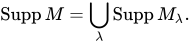
- Note that this union may not be a disjoint union.
- If is a sum of submodules , then
- If is a finitely generated R-module, then is the set of all prime ideals containing the annihilator of M. In particular, it is closed in the Zariski topology on Spec R.
- If are finitely generated R-modules, then
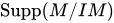
- If is a finitely generated R-module and I is an ideal of R, then is the set of all prime ideals containing This is .






Support of a quasicoherent sheaf
[edit]If F is a quasicoherent sheaf on a scheme X, the support of F is the set of all points x in X such that the stalk Fx is nonzero. This definition is similar to the definition of the support of a function on a space X, and this is the motivation for using the word "support". Most properties of the support generalize from modules to quasicoherent sheaves word for word. For example, the support of a coherent sheaf (or more generally, a finite type sheaf) is a closed subspace of X.[2]
If M is a module over a ring R, then the support of M as a module coincides with the support of the associated quasicoherent sheaf on the affine scheme Spec R. Moreover, if is an affine cover of a scheme X, then the support of a quasicoherent sheaf F is equal to the union of supports of the associated modules Mα over each Rα.[3]


Examples
[edit]As noted above, a prime ideal is in the support if and only if it contains the annihilator of .[4] For example, over , the annihilator of the module
![{\displaystyle R=\mathbb {C} [x,y,z,w]}](https://wikimedia.org/api/rest_v1/media/math/render/svg/374e83752e18b61098f8285791f9195519f1ba21)
![{\displaystyle M=R/I={\frac {\mathbb {C} [x,y,z,w]}{(x^{4}+y^{4}+z^{4}+w^{4})}}}](https://wikimedia.org/api/rest_v1/media/math/render/svg/8282e48f1f724a8dc322e95b742eaf45587ccbf6)
is the ideal . This implies that , the vanishing locus of the polynomial f. Looking at the short exact sequence



we might mistakenly conjecture that the support of I = (f) is Spec(R(f)), which is the complement of the vanishing locus of the polynomial f. In fact, since R is an integral domain, the ideal I = (f) = Rf is isomorphic to R as a module, so its support is the entire space: Supp(I) = Spec(R).
The support of a finite module over a Noetherian ring is always closed under specialization.[citation needed]
Now, if we take two polynomials in an integral domain which form a complete intersection ideal , the tensor property shows us that



See also
[edit]References
[edit]- ↑ Éléments de géométrie algébrique 0I, 1.7.1.
- ↑ The Stacks Project authors (2017). Stacks Project, Tag 01B4.
- ↑ The Stacks Project authors (2017). Stacks Project, Tag 01AS.
- ↑ Eisenbud, David. Commutative Algebra with a View Towards Algebraic Geometry. Corollary 2.7. p. 67.
{{cite book}}: CS1 maint: location (link)
- Grothendieck, Alexandre; Dieudonné, Jean (1960). "Éléments de géométrie algébrique: I. Le langage des schémas". Publications Mathématiques de l'IHÉS. 4. doi:10.1007/bf02684778. MR 0217083.
- Atiyah, M. F., and I. G. Macdonald, Introduction to Commutative Algebra, Perseus Books, 1969, ISBN 0-201-00361-9 MR 0242802