


Stirling transform
In combinatorial mathematics, the Stirling transform of a sequence { an : n = 1, 2, 3, ... } of numbers is the sequence { bn : n = 1, 2, 3, ... } given by
- ,

where is the Stirling number of the second kind, which is the number of partitions of a set of size into parts. This is a linear sequence transformation.


The inverse transform is
- ,
![{\displaystyle a_{n}=\sum _{k=1}^{n}(-1)^{n-k}\left[{n \atop k}\right]b_{k}}](https://wikimedia.org/api/rest_v1/media/math/render/svg/5b99352463fb9a4bacf6a28a7f79e5c684b4f076)
where is a signed Stirling number of the first kind, where the unsigned can be defined as the number of permutations on elements with cycles.
![{\textstyle (-1)^{n-k}\left[{n \atop k}\right]}](https://wikimedia.org/api/rest_v1/media/math/render/svg/010cbbee14fc66698377c583ea15f4071cae684a)
![{\displaystyle \left[{n \atop k}\right]}](https://wikimedia.org/api/rest_v1/media/math/render/svg/53e244be41a40ffd185e9edea632ba557f6ad945)
Berstein and Sloane (cited below) state "If an is the number of objects in some class with points labeled 1, 2, ..., n (with all labels distinct, i.e. ordinary labeled structures), then bn is the number of objects with points labeled 1, 2, ..., n (with repetitions allowed)."
If
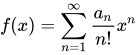
is a formal power series, and
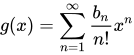
with an and bn as above, then
- .

Likewise, the inverse transform leads to the generating function identity
- .

See also
[edit]References
[edit]- Bernstein, M.; Sloane, N. J. A. (1995). "Some canonical sequences of integers". Linear Algebra and Its Applications. 226/228: 57–72. arXiv:math/0205301. doi:10.1016/0024-3795(94)00245-9. S2CID 14672360..
- Khristo N. Boyadzhiev, Notes on the Binomial Transform, Theory and Table, with Appendix on the Stirling Transform (2018), World Scientific.