


Steinberg symbol
In mathematics a Steinberg symbol is a pairing function which generalises the Hilbert symbol and plays a role in the algebraic K-theory of fields. It is named after mathematician Robert Steinberg.
For a field we define a Steinberg symbol (or simply a symbol) to be a function , where is an abelian group, written multiplicatively, such that for all ,




- and , and
- if then .




The first condition is sometimes referred to as being bimultiplicative, while the second condition is known as the Steinberg property.

The symbols on derive from a "universal" symbol, which may be regarded as taking values in . By a theorem of Hideya Matsumoto, this group is and is part of the Milnor K-theory for a field.


Properties
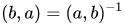
[edit]If is a symbol on , then for all we have

- ;
- ;
- is an element of order 1 or 2;
- .



Examples
[edit]- The trivial symbol which is identically 1.
- The Hilbert symbol on with values in {±1} defined by[1][2]

- The Contou-Carrère symbol is a symbol for the ring of Laurent power series over an Artinian ring.
Continuous symbols
[edit]If is a topological field then a symbol c is weakly continuous if for each y in F∗ the set of x in F∗ such that c(x,y) = 1 is closed in F∗. This makes no reference to a topology on the codomain G. If G is a topological group, then one may speak of a continuous symbol, and when G is Hausdorff then a continuous symbol is weakly continuous.[3]
The only weakly continuous symbols on R are the trivial symbol and the Hilbert symbol; the only weakly continuous symbol on C is the trivial symbol.[4] The characterisation of weakly continuous symbols on a non-Archimedean local field F was obtained by Moore. The group K2(F) is the direct sum of a cyclic group of order m and a divisible group K2(F)m. A symbol on F lifts to a homomorphism on K2(F) and is weakly continuous precisely when it annihilates the divisible component K2(F)m. It follows that every weakly continuous symbol factors through the norm residue symbol.[5]
See also
[edit]References
[edit]- ↑ Serre, Jean-Pierre (1996). A Course in Arithmetic. Graduate Texts in Mathematics. Vol. 7. Berlin, New York: Springer-Verlag. ISBN 978-3-540-90040-5.
- ↑ Milnor (1971) p.94
- ↑ Milnor (1971) p.165
- ↑ Milnor (1971) p.166
- ↑ Milnor (1971) p.175
- Conner, P.E.; Perlis, R. (1984). A Survey of Trace Forms of Algebraic Number Fields. Series in Pure Mathematics. Vol. 2. World Scientific. ISBN 9971-966-05-0. Zbl 0551.10017.
- Lam, Tsit-Yuen (2005). Introduction to Quadratic Forms over Fields. Graduate Studies in Mathematics. Vol. 67. American Mathematical Society. pp. 132–142. ISBN 0-8218-1095-2. Zbl 1068.11023.
- Milnor, John Willard (1971). Introduction to algebraic K-theory. Annals of Mathematics Studies. Vol. 72. Princeton, NJ: Princeton University Press. MR 0349811. Zbl 0237.18005.
- Steinberg, Robert (1962). "Générateurs, relations et revêtements de groupes algébriques". Colloq. Théorie des Groupes Algébriques (in French). Bruxelles: Gauthier-Villars: 113–127. MR 0153677. Zbl 0272.20036.