


Stable polynomial
A polynomial is defined to be stable in two different ways.
- Hurwitz-stable: In the context of a differential equation (continuous-time) the characteristic polynomial is stable if all its roots lie in the open left complex half-plane.
- Schur-stable: In the context of a difference equation (discrete-time), its characteristic polynomial is stable if all its roots lie in the open complex unit disk.
Also, in control theory, a linear, time-invariant system (see LTI system theory) is said to be BIBO stable if every bounded input produces bounded output. A linear system is BIBO stable if its denominator characteristic polynomial is stable (Hurwitz stable for a continuous-time system, Schur stable for discrete-time). In practice, stability is tested via several stability criteria.
Properties
[edit]- The Routh–Hurwitz theorem provides an algorithm for determining if a given polynomial is Hurwitz stable, which is implemented in the Routh–Hurwitz and Liénard–Chipart tests.
- To test if a given polynomial P (of degree d) is Schur stable, it suffices to apply this theorem to the transformed polynomial
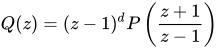
- obtained after the Möbius transformation which maps the left half-plane to the open unit disc: P is Schur stable if and only if Q is Hurwitz stable and . For higher degree polynomials the extra computation involved in this mapping can be avoided by testing the Schur stability by the Schur-Cohn test, the Jury test or the Bistritz test.


- Necessary condition: a Hurwitz stable polynomial (with real coefficients) has coefficients of the same sign (either all positive or all negative).
- Sufficient condition: a polynomial with (real) coefficients such that

- is Schur stable.

- Product rule: Two polynomials f and g are stable (of the same type) if and only if the product fg is stable.
- Hadamard product: The Hadamard (coefficient-wise) product of two Hurwitz stable polynomials is again Hurwitz stable.[1]
Examples
[edit]- is Schur stable because it satisfies the sufficient condition;
- is Schur stable (because all its roots equal 0) but it does not satisfy the sufficient condition;
- is not Hurwitz stable (its roots are −1 and 2) because it violates the necessary condition;
- is Hurwitz stable (its roots are −1 and −2).
- The polynomial (with positive coefficients) is neither Hurwitz stable nor Schur stable. Its roots are the four primitive fifth roots of unity





- Note here that
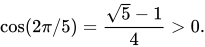
- It is a "boundary case" for Schur stability because its roots lie on the unit circle. The example also shows that the necessary (positivity) conditions stated above for Hurwitz stability are not sufficient.
Stable matrices
[edit]Just as stable polynomials are crucial for assessing the stability of systems described by polynomials, stability matrices play a vital role in evaluating the stability of systems represented by matrices.
Hurwitz matrix
[edit]A square matrix A is called a Hurwitz matrix if every eigenvalue of A has strictly negative real part.
Schur matrix
[edit]Schur matrices is an analogue of the Hurwitz matrices for discrete-time systems. A matrix A is a Schur (stable) matrix if its eigenvalues are located in the open unit disk in the complex plane.
See also
[edit]References
[edit]- ↑ Garloff, Jürgen; Wagner, David G. (1996). "Hadamard Products of Stable Polynomials Are Stable". Journal of Mathematical Analysis and Applications. 202 (3): 797–809. doi:10.1006/jmaa.1996.0348.