


Sphere mapping
 | This article needs more citations. (March 2026) |
In computer graphics, sphere mapping (or spherical environment mapping) is a parameterization of directional radiance obtained by projecting the reflection of a mirrored sphere onto a plane using an orthographic projection. The resulting 2D texture encodes incident light as a function of direction and is used for reflection mapping by converting a surface reflection vector into texture coordinates. The method assumes the environment is distant (so radiance depends only on direction), but it introduces non-uniform distortion and contains a singularity in the direction opposite the viewing direction used to create the map.[1]
To use this data, the surface normal of the object, view direction from the object to the camera, and/or reflected direction from the object to the environment is used to calculate a texture coordinate to look up in the aforementioned texture map. The result appears like the environment is reflected in the surface of the object that is being rendered.
Usage example
[edit]In the simplest case for generating texture coordinates, suppose:
- The map has been created as above, looking at the sphere along the z-axis.
- The texture coordinate of the center of the map is (0,0), and the sphere's image has radius 1.
- We are rendering an image in the same exact situation as the sphere, but the sphere has been replaced with a reflective object.
- The image being created is orthographic, or the viewer is infinitely far away, so that the view direction does not change as one moves across the image.
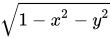
At texture coordinate , note that the depicted location on the sphere is (where z is ), and the normal at that location is also . However, we are given the reverse task (a normal for which we need to produce a texture map coordinate). So the texture coordinate corresponding to normal is .



See also
[edit]- Skybox (video games)
- HEALPix, mapping with little distortion, arbitrary precision, and equal-sized fragments
References
[edit]- ↑ Heidrich, Wolfgang (2000). "Environment Maps and Their Applications" (PDF). Max‑Planck‑Institute for Computer Science Technical Report. 19 (4). Saarbrücken, Germany. Retrieved 2026-03-02.
 | This computer graphics–related article is a stub. You can help Wikipedia by adding missing information. |