


// Workers AI · dad joke modeWhy was the special trinomial sad? It was a cubic failure.
In algebra, specifically in the factorization of polynomials, a special trinomial is a polynomial that can be expressed in the form:[1]

and for which there is a known method for factoring it as the product of two first-degree binomials.
Factoring Method
[edit]We can distinguish between the cases in which the coefficient of the quadratic term is equal to or different from .

a = 1
[edit]If the coefficient of the quadratic term is equal to , the trinomial takes the form:[1]

in this case, it can be factored into the product of two first-degree binomials, in the form:
- ,
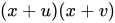
where and are two terms with the following two properties:


- .


In fact, performing the calculations yields:
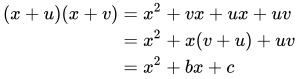
A practical method to find and is to solve for the two roots of the polynomial. In fact, if
- ,

then:

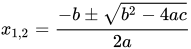
To find the roots of the quadratic trinomial, simply use the quadratic formula:
a ≠ 1
[edit]If the coefficient of the quadratic term is not , the trinomial can be factored as follows:
- ,

where and have the following properties:[2]
- .


In this case as well, the factorization can be demonstrated as follows:[3]

As in the previous case, and can be found by solving for the roots of the polynomial using the quadratic formula.
Trinomials of degree greater than 2
[edit]Factoring by substitution
[edit]More generally, if we consider the trinomial:[4]

This can be factored by making the substitution , which gives the trinomial:

- ,

that can be factored using the methods described above and then by reapplying the substitution in reverse.
Direct factoring
[edit]Considering the previous properties:
- .
The trinomial can also be directly factored as follows:

The factorization can be demonstrated as follows:

Also in this case and can be found by solving for the roots of the polynomial using the quadratic formula.
Notes
[edit]- 1 2 Massimo Bergamini, Graziella Barozzi, Anna Trifone. Matematica.blu (seconda edizione) Vol.1. Zanichelli - Bologna, 2018. ISBN 978-88-08-22085-1.
{{cite book}}: CS1 maint: multiple names: authors list (link)p.419 - ↑ Massimo Bergamini, Anna Trifone, Graziella Barozzi. Matematica.Blu-Volume 2. Zanichelli, 2010. ISBN 978-88-08-31344-7.
{{cite book}}: CS1 maint: multiple names: authors list (link)p.872 - ↑ Marzia Re Fraschini, Gabriella Grazzi (2012). I principi della matematica (Volume 3). Atlas. ISBN 978-88-268-1711-8.p.277
- ↑ Marzia Re Fraschini, Gabriella Grazzi (2012). I principi della matematica (Volume 3). Atlas. ISBN 978-88-268-1711-8.p.99
Bibliography
[edit]- Marzia Re Fraschini, Gabriella Grazzi (2012). I principi della matematica (Volume 3). Atlas. ISBN 978-88-268-1711-8.
- Massimo Bergamini, Graziella Barozzi, Anna Trifone. Matematica.blu (seconda edizione) Vol.1. Zanichelli - Bologna, 2018. ISBN 978-88-08-22085-1.
{{cite book}}: CS1 maint: multiple names: authors list (link)
