


// Workers AI · dad joke modeWhat did Serie A say to the ball? You're a-grade material.
 | |
| Organising body | Lega Serie A |
|---|---|
| Founded | 1898 (as Campionato Italiano di Football) 1929 (as Serie A) |
| Country | Italy |
| Confederation | UEFA |
| Number of clubs | 20 (since 2004–05) |
| Level on pyramid | 1 |
| Relegation to | Serie B |
| Domestic cups | |
| International cups | |
| Current champions | Inter Milan (21st title) (2025–26) |
| Most championships | Juventus (36 titles) |
| Most appearances |
|
| Top scorer | Silvio Piola (274) |
| Broadcaster(s) | List of broadcasters |
| Sponsor(s) | Enilive |
| Website | legaseriea.it |
| Current: 2026–27 Serie A | |
The Serie A (Italian pronunciation: [ˈsɛːrje ˈa]),[1] officially known as Serie A Enilive[2] in Italy and Serie A Made in Italy abroad for sponsorship reasons, is a professional association football league in Italy and the highest level of the Italian football league system. Established in the 1929–30 season, it restructured the existing Italian Football Championship, which had been played since 1898, into a national round-robin format alongside Serie B. It functions under a promotion and relegation system with Serie B.
The league was organised by the Direttorio Divisioni Superiori until 1943, the Lega Calcio from 1946 to 2010, and the Lega Serie A ever since. The 29 championships played from 1898 to the formation of the Serie A in 1929 are officially recognised by the Italian Football Federation (FIGC) as equal to later Serie A titles. Similarly the 1945–46 season, played under a temporary format due to World War II, is also recognized as an official championship.[3] Since 1924, the winner of Italy's top division has worn the scudetto emblem on its kit in the following season, and since 1961, the Coppa Campioni d'Italia trophy has been awarded to the Serie A champion.
The Serie A currently ranks second in the UEFA coefficient rankings as of 2024–25 based on performances in European competitions over the past five seasons, behind England's Premier League and ahead of Spain's La Liga.[4] The league has consistently ranked among the strongest in global football and has historically attracted top global talent, producing numerous Ballon d'Or winners.[5][6]
The Serie A is home to several of football's most successful and renowned clubs, including Juventus, Inter Milan, and AC Milan. These teams have played key roles in European football governance and competition history. Juventus, the most decorated club in Italy,[7][8] has achieved international success across all major UEFA and intercontinental tournaments. Milan and Inter have also earned significant honors, with Milan joint-third among clubs for most UEFA titles,[9] and Inter achieving a continental treble in 2009–10. Alongside Roma, Lazio, historically Parma and Fiorentina but now replaced by Napoli and Atalanta, these clubs form the "seven sisters" (sette sorelle) of Italian football.[10][11][12][13][14][note 1]
History
[edit]
Founded in 1898, the Italian championship was initially characterized by amateur organization and limited public interest.[15] During its first two decades, Genoa, the first team to win the Italian championship, and Pro Vercelli were the dominant clubs, winning most of the titles between them.[16] The Italian Football Federation (FIGC) organized the championship from its first edition, except in the 1921–22 season. After the clubs failed to reach an agreement over the proposed progetto Pozzo, two separate tournaments were held, one of which was organized by the Italian Football Confederation (CCI). The following season, the Colombo Compromise ended the split and reunited the competitions.[17]
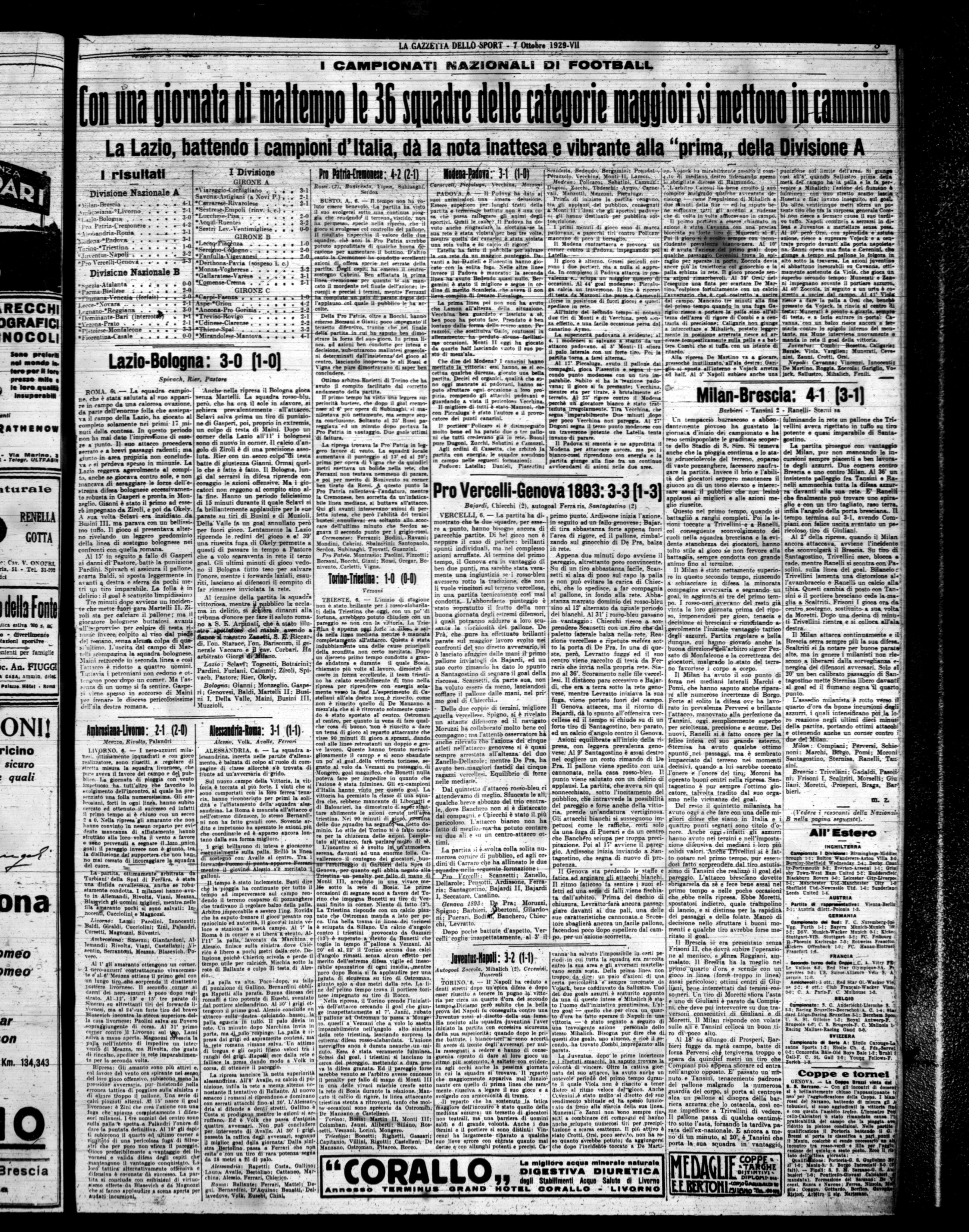
Until the end of the 1920s, the Italian championship was organized through multiple geographically based groups followed by knockout stages.[note 2] Since the introduction of the Scudetto patch in 1925, the championship has also commonly been referred to as the "Scudetto" by metonymy. From the 1929–30 season onward, the championship adopted a single round-robin format, which had already been briefly used in the 1909–10 season, and the name Serie A.[note 3]
The 1930s marked a significant change in Italian football, both in sporting terms and in its social significance. The period saw the emergence of a sustained dominance by three major clubs,[22] Juventus, Inter Milan, and AC Milan, with Juventus becoming the most successful club in Italy and Inter the only club to have remained continuously in the top flight. Football also attracted an increasingly large following among fans and the mass media, establishing itself as Italy's national sport and overtaking cycling.[15]
The dominance of the Milan–Turin axis was periodically challenged during the interwar period and the postwar period by Bologna and Torino. In subsequent decades, clubs including Fiorentina, Lazio, Roma, and Napoli also won top-flight titles. Roma's 1941–42 championship was the first won by a club from Central or Southern Italy.[23] Other clubs achieved isolated title successes, including Casale and Novese in the early 20th century, the latter during the split between the FIGC and CCI, and Cagliari, Verona, and Sampdoria in the second half of the 20th century.

Serie A experienced a period of decline following the decision by the Lega Nazionale Professionisti to restrict the signing of players and coaches from foreign leagues after the national team's defeat at the 1966 FIFA World Cup in England. The situation was further affected fourteen years later by the first major Italian football betting scandal. The decline continued into the early 1980s,[24] when Italy's top division ranked 12th in Europe for the 1981–82 season, behind leagues such as those of Belgium, the Soviet Union, East Germany, and Czechoslovakia.[25]
Serie A subsequently reached a peak in international prestige and visibility around the late 1980s and early 1990s.[26] The high technical level of the teams was reinforced by the gradual reopening of the league to foreign players,[27] while Italian clubs consistently achieved strong results in European competitions.[28] In the 1989–90 season, Italian clubs won all three major European club competitions, and Serie A subsequently occupied first place in the continental rankings for several seasons.[29] In the 1997–98 season, Serie A qualified a record nine teams for European competitions.
Serie A lost its position at the top of the continental rankings from the second half of the 2000s onward,[30] amid structural problems affecting both sporting matters[30][31] and off-field issues.[30][32][33][34] It has nevertheless remained one of Europe's major domestic leagues, alongside those of Germany, England, and Spain.
Format
[edit]For most of Serie A's history, there were 16 or 18 clubs competing at the top level. Since 2004–05, however, there have been 20 clubs in total. One season (1947–48) was played with 21 teams for political reasons, following post-war tensions with Yugoslavia. Below is a complete record of how many teams played in each season throughout the league's history:
- 18 clubs: 1929–1934
- 16 clubs: 1934–1943
- 20 clubs: 1946–1947
- 21 clubs: 1947–1948
- 20 clubs: 1948–1952
- 18 clubs: 1952–1967
- 16 clubs: 1967–1988
- 18 clubs: 1988–2004
- 20 clubs: 2004–present

During the season, which runs from August to May, each club plays each of the other teams twice; once at home and once away, totalling 38 games for each team by the end of the season. Thus, in Italian football a true round-robin format is used. In the first half of the season, called the andata, each team plays once against each league opponent, for a total of 19 games. In the second half of the season, called the ritorno, the teams play another 19 games, once more against each opponent, in which home and away matches are reversed. The two halves of the season had exactly the same order of fixtures until the 2021–22 season, when an asymmetrical calendar was introduced, following the format of the English, Spanish and French leagues.[35] Since the 1994–95 season, teams are awarded three points for a win, one point for a draw, and no points for a loss. Prior to this, a win was worth two points. The three lowest-placed teams at the end of the season are relegated to Serie B, and three Serie B teams are promoted to replace them for the next season.
European qualification
[edit]In 2023–24, Serie A was ranked as the best league by UEFA coefficient.[36] This was due to a combination of all seven Serie A teams progressing into the knockout stages in European competition, picking up extra coefficient points. Additionally, Atalanta won the Europa League Final and Fiorentina were losing finalists in the UEFA Europa Conference League. This continued a strong recent record where five of the six European club finals have featured at least one Serie A side over the past two seasons. As a result of this ranking the top 5 clubs in Serie A qualify for the Champions League in 2024.
Tiebreaking
[edit]
If after all 38 games, two teams are tied on points for either first place or for 17th (the last safety spot), the outcome is decided by a single-legged play-off match. This match consists of 90 minutes of regulation time followed by penalties if necessary (no extra time). The game is to be held at a neutral venue, with the designated "home" team determined by the performance-based criteria listed below.[37][38][39] In cases where there are at least three teams tied for one of these positions, a mini table is created using the same tiebreakers to determine which two teams will play in the decider. For ties concerning all other league positions, the following tiebreakers are applied:
- Head-to-head points
- Goal difference of head-to-head games
- Goal difference overall
- Higher number of goals scored
- Play-off game at a neutral venue if relevant to decide European qualification or relegation; otherwise by coin flip[40]
Between 2006–07 and 2021–22, the tiebreakers currently used for all places to decide the scudetto winner if necessary, though this was never needed. Before 2005–06, a play-off would immediately be used if teams were tied for first place, a European qualification spot, or a relegation spot. In some past years, the playoff was a single game at a neutral site while in others it was a two-legged tie decided by aggregate score.
The only time a playoff was used to decide the champion occurred in the 1963–64 season when Bologna and Inter both finished on 54 points. Bologna won the playoff 2–0 at the Stadio Olimpico in Rome to win the scudetto.[40] Playoff games have been used on multiple occasions to decide European competition qualifications (most recently in 1999–2000) and relegation (most recently in 2022–23).
Clubs
[edit]Before 1929, many clubs competed in the top level of Italian football as the earlier rounds were competed up to 1922 on a regional basis then interregional up to 1929. Below is a list of Serie A clubs who have competed in the competition since it has been a league format (68 in total).
2026–27 season
[edit]Clubs
[edit]The following 20 clubs compete in the Serie A during the 2026–27 season.
| Team | Location | Position in 2025–26 season | First season in Serie A | Seasons in Serie A | Serie A titles | First season of current spell | Seasons of current spell | National titles | Manager |
|---|---|---|---|---|---|---|---|---|---|
| Atalanta | Bergamo | 7th | 1937–38 | 66 | 0 | 2011–12 | 16 | 0 | Maurizio Sarri |
| Bologna | Bologna | 8th | 1929–30 | 80 | 5 | 2015–16 | 12 | 7 | Raffaele Palladino |
| Cagliari | Cagliari | 14th | 1964–65 | 46 | 1 | 2023–24 | 4 | 1 | Fabio Pisacane |
| Como | Como | 4th | 1949–50 | 16 | 0 | 2024–25 | 3 | 0 | Cesc Fàbregas |
| Fiorentina | Florence | 15th | 1931–32 | 89 | 2 | 1994–95 | 33 | 2 | Paolo Vanoli |
| Frosinone | Frosinone | 2nd (B) | 2015–16 | 4 | 0 | 2026–27 | 1 | 0 | Massimiliano Alvini |
| Genoa | Genoa | 16th | 1929–30 | 59 | 0 | 2023–24 | 4 | 9 | Daniele De Rossi |
| Inter Milan | Milan | 1st | 1929–30 | 95 | 20 | 1929–30 | 95 | 22 | Cristian Chivu |
| Juventus | Turin | 6th | 1929–30 | 94 | 34 | 2007–08 | 20 | 36 | Luciano Spalletti |
| Lazio | Rome | 9th | 1929–30 | 84 | 2 | 1988–89 | 39 | 2 | Gennaro Gattuso |
| Lecce | Lecce | 17th | 1985–86 | 21 | 0 | 2022–23 | 5 | 0 | Eusebio Di Francesco |
| AC Milan | Milan | 5th | 1929–30 | 93 | 16 | 1983–84 | 44 | 19 | Rúben Amorim |
| Monza | Monza | 3rd (B) | 2022–23 | 4 | 0 | 2026–27 | 1 | 0 | Ivan Jurić |
| Napoli | Naples | 2nd | 1929–30 | 81 | 4 | 2007–08 | 20 | 4 | Massimiliano Allegri |
| Parma | Parma | 13th | 1990–91 | 30 | 0 | 2024–25 | 3 | 0 | Carlos Cuesta |
| Roma | Rome | 3rd | 1929–30 | 94 | 3 | 1951–52 | 76 | 3 | Gian Piero Gasperini |
| Sassuolo | Sassuolo | 11th | 2013–14 | 13 | 0 | 2025–26 | 2 | 0 | Alberto Aquilani |
| Torino | Turin | 12th | 1929–30 | 83 | 5 | 2012–13 | 15 | 7 | Ignazio Abate |
| Udinese | Udine | 10th | 1950–51 | 54 | 0 | 1992–93 | 35 | 0 | Kosta Runjaić |
| Venezia | Venice | 1st (B) | 1939–40 | 15 | 0 | 2026–27 | 1 | 0 | Giovanni Stroppa |
Stadiums
[edit]| Team | Location | Current | Capacity |
|---|---|---|---|
| Atalanta | Bergamo | Stadio di Bergamo | 24,950 |
| Bologna | Bologna | Stadio Renato Dall'Ara | 38,279 |
| Cagliari | Cagliari | Sardegna Arena | 16,416 |
| Como | Como | Stadio Giuseppe Sinigaglia | 13,602 |
| Fiorentina | Florence | Stadio Artemio Franchi | 43,147 |
| Frosinone | Frosinone | Stadio Benito Stirpe | 16,227 |
| Genoa | Genoa | Stadio Luigi Ferraris | 36,599 |
| Inter Milan | Milan | Stadio Giuseppe Meazza | 80,018 |
| Juventus | Turin | Juventus Stadium | 41,507 |
| Lazio | Rome | Stadio Olimpico | 70,634 |
| Lecce | Lecce | Stadio Ettore Giardiniero - Via del Mare | 31,533 |
| AC Milan | Milan | San Siro | 80,018 |
| Monza | Monza | Stadio Brianteo | 17,102 |
| Napoli | Naples | Stadio Diego Armando Maradona | 54,726 |
| Parma | Parma | Stadio Ennio Tardini | 27,906 |
| Roma | Rome | Stadio Olimpico | 70,634 |
| Sassuolo | Reggio Emilia | Stadio Città del Tricolore | 21,525 |
| Torino | Turin | Stadio Olimpico Grande Torino | 27,958 |
| Udinese | Udine | Stadio Friuli | 25,144 |
| Venezia | Venice | Stadio Pier Luigi Penzo | 12,048 |
Maps
[edit]Current teams shown in green.


Seasons in Serie A
[edit]There are 68 teams that have taken part in 95 Serie A championships in a single round that was played from the 1929–30 season until the 2026–27 season. The teams in bold compete in Serie A currently. The year in parentheses represents the most recent year of participation at this level. Inter Milan is the only team that has played Serie A football in every season.
- 95 seasons: Inter Milan (2027)
- 94 seasons: Juventus (2027), Roma (2027)
- 93 seasons: AC Milan (2027)
- 89 seasons: Fiorentina (2027)
- 84 seasons: Lazio (2027)
- 83 seasons: Torino (2027)
- 81 seasons: Napoli (2027)
- 80 seasons: Bologna (2027)
- 66 seasons: Sampdoria (2023),[note 4] Atalanta (2027)
- 59 seasons: Genoa (2027)
- 54 seasons: Udinese (2027)
- 46 seasons: Cagliari (2027)
- 35 seasons: Hellas Verona (2026)
- 30 seasons: Vicenza (2001), Bari (2011), Parma (2027)
- 29 seasons: Palermo (2017)
- 26 seasons: Triestina (1959)
- 23 seasons: Brescia (2020)
- 21 seasons: Lecce (2027)
- 19 seasons: SPAL (2020)
- 18 seasons: Livorno (2014)
- 17 seasons: Catania (2014), ChievoVerona (2019), Empoli (2025)
- 16 seasons: Padova (1996), Ascoli (2007), Como (2027)
- 15 seasons: Venezia (2027)
- 13 seasons: Alessandria (1960), Modena (2004), Perugia (2004), Novara (2012), Cesena (2015), Sassuolo (2027)
- 12 seasons: Pro Patria (1956)
- 11 seasons: Foggia (1995)
- 10 seasons: Avellino (1988)
- 9 seasons: Reggina (2009), Siena (2013), Cremonese (2026)
- 8 seasons: Sampierdarenese (1943), Lucchese (1952), Piacenza (2003), Pisa (2026)
- 7 seasons: Mantova (1972), Varese (1975), Catanzaro (1983), Pescara (2017)
- 6 seasons: Pro Vercelli (1935)
- 5 seasons: Messina (2007), Salernitana (2024)
- 4 seasons: Casale (1934), Frosinone (2027), Monza (2027)
- 3 seasons: Legnano (1954), Lecco (1967), Reggiana (1997), Crotone (2021), Spezia (2023)
- 2 seasons: Ternana (1975), Ancona (2004), Benevento (2021)
- 1 season: Pistoiese (1981), Treviso (2006), Carpi (2016)
Logos
[edit]Serie A had logos that featured its sponsor Telecom Italia Mobile (TIM). The logo that was introduced in 2010 had a minor change in 2016 due to the change of the logo of TIM itself.[41][42] In August 2018, a new logo was announced, and another one in August 2019.[43]
On 5 February 2024, Serie A signed a new sponsor deal with Eni, otherwise known as Enilive, to take the main sponsor role of the Serie A.[44][45][46]
Television rights
[edit]In the past, individual clubs competing in the league had the rights to sell their broadcast rights to specific channels throughout Italy, unlike in most other European countries. Currently, the two broadcasters in Italy are the satellite broadcaster Sky Italia and streaming platform DAZN for its own pay television networks; RAI is allowed to broadcast only highlights (exclusively from 13:30 to 22:30 CET). This is a list of television rights in Italy (since 2021–22):
- Sky Italia (3 matches per week)
- DAZN (all matches, including the previous 3)
- OneFootball (highlights)
Since the 2010–11 season, Serie A clubs have negotiated television rights collectively rather than on an individual club basis, having previously abandoned collective negotiation at the end of the 1998–99 season.[47]
International broadcasters
[edit]In the 1990s, Serie A was at its most popular in the United Kingdom when it was shown on Football Italia on Channel 4, although it has actually appeared on more UK channels than any other league, rarely staying in one place for long since 2002. Serie A has appeared in the UK on BSB's The Sports Channel (1990–91), Sky Sports (1991–1992), Channel 4 (1992–2002), Eurosport (2002–2004), Setanta Sports and Bravo (2004–2007), Channel 5 (2007–2008), ESPN (2009–2013), Eleven Sports Network (2018), Premier, FreeSports (2019–2021) and currently BT Sport (2013–2018; 2021–present).[48]
In the United States, Serie A is currently shown on CBS Sports and its streaming network Paramount+. Prior to 2021–22 it was shown on the ESPN family of networks.[49]
2024–29
[edit]For the 2024–29 cycle, the Serie A sold its international rights to the Infront agency (except in United States and MENA), which is in charge of reaching an agreement with the interested companies.[50]
Africa
[edit]| Country | Broadcasters |
|---|---|
| Sub-Saharan Africa | SuperSport, New World TV |
Americas
[edit]| Country | Broadcasters |
|---|---|
| Brazil | ESPN |
| Canada | fubo TV, TLN |
| Caribbean | ESPN |
| Latin America | ESPN |
| United States | CBS Sports[51] Telemundo Deportes |
Asia and Oceania
[edit]| Country | Broadcasters |
|---|---|
| Australia | beIN Sports[52] |
| Brunei | beIN Sports |
| Bangladesh | Galaxy Racer[53] |
| Cambodia | beIN Sports |
| Central Asia | Setanta Sports |
| China | CCTV, IQIYI, Migu |
| Hong Kong | I-CABLE HOY |
| Indian Subcontinent | TBA |
| Indonesia | beIN Sports, Vidio, ANTV |
| Japan | DAZN |
| Laos | beIN Sports |
| Macau | Macau Cable TV, M Plus |
| Malaysia | beIN Sports, Astro |
| Maldives | Ice Sports |
| New Zealand | beIN Sports |
| Philippines | beIN Sports, TAP DMV |
| Singapore | beIN Sports |
| South Korea | SPOTV |
| Taiwan | ELTA Sports[54] |
| Tajikistan | TV Varzish, TV Football |
| Thailand | beIN Sports, TrueVisions |
| Uzbekistan | Sport |
| Vietnam | MyTV |
Europe
[edit]| Country | Broadcasters |
|---|---|
| Albania | SuperSport, Tring Sport |
| Andorra | DAZN |
| Armenia | Setanta Sports Eurasia, Fast Sports |
| Austria | DAZN |
| Azerbaijan | CBC Sport, Setanta Sports Eurasia |
| Belarus | Setanta Sports Eurasia, Sport TV |
| Belgium | DAZN, Play Sports |
| Bosnia and Herzegovina | Arena Sport |
| Bulgaria | Max Sport, Ring |
| Croatia | Arena Sport |
| Cyprus | CYTA |
| Czech Republic | Nova Sport, Premier Sport |
| Denmark | TV 2 Sport |
| Estonia | Setanta Sports Eurasia, Go3 Sport |
| Finland | MTV Urheilu |
| France | DAZN[55] |
| Georgia | Setanta Sports Eurasia (Limited to 5 matches per week) |
| Germany | DAZN |
| Greece | Cosmote Sport |
| Hungary | Sport1 |
| Iceland | Livey |
| Ireland | TNT Sports, DAZN |
| Kosovo | SuperSport, Artmotion |
| Latvia | Setanta Sports Eurasia, Go3 Sport |
| Liechtenstein | Blue Sport, Sky Sport |
| Lithuania | Setanta Sports Eurasia, Go3 Sport |
| Luxembourg | DAZN |
| Malta | Total Sports Network |
| Moldova | Setanta Sports Eurasia |
| Montenegro | Arena Sport |
| Netherlands | Ziggo Sport |
| North Macedonia | Arena Sport |
| Norway | VG+ |
| Poland | Eleven Sports |
| Portugal | Sport TV |
| Romania | Digi Sport, Prima Sport |
| Russia | Match TV |
| San Marino | DAZN |
| Serbia | Arena Sport |
| Slovakia | Nova Sport, Premier Sport |
| Slovenia | Arena Sport |
| Spain | DAZN[56] |
| Sweden | TV4 |
| Switzerland | DAZN[57] |
| Turkey | S Sport |
| Ukraine | MEGOGO |
| United Kingdom | TNT Sports, DAZN, BBC Sport, BBC Alba |
Middle East and North Africa
[edit]| Country | Broadcasters |
|---|---|
| MENA | StarzPlay |
| Israel | ONE |
Champions
[edit]The FIGC officially recognises 29 Italian Football Championships held prior to the 1929 reorganisation of the top division into Serie A. The most successful club in terms of national championships is Juventus, with a total of 36 titles. The second most successful club is Inter Milan, with 21 championships, followed by AC Milan, with 19 titles. In recognition of domestic success, the FIGC awards a star for every ten championships won, which may be displayed on a club's jersey.
No national titles were awarded for the 1926–27 and 2004–05 seasons. In both instances, the championships were revoked from Torino and Juventus respectively, due to their involvement in football-related scandals.

- Notes
- Bold denotes clubs competing in the 2025–26 Serie A season.
- In 2002, the FIGC awarded Spezia a special decoration for their victory in the 1944 wartime championship. However, the federation clarified that this recognition does not constitute an official scudetto.
By city
[edit]| City | Championships | Clubs |
|---|---|---|
| Turin | 43 | Juventus (36), Torino (7) |
| Milan | 40 | Inter Milan (21), AC Milan (19) |
| Genoa | 10 | Genoa (9), Sampdoria (1) |
| Bologna | 7 | Bologna (7) |
| Vercelli | 7 | Pro Vercelli (7) |
| Rome | 5 | Roma (3), Lazio (2) |
| Naples | 4 | Napoli (4) |
| Florence | 2 | Fiorentina (2) |
| Cagliari | 1 | Cagliari (1) |
| Casale Monferrato | 1 | Casale (1) |
| Novi Ligure | 1 | Novese (1) |
| Verona | 1 | Hellas Verona (1) |
By region
[edit]| Region | Championships | Clubs |
|---|---|---|
| Piedmont | 52 | Juventus (36), Torino (7), Pro Vercelli (7), Casale (1), Novese (1) |
| Lombardy | 40 | Inter Milan (21), AC Milan (19) |
| Liguria | 10 | Genoa (9), Sampdoria (1) |
| Emilia-Romagna | 7 | Bologna (7) |
| Lazio | 5 | Roma (3), Lazio (2) |
| Campania | 4 | Napoli (4) |
| Tuscany | 2 | Fiorentina (2) |
| Sardinia | 1 | Cagliari (1) |
| Veneto | 1 | Hellas Verona (1) |
Records
[edit]Boldface indicates a player still active in Serie A. Italics indicates a player active outside Serie A.
Most appearances
[edit]_(cropped).jpg)
- As of 4 June 2023
| Rank | Player | Club(s) | Years active | Apps | Goals |
|---|---|---|---|---|---|
| 1 |  Gianluigi Buffon Gianluigi Buffon |
Parma, Juventus | 1995–2006 2007–2018 2019–2021 | 657 | 0 |
| 2 | Paolo Maldini |
AC Milan | 1984–2009 | 647 | 29 |
| 3 | Francesco Totti |
Roma | 1992–2017 | 619 | 250 |
| 4 |  Javier Zanetti Javier Zanetti |
Inter Milan | 1995–2014 | 615 | 12 |
| 5 | Gianluca Pagliuca |
Sampdoria, Inter Milan, Bologna, Ascoli | 1987–2005 2006–2007 | 592 | 0 |
| 6 | Dino Zoff |
Udinese, Mantova, Napoli, Juventus | 1961–1983 | 570 | 0 |
| 7 |  Samir Handanović Samir Handanović |
Treviso, Lazio, Udinese, Inter Milan | 2004–2006 2007–2023 | 566 | 0 |
| 8 | Pietro Vierchowod |
Como, Fiorentina, Roma, Sampdoria, Juventus, AC Milan, Piacenza | 1980–2000 | 562 | 38 |
| 9 | Fabio Quagliarella |
Torino, Ascoli, Sampdoria, Udinese, Napoli, Juventus | 1999–2000 2001–2002 2005–2023 | 556 | 182 |
| 10 | Roberto Mancini |
Bologna, Sampdoria, Lazio | 1981–2000 | 541 | 156 |
Most goals
[edit].jpg)
- As of 25 January 2026
| Rank | Player | Club(s) | Years active | Goals | Apps | Ratio |
|---|---|---|---|---|---|---|
| 1 | Silvio Piola |
Pro Vercelli, Lazio, Juventus, Novara | 1929–1943 1946–1947 1948–1954 | 274 | 537 | 0.51 |
| 2 | Francesco Totti |
Roma | 1992–2017 | 250 | 619 | 0.4 |
| 3 |  Gunnar Nordahl Gunnar Nordahl |
AC Milan, Roma | 1949–1958 | 225 | 291 | 0.77 |
| 4 | Giuseppe Meazza |
Inter Milan, AC Milan, Juventus | 1929–1943 1946–1947 | 216 | 367 | 0.59 |
 José Altafini José Altafini |
AC Milan, Napoli, Juventus | 1958–1976 | 216 | 459 | 0.47 | |
| 6 | Antonio Di Natale |
Empoli, Udinese | 2002–2016 | 209 | 445 | 0.47 |
| 7 | Roberto Baggio |
Fiorentina, Juventus, AC Milan, Bologna, Inter Milan, Brescia | 1985–2004 | 205 | 452 | 0.45 |
| 8 | Ciro Immobile |
Juventus, Genoa, Torino, Lazio, Bologna | 2009–2010 2012–2014 2015–2024 2025–2026 | 201 | 359 | 0.56 |
| 9 | Kurt Hamrin |
Juventus, Padova, Fiorentina, AC Milan, Napoli | 1956–1971 | 190 | 400 | 0.48 |
| 10 | Giuseppe Signori |
Foggia, Lazio, Sampdoria, Bologna | 1991–2004 | 188 | 344 | 0.55 |
| Alessandro Del Piero |
Juventus | 1993–2006 2007–2012 | 188 | 478 | 0.39 | |
| Alberto Gilardino |
Piacenza, Hellas Verona, Parma, AC Milan, Fiorentina, Genoa, Bologna, Palermo | 1999–2017 | 188 | 514 | 0.37 |
Players
[edit]Non-EU players
[edit]Unlike La Liga, for example, which has long imposed a quota on the number of players able to play for each club who hold passports from countries that are not in the European Union, Serie A has undergone many rule changes concerning the number of non-EU players clubs could sign.
During the 1980s and 1990s, most Serie A clubs signed a large number of players from foreign nations (both EU and non-EU members). Notable foreign players to play in Serie A during this era included Irish international Liam Brady, England internationals Paul Gascoigne and David Platt, France's Michel Platini and Laurent Blanc, Lothar Matthäus and Jürgen Klinsmann from Germany, Dutchmen Ruud Gullit and Dennis Bergkamp, and Argentina's Diego Maradona.
In the middle of the 2000–01 season, the old quota system, which limited each team to having no more than five non-EU players and using no more than three in each match, was abolished.[58][59] Concurrent with the abolishment of the quota, the FIGC had investigated footballers that used fake passports. Alberto and Warley, Alejandro Da Silva and Jorginho Paulista of Udinese;[60] Fábio Júnior and Gustavo Bartelt of Roma;[61] Dida of Milan; Álvaro Recoba of Inter; Thomas Job, Francis Zé, Jean Ondoa of Sampdoria; and Jeda and Dede of Vicenza were all banned in July 2001 for lengths ranging from six months to one year.[62] However, most of the bans were subsequently reduced.
At the start of the 2003–04 season, a quota was imposed on each of the clubs limiting the number of non-EU, non-EFTA and non-Swiss players who may be signed from abroad each season,[63] following provisional measures[58] introduced in the 2002–03 season, which allowed Serie A and B clubs to sign only one non-EU player in the 2002 summer transfer window.
The rule underwent minor changes in August 2004,[64] June 2005,[65] June 2006,[66][67] and June 2007.[68]
The number of non-EU players was reduced from 265 in 2002–03 season to 166 in 2006–07 season.[69] This reduction also included players who received EU status after their respective countries joined the EU (see 2004 and 2007 enlargement), which made players such as Adrian Mutu, Valeri Bojinov, Marek Jankulovski and Marius Stankevičius EU players.
The quota system changed again at the beginning of the 2008–09 season: three quotas were awarded to clubs that do not have non-EU players in their squad (previously only newly promoted clubs could have three quotas); clubs that had one non-EU player had two quotas. Those clubs that had two non-EU players were awarded one quota and one conditional quota, which was awarded after: 1) Transferred 1 non-EU player abroad, or 2) Release 1 non-EU player as free agent, or 3) A non-EU player received EU nationality. Clubs with three or more non-EU players had two conditional quotas, but releasing two non-EU players as free agent only gave one quota instead of two.[70] Serie B and Lega Pro clubs could not sign non-EU players from abroad, except those that followed a club promoted from Serie D.
On 2 July 2010, the above conditional quota was reduced back to one, though if a team did not have any non-EU players, that team could still sign up to three non-EU players.[71][72][73] In 2011 the signing quota reverted to two.[74]
Large clubs with many foreigners usually borrow quotas from other clubs that have few foreigners or no foreigners in order to sign more non-EU players. For example, Adrian Mutu joined Juventus via Livorno in 2005, as at the time Romania was not a member of the EU. Other examples include Júlio César, Victor Obinna and Maxwell, who joined Inter from Chievo (first two) and Empoli, respectively.
Homegrown players
[edit]Serie A also imposed Homegrown players rule, a modification of Homegrown Player Rule (UEFA). Unlike UEFA, Serie A at first did not cap the number of players in first team squad at 25, meaning the club could employ more foreigners by increasing the size of the squad.[75] However, a cap of 25 (under-21 players were excluded) was introduced to 2015–16 season (in 2015–16 season, squad simply require 8 homegrown players but not require 4 of them from their own youth team).[76] In the 2016–17 season, the FIGC sanctioned Sassuolo for fielding ineligible player, Antonino Ragusa.[77] Although the club did not exceed the capacity of 21 players that were not from their own youth team (only Domenico Berardi was eligible as youth product of their own) as well as under 21 of age (born 1995 or after, of which four players were eligible) in their 24-men call-up,[78] It was reported that on Lega Serie A side the squad list was not updated.[79]
In 2015–16 season, the following quota was announced.
| Size of first team squad | Local + club youth product |
|---|---|
| ← 25 | min. 8 (max. 4 not from own youth team) |
FIFA World Players of the Year
[edit] Lothar Matthäus: 1991 (Inter Milan)
 Marco van Basten: 1992 (AC Milan)
- Roberto Baggio: 1993 (Juventus)
 George Weah: 1995 (AC Milan)
- Ronaldo: 1997, 2002 (Inter Milan)[note 6]
 Zinedine Zidane: 1998, 2000 (Juventus)
- Fabio Cannavaro: 2006 (Juventus)[note 7]
- Kaká: 2007 (AC Milan)
Serie A Player of The Month
[edit]The Serie A Player of the Month recognises the best player each month in Serie A, which is usually done via online voting out of the five nominees.
- As of 2026
| Rank | Player | Wins |
|---|---|---|
| 1 | Paulo Dybala |
5 |
| 2 |  Khvicha Kvaratskhelia Khvicha Kvaratskhelia |
4 |
| 3 |  Rafael Leão Rafael Leão |
3 |
| Lautaro Martínez | ||
| 5 |  Frank Anguissa Frank Anguissa |
2 |
 Hakan Çalhanoğlu Hakan Çalhanoğlu | ||
| Alejandro Gómez | ||
| Moise Kean | ||
 Ruslan Malinovskyi Ruslan Malinovskyi | ||
 Sergej Milinković-Savić Sergej Milinković-Savić | ||
 Victor Osimhen Victor Osimhen | ||
 Christian Pulisic Christian Pulisic | ||
| Cristiano Ronaldo | ||
| Marcus Thuram | ||
| Dušan Vlahović |
See also
[edit]Notes
[edit]- ↑ In the 1990s, when the term originated, Parma was seen as one of the Seven Sisters and Napoli was not included.
- ↑ Regional groups survived until 1921–22 in the North and 1925–26 in the South. The northern groups from 1921–22 to 1925–26 were drawn without following any geographical criteria, with teams required to travel throughout Northern Italy, including Tuscany. The first national championship was the 1926–27 edition, in which the twenty admitted teams (seventeen from the North and three from the South) were divided into two groups of ten, again without following any geographical criteria. Furthermore, the final stages were not always knockout tournaments: in 1926–27 and 1927–28, the title was awarded through a final group of six or eight teams. The knockout matches were in fact groups consisting of only two teams, in which aggregate score was not taken into account, as the concept had not yet been introduced at the time. Instead, as in any group containing more than two teams, a win was worth two points, a draw one point and a defeat zero. The 1925–26 season was an exception, when the goal quotient was briefly introduced to separate teams level on points (in two-team groups, the team with the better goal quotient was automatically the team that prevailed on aggregate).
- ↑ In its first decades, the full name of the top-flight single round-robin championship was Divisione Nazionale Serie A, following the division of Divisione Nazionale, the previous top-level championship, into two single round-robin divisions.[18][19] During the interwar period, Serie A was one of several abbreviations in use, alongside the less common terms Divisione Nazionale A, Divisione A and Nazionale A.[20][21] From the postwar period onward, Serie A became the established name, while the full designation gradually fell out of use, including at the official level. It nevertheless continued to appear occasionally, such as in the 1958 FIGC resolution that awarded a star to clubs that had won ten Divisione Nazionale Serie A championships.
- ↑ Pursuant to the Federal Internal Organizational Rules of the Italian Football Federation (NOIF, art. 20, subsection 5), Unione Calcio Sampdoria inherits and continues the sporting tradition of its most valuable ancestor, A.C. Sampierdarenese, which spent 8 seasons in Serie A, for a total of 74 appearances. However, Sampdoria and Sampierdarenese are treated as separate clubs in history and statistics.
- ↑ Title was put sub judice, then assigned to Inter Milan through the courts following the Calciopoli.
- ↑ Ronaldo was signed by Inter Milan from Barcelona midway through 1997. He was signed by Real Madrid from Inter Milan midway through 2002.
- ↑ Cannavaro was signed by Real Madrid from Juventus midway through 2006.
References
[edit]- ↑ Luciano Canepari. "serie". DiPI Online (in Italian). Archived from the original on 22 September 2022. Retrieved 26 March 2021.
- ↑ "Enilive è il Title sponsor della Serie A, accordo di sponsorizzazione fino al 2027". www.eni.com (in Italian). Archived from the original on 22 September 2022. Retrieved 4 July 2024.
- ↑ "Page 21: official statistical records recognized by FIGC" (PDF). Archived from the original (PDF) on 16 July 2011. Retrieved 3 October 2010.
- ↑ "Member associations - UEFA rankings - Country coefficients". UEFA. July 2018. Archived from the original on 23 April 2025. Retrieved 26 January 2025.
- ↑ "The Big Five Leagues". Archived from the original on 24 September 2015. Retrieved 25 June 2015.
- ↑ "European Footballer of the Year ("Ballon d'Or")". RSSSF. Archived from the original on 26 March 2023. Retrieved 17 December 2007.
- ↑ "Europe's club of the Century". International Federation of Football History & Statistics. Archived from the original on 5 November 2013. Retrieved 10 September 2009.
- ↑ "Juventus building bridges in Serie B". fifa.com. Archived from the original on 11 May 2008. Retrieved 20 November 2006.
- ↑ "Milan top of the world!". Channel4.com. Archived from the original on 18 December 2007. Retrieved 17 December 2007.
- ↑ "Le "7 sorelle" dell'Italcalcio tornano a spendere all'estero – IlGiornale.it". 3 August 2013.
- ↑ "Calcio al via, uno scudetto per sette sorelle – Avvenire.it". Archived from the original on 8 December 2015. Retrieved 16 September 2015.
- ↑ "Serie A al via: le sette sorelle sono tornate". Archived from the original on 4 March 2016.
- ↑ "Il Puto di Cm.it – Dalla 'paziente' Juventus al Napoli 'esaurito': come perdono le nostre big". Archived from the original on 8 December 2015.
- ↑ "Calciomercato Serie A, le nuove formazioni delle 'sette sorelle'". Archived from the original on 8 December 2015.
- 1 2 Bernardini, Massimo; Bisegna, Alessandra; Cirafici, Francesco; Gorno, Cristoforo (9 December 2013). "Calcio anni '30". Il tempo e la storia. Event occurs at 42:23. Rai 3.
- ↑ ""Primi campioni d'Italia", il Genoa lancia la maglia celebrativa". 9 May 2015.
- ↑ Olivari, Stefano (19 February 2011). "Il compromesso Colombo".
- ↑ Bertazzoni, Luigi Saverio, ed. (1930). Annuario Italiano Giuoco del Calcio. Vol. II. Modena: Società Tipografica Modenese. p. 257.
- ↑ Zappa, Mario (1938). "Calcio". Enciclopedia Italiana.
- ↑ "La Gazzetta dello Sport". 7 October 1929.
- ↑ "Il Littoriale". 28 June 1934.
- ↑ "Le tre grandi vanno (bravo Carletto) Roma, solo un derby di mediocrità". 24 October 2005.
- ↑ Schianchi, Andrea (9 February 2016). "Gli altri Leicester: storie di piccole che divorano gli squadroni".
- ↑ Passerin d'Entrevès, Ludovico, ed. (15 May 2013). Il lunedì si parlava di calcio. Agnelli-Juventus: 90 anni di passione bianconera. Turin: J-Museum, Juventus Football Club S.p.A.
- ↑ Bomba, Antonio (24 April 2014). "La storia (ufficiale e non) del Ranking UEFA: gli anni '80". Archived from the original on 10 April 2015. Retrieved 21 May 2016.
- ↑ Vernazza, Sebastiano (2 December 2015). "Serie A, ora ci piaci: è il nuovo Rinascimento italiano".
- ↑ Sorrentino, Andrea (11 January 2008). "Il boom dei calciatori stranieri. Bravi o scarsi, chi li ferma più?".
- ↑ "C'era una volta la Coppa dello stivale". 8 September 2006.
- ↑ "Un pallone sempre meno d'oro, il declino della Serie A". 10 January 2014.
- 1 2 3 Padovan, Giancarlo (2011). "Il declino del calcio italiano". Il Libro dell'Anno. Istituto dell'Enciclopedia Italiana.
- ↑ "All'estero la serie A non piace più". 26 May 2009.
- ↑ Franceschini, Enrico (11 March 2009). "Scandali, violenza, stadi vecchi il declino del calcio italiano".
- ↑ Iaria, Marco (5 March 2015). "Serie A a un passo dal crac: i debiti salgono da 1,6 a 1,7 miliardi".
- ↑ Iaria, Marco (4 March 2016). "Serie A, il deficit a 365 milioni: così il sistema non regge più".
- ↑ "Rivoluzione in Serie A: il calendario sarà asimmetrico". Corriere dello Sport (in Italian). 2 July 2021. Archived from the original on 20 November 2023. Retrieved 18 July 2021.
- ↑ Ferrini, David (11 May 2024). "Italy's Serie A Is Top Soccer League In Europe, Bumping English Premier League To Third". Forbes. Archived from the original on 11 September 2024. Retrieved 2 October 2024.
- ↑ "Serie A introduce Scudetto tiebreaker: One match playoff to determine champion if teams tied at season's end". CBS Sports. 29 June 2022. Archived from the original on 6 January 2024. Retrieved 19 September 2022.
- ↑ "Playoff to decide Serie A title if 2 teams finish level". AP NEWS. 29 June 2022. Archived from the original on 20 November 2023. Retrieved 19 February 2023.
- ↑ "Soccer-Serie A considering play-off to decide title and final relegation spot". Reuters. 8 June 2022. Archived from the original on 19 February 2023. Retrieved 19 February 2023.
- 1 2 "Goal difference or head to head? How every major football competition ranks teams level on points | Goal.com". www.goal.com. Archived from the original on 2 March 2021. Retrieved 13 September 2021.
- ↑ "Serie A col nuovo logo. Il campionato 2016 al via il 21 agosto". Sky Sport (in Italian). Sky Italia. 15 January 2016. Archived from the original on 28 July 2018. Retrieved 27 July 2018.
- ↑ "New Serie A TIM Logo Revealed". forza27.com. 26 January 2016. Archived from the original on 28 July 2018. Retrieved 27 July 2018.
- ↑ "La Lega Serie A Rinnova i Propri Loghi" (Press release) (in Italian). Lega Serie A. 8 August 2018. Archived from the original on 16 January 2019. Retrieved 9 August 2018.
- ↑ "Enilive becomes Serie A Title sponsor with sponsorship agreement up until 2027". www.eni.com. Retrieved 14 May 2024.
- ↑ Lingeswaran, Susan (6 February 2024). "Enilive replaces TIM as Serie A title sponsor". Sportcal. Archived from the original on 14 May 2024. Retrieved 14 May 2024.
- ↑ "Serie A gets new name after sponsorship deal - Football Italia". football-italia.net. 5 February 2024. Archived from the original on 14 May 2024. Retrieved 14 May 2024.
- ↑ "Italian clubs cross fingers over TV ruling". FourFourTwo. fourfourtwo.com. 13 May 2010. Archived from the original on 12 March 2012. Retrieved 5 January 2011.
- ↑ "Serie A: Eleven Sports gain TV rights from BT in three-year deal". BBC Sport. British Broadcasting Corporation. 13 July 2018. Archived from the original on 28 August 2022. Retrieved 13 July 2018.
- ↑ Galardini, Giacomo (29 March 2021). "CBS Sports Inks Serie A And Coppa Italia U.S. Rights For A Reported $75 Million A Year". Forbes. Archived from the original on 21 March 2024. Retrieved 21 March 2024.
- ↑ "Serie A Starts Again". 13 August 2022. Archived from the original on 18 May 2023. Retrieved 7 May 2024.
- ↑ "CBS Sports and Serie A Announce Renewal of Media Rights Agreement in the U.S." www.legaseriea.it. Archived from the original on 20 August 2024. Retrieved 20 August 2024.
- ↑ "Optus Sport secures exclusive rights for LaLiga". Optus Sport. Archived from the original on 10 August 2024. Retrieved 27 June 2022.
- ↑ "Home". gxr. Archived from the original on 19 August 2024. Retrieved 18 August 2024.
- ↑ ELTA TV (29 January 2025). "義甲、法甲、蘇超鎖定愛爾達 12頻道看12大足球賽事!ELTA.tv 打造最狂足球轉播平台". Yahoo! Taiwan (in Chinese (Taiwan)). Archived from the original on 31 January 2025. Retrieved 31 January 2025.
- ↑ Sim, Josh (11 July 2025). "DAZN expands French offering with exclusive Serie A rights". Archived from the original on 24 July 2025. Retrieved 17 September 2025.
- ↑ "DAZN acquires Exclusive Serie a rights for Spain until 2027". DAZN. Archived from the original on 16 February 2025. Retrieved 16 February 2025.
- ↑ "DAZN secures exclusive Ligue 1 and Serie A rights in Switzerland". DAZN. Archived from the original on 16 February 2025. Retrieved 16 February 2025.
- 1 2 "Italians bar non-EU imports". UEFA. 17 July 2002. Archived from the original on 4 June 2011. Retrieved 9 March 2010.
- ↑ "Milan challenge non-EU rule". BBC Sport. 3 November 2000. Archived from the original on 12 January 2016. Retrieved 9 March 2010.
- ↑ "Fake passport scandal hits Serie A". BBC News. 8 October 2000. Archived from the original on 21 August 2025. Retrieved 23 May 2010.
- ↑ "Lazio hit with passport charges". BBC News. 8 May 2001. Archived from the original on 24 October 2025. Retrieved 23 May 2010.
- ↑ Kennedy, Frances (28 June 2001). "Players banned over false passport scandal". The Independent. London. Archived from the original on 6 February 2010. Retrieved 23 May 2010.
- ↑ "Italy blocks non-EU players". UEFA. 5 March 2003. Archived from the original on 4 June 2011. Retrieved 9 March 2010.
- ↑ "Comunicato n° 090 del 25 agosto 2004" (PDF). FIGC (in Italian). 25 August 2004. Archived (PDF) from the original on 4 March 2016. Retrieved 6 December 2010.
- ↑ "Comunicato n° 225 del 13 giugno 2005" (PDF). FIGC (in Italian). 13 June 2005. Archived (PDF) from the original on 4 March 2016. Retrieved 6 December 2010.
- ↑ "Comunicato n° 7 dell' 8 giugno 2006" (PDF). FIGC (in Italian). 8 June 2006. Archived (PDF) from the original on 3 March 2016. Retrieved 6 December 2010.
- ↑ "Comunicato n° 8 dell' 8 giugno 2006" (PDF). FIGC (in Italian). 8 June 2006. Archived (PDF) from the original on 4 March 2016. Retrieved 6 December 2010.
- ↑ "Comunicato n° 023/A del 21 giugno 2007" (PDF). FIGC (in Italian). 21 June 2007. Archived (PDF) from the original on 4 March 2016. Retrieved 6 December 2010.
- ↑ "Coumunicato Stampa: Consiglio Federale" (PDF). FIGC (in Italian). 21 June 2007. Archived (PDF) from the original on 4 March 2016. Retrieved 17 July 2010.
- ↑ "Comunicato n° 003/A del 3 luglio 2008/" (PDF) (in Italian). FIGC. 3 July 2008. Archived (PDF) from the original on 23 March 2012. Retrieved 1 February 2010.
- ↑ "Coumunicato Stampa" [Press Release] (PDF). The Federal Council (in Italian). FIGC. 2 July 2010. Archived (PDF) from the original on 13 August 2012. Retrieved 3 July 2010.
- ↑ "Su extracomunitari, vivai, Club Italia e Settori le prime misure della FIGC". FIGC (in Italian). 2 July 2010. Archived from the original on 6 July 2010. Retrieved 3 July 2010.
- ↑ "C.U. N°6/A (2010–11)" (PDF). FIGC (in Italian). 5 July 2010. Archived (PDF) from the original on 12 January 2016. Retrieved 13 November 2011.
- ↑ "C.U. N°6/A (2011–12): Tesseramento extracomunitari" (PDF). The Federal Council (in Italian). FIGC. 5 July 2011. Archived (PDF) from the original on 13 August 2012. Retrieved 22 August 2016.
- ↑ "Incentivazione e promozione calciatori locali di Serie A" (PDF). Segreteria Federale. Comunicato Ufficiale (in Italian). 2011–12 (7/A). Italian Football Federation. 5 July 2011. Archived from the original (PDF) on 29 October 2018. Retrieved 29 October 2018.
- ↑ "C.U. N°83/A (2014–15)" (PDF). Consiglio Federale (in Italian). FIGC. 20 November 2014. Archived (PDF) from the original on 10 October 2016. Retrieved 31 August 2016.
- ↑ "C.U. N°24 (2016–17)" (PDF) (in Italian). Lega Serie A. 30 August 2016. Archived from the original (PDF) on 19 October 2016. Retrieved 31 August 2016.
- ↑ "Sassuolo-Pescara: sono 24 i convocati neroverdi" (in Italian). U.S. Sassuolo Calcio. 27 August 2016. Archived from the original on 5 March 2017. Retrieved 31 August 2016.
- ↑ "Comunicato Ufficiale" (in Italian). U.S. Sassuolo Calcio. 30 August 2016. Archived from the original on 5 March 2017. Retrieved 1 September 2016.
- ↑ "FIFA Awards – World Player of the Year – Top 10". RSSSF. Archived from the original on 12 January 2016. Retrieved 31 March 2016.
External links
[edit]- Official website
 (in Italian and English)
  Media related to Serie A (association football, Italy) at Wikimedia Commons


| National teams | |
|---|---|
| Leagues |
|
| League competitions | |
| Cup competitions | |
| Youth competitions |
|
| Women's competitions | |
| Awards | |
| Lists | |
| Miscellaneous |
|