


// Workers AI · dad joke modeIs Sentinel Mountain watching? Yes, it's on the lookout.
| Sentinel Mountain | |
|---|---|
 Sentinel Mountain from the David Thompson Highway | |
| Highest point | |
| Elevation | 2,591 m (8,501 ft)[1] |
| Prominence | 107 m (351 ft)[1] |
| Parent peak | Elliott Peak (2873 m)[1] |
| Listing | Mountains of Alberta |
| Coordinates | 52°08′14″N 116°29′32″W / 52.13722°N 116.49222°W[2] |
| Geography | |
  Sentinel Mountain Location within Alberta  Sentinel Mountain Location within Canada | |
| Location | Alberta, Canada |
| Parent range | Canadian Rockies |
| Topo map | NTS 83C1 Whiterabbit Creek[2] |
| Geology | |
| Rock type | Sedimentary |
| Climbing | |
| First ascent | 1858 by James Hector[3] |
Sentinel Mountain is a 2,591-metre (8,501-foot) mountain located in the North Saskatchewan River valley of the Canadian Rockies of Alberta, Canada. Its nearest higher peak is Elliott Peak, 1.6 km (0.99 mi) to the southeast.[1] Both can be seen from the David Thompson Highway and Abraham Lake. Precipitation runoff from Sentinel Mountain drains into tributaries of the North Saskatchewan River. The mountain was named in 1893 by Arthur P. Coleman and the toponym was officially adopted in 1928 by the Geographical Names Board of Canada.[2]
Geology
[edit]Sentinel Mountain is composed of sedimentary rock laid down from the Precambrian to Jurassic periods.[4] Formed in shallow seas, this sedimentary rock was pushed east and over the top of younger rock during the Laramide orogeny.[5]
Climate
[edit]Based on the Köppen climate classification, Sentinel Mountain is located in a subarctic climate zone with cold, snowy winters, and mild summers.[6] Winter temperatures can drop below -20 °C with wind chill factors below -30 °C.
Gallery
[edit]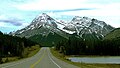 Elliott Peak (left) with Sentinel Mountain

See also
[edit]References
[edit]- 1 2 3 4 "Sentinel Mountain". Bivouac.com. Retrieved 2019-03-14.
- 1 2 3 "Sentinel Mountain". Geographical Names Data Base. Natural Resources Canada. Retrieved 2019-03-14.
- ↑ "Sentinel Mountain". cdnrockiesdatabases.ca. Retrieved 2019-09-13.
- ↑ Belyea, Helen R. (1960). The Story of the Mountains in Banff National Park (PDF). parkscanadahistory.com (Report). Ottawa: Geological Survey of Canada. Archived (PDF) from the original on 2015-10-02. Retrieved 2019-09-13.
- ↑ Gadd, Ben (2008). Geology of the Rocky Mountains and Columbias.
- ↑ Peel, M. C.; Finlayson, B. L.; McMahon, T. A. (2007). "Updated world map of the Köppen−Geiger climate classification". Hydrol. Earth Syst. Sci. 11: 1633–1644. ISSN 1027-5606.
External links
[edit]- Weather forecast: Sentinel Mountain