


Savart

The savart /səˈvɑːr/ is a unit of measurement for musical pitch intervals (ⓘ). One savart is equal to one thousandth of a decade (10/1: 3,986.313714 cents): 3.9863 cents. Musically, in just intonation, the interval of a decade is precisely a just major twenty-fourth, or, in other words, three octaves and a just major third. Today, musical use of the savart has largely been replaced by the cent and the millioctave. The savart is practically the same as the earlier heptameride (eptameride), one seventh of a meride (ⓘ). One tenth of an heptameride is a decameride (ⓘ) and a hundredth of an heptameride (thousandth of a decade) is approximately one jot (ⓘ).
Definition
[edit]If is the ratio of frequencies of a given interval, the corresponding measure in savarts is given by:

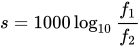
or
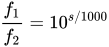
Like the more common cent, the savart is a logarithmic measure, and thus intervals can be added by simply adding their savart values, instead of multiplying them as you would frequencies. The number of savarts in an octave is 1000 times the base-10 logarithm of 2, or nearly 301.03. Sometimes this is rounded to 300, which makes the unit more useful for equal temperament.[1]
Conversion
[edit]The conversion from savarts into cents, millioctaves or millidecades is:


1 savart = 0.001 decade = 1 millidecade[2]
History
[edit]The savart is named after the French physicist and doctor Félix Savart (1791–1841) and is similar to the earlier proposal of the French acoustician Joseph Sauveur (1653–1716). Sauveur proposed the méride, eptaméride (or heptaméride), and decaméride. In English these are meride, heptameride, and decameride respectively. The octave is divided into 43 merides, the meride is divided into seven heptamerides, and the heptameride is divided into ten decamerides. There are thus 43 × 7 = 301 heptamerides in an octave.[3] The attraction of this scheme to Sauveur was that log10(2) is very close to .301, and thus the number of heptamerides in a given ratio is found to a high degree of accuracy from simply its log times 1000. This is equivalent to assuming 1000 heptamerides in a decade rather than 301 in an octave, the same as in the definition of the savart.
The unit was proposed by Auguste Guillemin, who first gave it the name millisavart, in 1902.[4][5]. It was renamed the savart 25 years later.[6]
A disadvantage of this scheme is that there are not an exact number of heptamerides/savarts in an equal tempered semitone. For this reason Alexander Wood used a modified definition of the savart, with 300 savarts in an octave, and hence 25 savarts in a semitone.[7]
A related unit is the jot, of which there are 30103 in an octave, or approximately 100,000 in a decade. The jot is defined in a similar way to the savart, but has a more accurate rounding of log10(2) because more digits are used.[8] There are approximately 100 jots in a savart. The jot was first described by Augustus De Morgan (1806-1871) which he called an atom. The name jot was coined by John Curwen (1816-1880) at the suggestion of Hermann von Helmholtz.[9]
Comparison
[edit]| Name | Steps per octave | Cents | Relative | Interval | Ratio | Audio |
|---|---|---|---|---|---|---|
| Decade | 0.301030 | 3,986.313714 | 1,000 heptamérides | 101/1 | 10.000000 | ⓘ |
| Méride | 43.004285 | 27.904196 | 7 heptamérides | 107/1,000 | 1.016249 | ⓘ |
| Heptaméride | 301.029996 | 3.986314 | 1/1,000 decade, 1/7 méride, 10 decamérides, or 100 jots | 101/1,000 | 1.002305 | ⓘ |
| Demi-heptaméride | 602.059991 | 1.993157 | 1/2 heptaméride | 101/2,000 | 1.001152 | ⓘ |
| Decaméride | 3,010.299957 | 0.398631 | 1/10 heptaméride | 101/10,000 | 1.000230 | ⓘ |
| Jot | 30,103 | 0.0398631 | 1/30,103 octave | 21/30,103 | 1.000023 | ⓘ |
Other uses
[edit]The unit is used for acoustical engineering analysis, especially in underwater acoustics, where it is known as a millidecade.
See also
[edit]
Notes
[edit]- ↑ Huygens-Fokker Foundation. "Logarithmic Interval Measures". Retrieved 2007-06-13.
- ↑ Martin, S. B., Gaudet, B. J., Klinck, H., Dugan, P. J., Miksis-Olds, J. L., Mellinger, D. K., ... & Moors-Murphy, H. (2021). Hybrid millidecade spectra: A practical format for exchange of long-term ambient sound data. JASA Express Letters, 1(1), 011203.
- ↑ Hermann von Helmholtz (1912). On the sensations of tone as a physiological basis for the theory of music, p.437. Longmans, Green.
- ↑ Anonymons, "Notes", Nature. A Weekly Illustrated Journal of Science, vol. LXVI (May-October 1902), p. 398: "In acoustics it is common to measure large intervals of pitch in octaves and smaller ones in “commas”. M. A. Guillemin proposes to adopt instead of these units the savart and the millisavart. By the savart is meant an interval of ten to one, which equals three octaves plus a major third. The millisavart, which is the thousandth part of the savart, represents the interval between two French standard diapasons giving one beat per second".
- ↑ Nicolas Meeùs, "Qu'est-ce qu'un savart ?", Musurgia XXX/4 (2023), pp. 35-50.
- ↑ Étienne Souriau, "L’Algorithme musical", Revue philosophique de la France et de l’Étranger 104 (1927), p. 229.
- ↑ Alexander Wood, The Physics of Music, pages 53-54, Read Books, 2007 ISBN 140674493X (first published Methuen, 1944 OCLC 220112916.
- ↑ Joe Monzo, "Heptaméride" and "Jot", Tonalsoft Encyclopedia of Microtonal Music Theory, retrieved and archived 11 October 2012.
- ↑ Hermann von Helmholtz, (trans. A. J. Ellis), On the Sensations of Tone as a Physiological Basis for the Theory of Music, page 654, Longmans, 1875 OCLC 8101251.
| Twelve- semitone (post-Bach Western) |
| ||||||||||||||
|---|---|---|---|---|---|---|---|---|---|---|---|---|---|---|---|
| Other tuning systems |
| ||||||||||||||
| Other intervals |
| ||||||||||||||
