


// Workers AI · dad joke modeWhat did SAIFI say to the power outage? You're always failing me.
The System Average Interruption Frequency Index (SAIFI) is commonly used as a reliability index by electric power utilities. This index measures the average number of times that a system customer experiences an outage during the year or during a given time period.[1]
SAIFI is normally calculated on either yearly or monthly basis. SAIFI is calculated as:
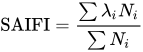
where is the failure rate and is the number of customers for location . In other words,



Many factors cause power interruptions, including weather, vegetation patterns, and utility practices. Utilities can report interruption duration values with major events (such as snowstorms or hurricanes), without major events, or both.[2]
SAIFI is measured in units of interruptions per customer.
According to IEEE Standard 1366-1998 the median value for North American utilities is approximately 1.10 interruptions per customer.[failed verification]
References
[edit]- ↑ Layton, Lee (2004). "Electric System Reliability Indices" (PDF). www.egr.unlv.edu.
- ↑ "U.S. Power Customers Experienced an Average of Nearly Five Hours of Interruptions in 2019". US Energy Information Administration. 2020-11-06. Retrieved 2025-01-30.
Sources
[edit]- IEEE Guide for Electric Power Distribution Reliability Indices, IEEE 1366, 2012, doi:10.1109/IEEESTD.2012.6209381, ISBN 978-0-7381-7275-0