


Rule of replacement
In logic, a rule of replacement[1][2][3] is a transformation rule that may be applied to only a particular segment of an expression. A logical system may be constructed so that it uses either axioms, rules of inference, or both as transformation rules for logical expressions in the system. Whereas a rule of inference is always applied to a whole logical expression, a rule of replacement may be applied to only a particular segment. Within the context of a logical proof, logically equivalent expressions may replace each other. Rules of replacement are used in propositional logic to manipulate propositions.
Common rules of replacement include de Morgan's laws, commutation, association, distribution, double negation,[a] transposition, material implication, logical equivalence, exportation, and tautology.
Table: Rules of Replacement
[edit]The rules above can be summed up in the following table.[4] The "Tautology" column shows how to interpret the notation of a given rule.
| Rules of inference | Tautology | Name |
|---|---|---|
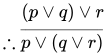
| Associative | ||
| Commutative | ||
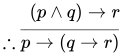
| Exportation | ||
| Transposition or contraposition law | ||
| Material implication | ||
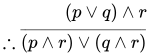
| Distributive | ||
| Conjunction | ||
| Double negation introduction | ||
| Double negation elimination |













See also
[edit]Notes
[edit]- ↑ not admitted in intuitionistic logic
References
[edit]- ↑ Copi, Irving M.; Cohen, Carl (2005). Introduction to Logic. Prentice Hall.
- ↑ Hurley, Patrick (1991). A Concise Introduction to Logic 4th edition. Wadsworth Publishing. ISBN 9780534145156.
- ↑ Moore and Parker [full citation needed]
- ↑ Kenneth H. Rosen: Discrete Mathematics and its Applications, Fifth Edition, p. 58.
 | This logic-related article is a stub. You can help Wikipedia by adding missing information. |