// Workers AI · traducción al español
Funciones redondas
En topología y en cálculo, una función redonda es una función escalar, sobre un múltiplo, cuyos puntos críticos forman uno o varios componentes conectados, cada uno homeomórfico al círculo, también llamado loop crítico.
Traducción generada por IA. El artículo original en inglés continúa abajo.
// Workers AI · dad joke mode What did the round function say? I circle back.
From Wikipedia, the free encyclopedia
For example, let
M
{\displaystyle M}
be the torus . Let
K
=
(
0
,
2
π
)
×
(
0
,
2
π
)
.
{\displaystyle K=(0,2\pi )\times (0,2\pi ).\,}
Then we know that a map
X
:
K
→
R
3
{\displaystyle X\colon K\to {\mathbb {R} }^{3}\,}
given by
X
(
θ
,
ϕ
)
=
(
(
2
+
cos
θ
)
cos
ϕ
,
(
2
+
cos
θ
)
sin
ϕ
,
sin
θ
)
{\displaystyle X(\theta ,\phi )=((2+\cos \theta )\cos \phi ,(2+\cos \theta )\sin \phi ,\sin \theta )\,}
is a parametrization for almost all of
M
{\displaystyle M}
. Now, via the projection
π
3
:
R
3
→
R
{\displaystyle \pi _{3}\colon {\mathbb {R} }^{3}\to {\mathbb {R} }}
we get the restriction
G
=
π
3
|
M
:
M
→
R
,
(
θ
,
ϕ
)
↦
sin
θ
{\displaystyle G=\pi _{3}|_{M}\colon M\to {\mathbb {R} },(\theta ,\phi )\mapsto \sin \theta \,}
G
=
G
(
θ
,
ϕ
)
=
sin
θ
{\displaystyle G=G(\theta ,\phi )=\sin \theta }
is a function whose critical sets are determined by

g
r
a
d
G
(
θ
,
ϕ
)
=
(
∂
G
∂
θ
,
∂
G
∂
ϕ
)
(
θ
,
ϕ
)
=
(
0
,
0
)
,
{\displaystyle {\rm {grad}}\ G(\theta ,\phi )=\left({{\partial }G \over {\partial }\theta },{{\partial }G \over {\partial }\phi }\right)\!\left(\theta ,\phi \right)=(0,0),\,}
this is if and only if
θ
=
π
2
,
3
π
2
{\displaystyle \theta ={\pi \over 2},\ {3\pi \over 2}}
.
These two values for
θ
{\displaystyle \theta }
give the critical sets
X
(
π
/
2
,
ϕ
)
=
(
2
cos
ϕ
,
2
sin
ϕ
,
1
)
{\displaystyle X({\pi /2},\phi )=(2\cos \phi ,2\sin \phi ,1)\,}
X
(
3
π
/
2
,
ϕ
)
=
(
2
cos
ϕ
,
2
sin
ϕ
,
−
1
)
{\displaystyle X({3\pi /2},\phi )=(2\cos \phi ,2\sin \phi ,-1)\,}
which represent two extremal circles over the torus
M
{\displaystyle M}
.
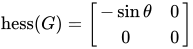
Observe that the Hessian for this function is
h
e
s
s
(
G
)
=
[
−
sin
θ
0
0
0
]
{\displaystyle {\rm {hess}}(G)={\begin{bmatrix}-\sin \theta &0\\0&0\end{bmatrix}}}
which clearly it reveals itself as rank of
h
e
s
s
(
G
)
{\displaystyle {\rm {hess}}(G)}
equal to one
at the tagged circles, making the critical point degenerate, that is, showing that the critical points are not isolated.
Mimicking the L–S category theory one can define the round complexity asking for whether or not exist round functions on manifolds and/or for the minimum number of critical loops.
Siersma and Khimshiasvili, On minimal round functions , Preprint 1118, Department of Mathematics, Utrecht University, 1999, pp. 18. . An update at





