Cloudflare fetched the original article and streamed it through HTMLRewriter to apply an entirely new visual system without rebuilding the source page.
// request.cf · coarse context
A page that knows where it met you.
Only coarse request metadata is shown. This demo does not display or persist visitor IP addresses.
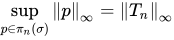
The R.i., combined with an estimate on Chebyshev polynomials, implies the following corollary: If J⊂R is a finite interval, and E⊂J is an arbitrary measurable set, then
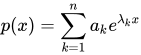
be an exponential sum (with arbitrary λk∈C), and let J⊂R be a finite interval, E⊂J—an arbitrary measurable set. Then
where C > 0 is a numerical constant.
In the special case when λk are pure imaginary and integer, and the subset E is itself an interval, the inequality was proved by Pál Turán and is known as Turán's lemma.
This inequality also extends to in the following way
for some A > 0 independent of p, E, and n. When
a similar inequality holds for p > 2. For p = ∞ there is an extension to multidimensional polynomials.
One of the corollaries of the Remez inequality is the Pólya inequality, which was proved by George Pólya(Pólya 1928), and states that the Lebesgue measure of a sub-level set of a polynomial p of degree n is bounded in terms of the leading coefficient LC(p) as follows:
Remez, E. J. (1936). "Sur une propriété des polynômes de Tchebyscheff". Comm. Inst. Sci. Kharkow. 13: 93–95.
Bojanov, B. (May 1993). "Elementary Proof of the Remez Inequality". The American Mathematical Monthly. 100 (5). Mathematical Association of America: 483–485. doi:10.2307/2324304. JSTOR2324304.
Nazarov, F. (1993). "Local estimates for exponential polynomials and their applications to inequalities of the uncertainty principle type". Algebra i Analiz. 5 (4): 3–66.


![{\displaystyle [1,+\infty ]}](https://wikimedia.org/api/rest_v1/media/math/render/svg/e753c04c83a9874ecd5cd798b95b3b1e720e8c60)







![{\displaystyle {\begin{aligned}\int _{x\in E}|p(x)|^{p}\,{\mbox{d}}x&\geq \int _{x\in E\setminus E_{\lambda }}|p(x)|^{p}\,{\mbox{d}}x\\[6pt]&\geq \lambda ^{p}{\frac {1}{2}}\operatorname {mes} E\\[6pt]&={\frac {1}{2}}\operatorname {mes} E\left({\frac {\operatorname {mes} E}{2C\operatorname {mes} J}}\right)^{p(n-1)}e^{-p\max _{k}|\Re \lambda _{k}|\,\operatorname {mes} J}\max _{x\in J}|p(x)|^{p}\\[6pt]&\geq {\frac {1}{2}}{\frac {\operatorname {mes} E}{\operatorname {mes} J}}\left({\frac {\operatorname {mes} E}{2C\operatorname {mes} J}}\right)^{p(n-1)}e^{-p\max _{k}|\Re \lambda _{k}|\,\operatorname {mes} J}\int _{x\in J}|p(x)|^{p}\,{\mbox{d}}x,\end{aligned}}}](https://wikimedia.org/api/rest_v1/media/math/render/svg/7b625887647f3cf3d9dbe274b21ebdfc2c431369)
