


Rational dependence
In mathematics, a collection of real numbers is rationally independent if none of them can be written as a linear combination of the other numbers in the collection with rational coefficients. A collection of numbers which is not rationally independent is called rationally dependent. For instance we have the following example.
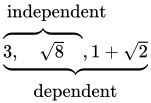
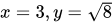
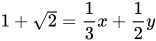
Because if we let , then .
Formal definition
[edit]The real numbers ω1, ω2, ... , ωn are said to be rationally dependent if there exist integers k1, k2, ... , kn, not all of which are zero, such that

If such integers do not exist, then the vectors are said to be rationally independent. This condition can be reformulated as follows: ω1, ω2, ... , ωn are rationally independent if the only n-tuple of integers k1, k2, ... , kn such that

is the trivial solution in which every ki is zero.
The real numbers form a vector space over the rational numbers, and this is equivalent to the usual definition of linear independence in this vector space.
See also
[edit]Bibliography
[edit]- Anatole Katok and Boris Hasselblatt (1996). Introduction to the modern theory of dynamical systems. Cambridge. ISBN 0-521-57557-5.