


Quotient

| Arithmetic operations | ||||||||||||||||||||||||||||||||||||||||||
|
||||||||||||||||||||||||||||||||||||||||||
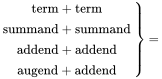

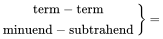

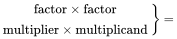

![{\displaystyle \scriptstyle \left.{\begin{matrix}\scriptstyle {\frac {\scriptstyle {\text{dividend}}}{\scriptstyle {\text{divisor}}}}\\[1ex]\scriptstyle {\frac {\scriptstyle {\text{numerator}}}{\scriptstyle {\text{denominator}}}}\end{matrix}}\right\}\,=\,}](https://wikimedia.org/api/rest_v1/media/math/render/svg/5d5d22ff59234f0d437be740306e8dd905991e1e)


![{\displaystyle \scriptstyle {\sqrt[{\text{degree}}]{\scriptstyle {\text{radicand}}}}\,=\,}](https://wikimedia.org/api/rest_v1/media/math/render/svg/5582d567e7e7fbcdb728291770905e09beb0ea18)



In arithmetic, a quotient (from Latin: quotiens 'how many times', pronounced /ˈkwoʊʃənt/) is a quantity produced by the division of two numbers.[1] The quotient has widespread use throughout mathematics. It has two definitions: either the integer part of a division (in the case of Euclidean division)[2] or a fraction or ratio (in the case of a general division). For example, when dividing 20 (the dividend) by 3 (the divisor), the quotient is 6 (with a remainder of 2) in the first sense and (a repeating decimal) in the second sense.

Unit of measurement
[edit]In metrology (International System of Quantities and the International System of Units), "quotient" refers to the general case with respect to the units of measurement of physical quantities.[3][4] [5] Ratios is the special case for dimensionless quotients of two quantities of the same kind.[3][6] Quotients with a non-trivial dimension and compound units, especially when the divisor is a duration (e.g., "per second"), are known as rates.[7] For example, density (mass divided by volume, in units of kg/m3) is said to be a "quotient", whereas mass fraction (mass divided by mass, in kg/kg or in percent) is a "ratio".[8] Specific quantities are intensive quantities resulting from the quotient of a physical quantity by mass, volume, or other measures of the system "size".[3]
Notation
[edit]The quotient is most frequently encountered as two numbers, or two variables, divided by a horizontal line. The words "dividend" and "divisor" refer to each individual part, while the word "quotient" refers to the whole.

Integer part definition
[edit]The quotient is also less commonly defined as the greatest whole number of times a divisor may be subtracted from a dividend—before making the remainder negative. For example, the divisor 3 may be subtracted up to 6 times from the dividend 20, before the remainder becomes negative:
- 20 − 3 − 3 − 3 − 3 − 3 − 3 ≥ 0,
while
- 20 − 3 − 3 − 3 − 3 − 3 − 3 − 3 < 0.
In this sense, a quotient is the integer part of the ratio of two numbers.[9]
Quotient of two integers
[edit]A rational number can be defined as the quotient of two integers (as long as the denominator is non-zero).
A more detailed definition goes as follows:[10]
- A real number r is rational, if and only if it can be expressed as a quotient of two integers with a nonzero denominator. A real number that is not rational is irrational.
Or more formally:
- Given a real number r, r is rational if and only if there exists integers a and b such that and .


The existence of irrational numbers—numbers that are not a quotient of two integers—was first discovered in geometry, in such things as the ratio of the diagonal to the side in a square.[11]
More general quotients
[edit]Outside of arithmetic, many branches of mathematics have borrowed the word "quotient" to describe structures built by breaking larger structures into pieces. Given a set with an equivalence relation defined on it, a "quotient set" may be created which contains those equivalence classes as elements. A quotient group may be formed by breaking a group into a number of similar cosets, while a quotient space may be formed in a similar process by breaking a vector space into a number of similar linear subspaces.
See also
[edit]References
[edit]- ↑ "Quotient". Dictionary.com.
- ↑ Weisstein, Eric W. "Integer Division". mathworld.wolfram.com. Retrieved 2020-08-27.
- 1 2 3 "ISO 80000-1:2022(en) Quantities and units — Part 1: General". iso.org. Retrieved 2023-07-23.
- ↑ James, R. C. (1992-07-31). Mathematics Dictionary. Springer Science & Business Media. ISBN 978-0-412-99041-0.
- ↑ "IEC 60050 - Details for IEV number 102-01-22: "quotient"". International Electrotechnical Vocabulary (in Japanese). Retrieved 2023-09-13.
- ↑ "IEC 60050 - Details for IEV number 102-01-23: "ratio"". International Electrotechnical Vocabulary (in Japanese). Retrieved 2023-09-13.
- ↑ "IEC 60050 - Details for IEV number 112-03-18: "rate"". International Electrotechnical Vocabulary (in Japanese). Retrieved 2023-09-13.
- ↑ Thompson, A.; Taylor, B. N. (March 4, 2020). "NIST Guide to the SI, Chapter 7: Rules and Style Conventions for Expressing Values of Quantities". Special Publication 811 | The NIST Guide for the use of the International System of Units. National Institute of Standards and Technology. Retrieved October 25, 2021.
- ↑ Weisstein, Eric W. "Quotient". MathWorld.
- ↑ Epp, Susanna S. (2011-01-01). Discrete mathematics with applications. Brooks/Cole. p. 163. ISBN 9780495391326. OCLC 970542319.
- ↑ "Irrationality of the square root of 2". www.math.utah.edu. Archived from the original on 2023-06-05. Retrieved 2020-08-27.
External links
[edit] Media related to Quotients at Wikimedia Commons

 | Division and ratio |  | |
|---|---|---|---|
| Fraction |
| ||
| International | |
|---|---|
| Other | |
