


Quantum fluid
A quantum fluid refers to any system that exhibits quantum mechanical effects at the macroscopic level: such as superfluids, superconductors, and ultracold atoms. Typically, quantum fluids occur in situations where both quantum mechanical effects and quantum statistical effects are significant.
Most matter is either solid or gaseous (at low densities) near absolute zero. However, for both isotopes of helium, helium-4 and helium-3, there is a pressure range within which they can remain liquid down to absolute zero, because the wavelengths of the quantum fluctuations within the helium atoms are larger than the inter-atomic distances.
In the case of solid quantum fluids, it is only a fraction of its electrons or protons that behave like a "fluid". One prominent example is superconductivity, where quasi-particles made up of pairs of electrons and a phonon act as bosons. As these are not subject to the Pauli exclusion principle, they can collapse into the ground state, and thus establish a supercurrent with a resistivity near zero.
Derivation
[edit]Quantum mechanical effects become significant for physics in the range of the de Broglie wavelength. For condensed matter, this is when the de Broglie wavelength of a particle is greater than the spacing between the particles in the lattice that comprises the matter. The de Broglie wavelength associated with a massive particle is

where h is the Planck constant. The momentum can be found from the kinetic theory of gases, where

Here, the temperature can be found as

Of course, we can replace the momentum here with the momentum derived from the de Broglie wavelength like so:
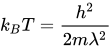
Hence, we can say that quantum fluids will manifest at approximate temperature regions where , where d is the lattice spacing (or inter-particle spacing). Mathematically, this is stated like so:

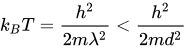
It is easy to see how the above definition relates to the particle density, n. We can write
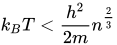
as for a three dimensional lattice

The above temperature limit has different meaning depending on the quantum statistics followed by each system, but generally refers to the point at which the system manifests quantum fluid properties. For a system of fermions, is an estimation of the Fermi energy of the system, where processes important to phenomena such as superconductivity take place. For bosons, gives an estimation of the Bose-Einstein condensation temperature.

New technology for quantum fluids
[edit]In recent years, there has been a significant surge in the adoption of advanced technological tools and methodologies in the investigation of quantum fluids, particularly in their preparation and characterization. Among these innovations is the employment of sophisticated simulation techniques, such as Multiphase Computational Fluid Dynamics (CFD) modeling. This approach enables scientists to perform comprehensive analyses of superfluid behaviors and other quantum fluid phenomena, capturing intricate fluid dynamics at the quantum level that were previously inaccessible through traditional experimental methods.[1][2]
Furthermore, the integration of artificial intelligence (AI) and machine learning algorithms into research workflows has opened new horizons for understanding quantum fluids. These AI-driven techniques facilitate more accurate predictions of fluid properties, enhance data analysis capabilities, and optimize experimental design and procedures. By automating data processing and uncovering patterns in large datasets, AI tools can accelerate discovery and provide insights into the underlying physics of quantum fluids.[3]
these technological developments have advanced the understanding of the properties of quantum fluids also furthering the development of new applications across various fields, such as quantum computing and cryogenics, materials science and energy storage. Physics Informed Neural Networks (PINNs) are proven useful in simulating quantum fluids. [4][3]
See also
[edit]References
[edit]- ↑ Subah, S.; Billah, M. M.; Uddin, M. N.; Hoque, K. E. (September 2025). "Multiphase CFD modeling of alumina nanoparticle drug delivery in bifurcated coronary arteries with stenosis, aneurysm, and bypass conditions". International Journal of Thermofluids. 29 101367. Bibcode:2025IJTf...2901367S. doi:10.1016/j.ijft.2025.101367.
- ↑ Holmlid, Leif; Kotzias, Bernhard (2016-04-01). "Phase transition temperatures of 405-725 K in superfluid ultra-dense hydrogen clusters on metal surfaces". AIP Advances. 6 (4) 045111. Bibcode:2016AIPA....6d5111H. doi:10.1063/1.4947276. ISSN 2158-3226.
- 1 2 Al-Raeei, Marwan (September 2026). "Unlocking quantum fluids by the transformative power of artificial intelligence". International Journal of Thermofluids. 35 101689. doi:10.1016/j.ijft.2026.101689.
- ↑ Li, Linying; Zhang, Lanqi; Zhang, Bin; Liu, Hong; Zheng, Zhonghua (May 2023). "A review of uncertainty quantification and its applications in numerical simulation of scramjet combustor". International Journal of Thermofluids. 18 100351. Bibcode:2023IJTf...1800351L. doi:10.1016/j.ijft.2023.100351.
- Lerner, Rita G.; Trigg, George L. (1990). Encyclopedia of Physics. VHC Publishers. ISBN 0-89573-752-3.