


// Workers AI · dad joke modeWhat did quantum fingerprinting say to its date? You've got a print on me.
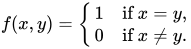
Quantum fingerprinting is a proposed technique that uses a quantum computer to generate a string with a similar function to the cryptographic hash function. Alice and Bob hold -bit strings and . Their goal and a referee's is to obtain the correct value of . To do this, quantum states are produced from the O(logn)-qubit state fingerprints and sent to the referee who performs the Swap test to detect if the fingerprints are similar or different with a high probability.[1]



If unconditional guarantees of security are needed, and if it is impractical for the communicating parties to arrange to share a secret that can be used in a Carter–Wegman MAC, this technique might one day be faster than classical techniques given a quantum computer with 5 to 10 qubits. However, these circumstances are very unusual and it is unlikely the technique will ever have a practical application; it is largely of theoretical interest.
See also
[edit]References
[edit]- ↑
Harry Buhrman, Richard Cleve, John Watrous, Ronald de Wolf (2001). "Quantum Fingerprinting". Physical Review Letters. 87 (16) 167902. arXiv:quant-ph/0102001. Bibcode:2001PhRvL..87p7902B. doi:10.1103/PhysRevLett.87.167902. PMID 11690244. S2CID 1096490.
{{cite journal}}: CS1 maint: multiple names: authors list (link)