


Quadratic integrate and fire
 | This article needs more citations. (March 2023) |
The quadratic integrate and fire (QIF) model is a biological neuron model that describes action potentials in neurons. In contrast to physiologically accurate but computationally expensive neuron models like the Hodgkin–Huxley model, the QIF model seeks only to produce action potential-like patterns by ignoring the dynamics of transmembrane currents and ion channels. Thus, the QIF model is computationally efficient and has found ubiquitous use in computational neuroscience.[1] The QIF model is related to the Ermentrout–Kopell canonical "theta" model via a change of variables.
An idealized model of neural spiking is given by the autonomous differential equation,
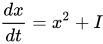
where represents the membrane voltage and represents an input current. A solution to this differential equation is the function,[2]



where is an arbitrary shift dependent on the initial condition (specifically by the formula ). This solution "blows up" in finite time, namely at for all , which resembles the rhythmic action potentials generated by neurons stimulated by some input current. Thus a "spike" is said to have occurred when the solution reaches positive infinity. Just after this point in time, the solution resets to negative infinity by definition.





When implementing this model in a numerical simulation, a threshold crossing value () and a reset value () is assigned, so that when the solution rises above the threshold, , the solution is immediately reset to .


The above equation is directly related to an alternative form of the QIF model,
- ,
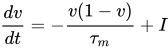
where is the membrane time constant.

References
[edit]- ↑ Fourcaud-Trocmé, Nicolas (2013), "Integrate and Fire Models, Deterministic", in Jaeger, Dieter; Jung, Ranu (eds.), Encyclopedia of Computational Neuroscience, New York, NY: Springer, pp. 1–9, doi:10.1007/978-1-4614-7320-6_148-1, ISBN 978-1-4614-7320-6, retrieved 2023-03-01
- ↑ Ermentrout, Bard; Terman, David (July 1, 2010). Mathematical Foundations of Neuroscience (1 ed.). Springer. doi:10.1007/978-0-387-87708-2. ISBN 978-0-387-87708-2.
 | This applied mathematics–related article is a stub. You can help Wikipedia by adding missing information. |
_artificial_intelligence_icon.png) | This computational neuroscience-related article is a stub. You can help Wikipedia by adding missing information. |