


q-difference polynomial
In combinatorial mathematics, the q-difference polynomials or q-harmonic polynomials are a polynomial sequence defined in terms of the q-derivative. They are a generalized type of Brenke polynomial, and generalize the Appell polynomials. See also Sheffer sequence.
Definition
[edit]The q-difference polynomials satisfy the relation
![{\displaystyle \left({\frac {d}{dz}}\right)_{q}p_{n}(z)={\frac {p_{n}(qz)-p_{n}(z)}{qz-z}}={\frac {q^{n}-1}{q-1}}p_{n-1}(z)=[n]_{q}p_{n-1}(z)}](https://wikimedia.org/api/rest_v1/media/math/render/svg/b2ca72d545aa327046b9836678ce2bb9420de189)
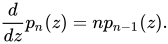
where the derivative symbol on the left is the q-derivative. In the limit of , this becomes the definition of the Appell polynomials:

Generating function
[edit]The generalized generating function for these polynomials is of the type of generating function for Brenke polynomials, namely
![{\displaystyle A(w)e_{q}(zw)=\sum _{n=0}^{\infty }{\frac {p_{n}(z)}{[n]_{q}!}}w^{n}}](https://wikimedia.org/api/rest_v1/media/math/render/svg/869892467086125cb8fab773825bdbeae97ad90e)
where is the q-exponential:

![{\displaystyle e_{q}(t)=\sum _{n=0}^{\infty }{\frac {t^{n}}{[n]_{q}!}}=\sum _{n=0}^{\infty }{\frac {t^{n}(1-q)^{n}}{(q;q)_{n}}}.}](https://wikimedia.org/api/rest_v1/media/math/render/svg/09d9d40b149c5438ae0730aa3ff72930db4be582)
Here, is the q-factorial and
![{\displaystyle [n]_{q}!}](https://wikimedia.org/api/rest_v1/media/math/render/svg/265dcf73f45dc7d6cff172fe6b6d0f457f1c107f)

is the q-Pochhammer symbol. The function is arbitrary but assumed to have an expansion

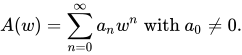
Any such gives a sequence of q-difference polynomials.
References
[edit]- A. Sharma and A. M. Chak, "The basic analogue of a class of polynomials", Riv. Mat. Univ. Parma, 5 (1954) 325–337.
- Ralph P. Boas, Jr. and R. Creighton Buck, Polynomial Expansions of Analytic Functions (Second Printing Corrected), (1964) Academic Press Inc., Publishers New York, Springer-Verlag, Berlin. Library of Congress Card Number 63-23263. (Provides a very brief discussion of convergence.)