


Pure shear
In mechanics and geology, pure shear is a three-dimensional homogeneous flattening of a body.[1] It is an example of irrotational strain in which body is elongated in one direction while being shortened perpendicularly. For soft materials, such as rubber, a strain state of pure shear is often used for characterizing hyperelastic and fracture mechanical behaviour.[2] Pure shear is differentiated from simple shear in that pure shear involves no rigid body rotation.[3][4]
The deformation gradient for pure shear is given by:
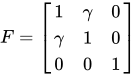
Note that this gives a Green-Lagrange strain of:
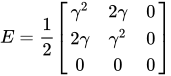
Here there is no rotation occurring, which can be seen from the equal off-diagonal components of the strain tensor. The linear approximation to the Green-Lagrange strain shows that the small strain tensor is:
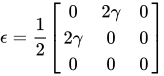
which has only shearing components.
For the aforementioned deformation gradient, the eigenvalues of the right Cauchy-Green deformation tensor (, see Finite strain theory) are and . The volume change is given as , which is not unity. In literature, a volume preserving formulation for is used to denote pure shear in large deformation[5]. This is written in the principal coordinate frame as:


where is the principal stretch.

See also
[edit]References
[edit]- ↑ Reish, Nathaniel E.; Gary H. Girty. "Definition and Mathematics of Pure Shear". San Diego State University Department of Geological Sciences. Retrieved 24 December 2011.
- ↑ Yeoh, O. H. (2001). "Analysis of deformation and fracture of 'pure shear'rubber testpiece". Plastics, Rubber and Composites. 30 (8): 389–397. Bibcode:2001PRC....30..389Y. doi:10.1179/146580101101541787. S2CID 136628719.
- ↑ "Where do the Pure and Shear come from in the Pure Shear test?" (PDF). Retrieved 1 April 2026.
- ↑ "Comparing Simple Shear and Pure Shear" (PDF). Retrieved 12 April 2013.
- ↑ Thiel, Christian; Voss, Jendrik; Martin, Robert J.; Neff, Patrizio (1 June 2019). "Shear, pure and simple". International Journal of Non-Linear Mechanics. 112: 57–72. arXiv:1806.07749. doi:10.1016/j.ijnonlinmec.2018.10.002. ISSN 0020-7462.

 | This classical mechanics–related article is a stub. You can help Wikipedia by adding missing information. |
 | This geology article is a stub. You can help Wikipedia by adding missing information. |