


Progressive function
 | This article needs more citations. (February 2024) |
In mathematics, a progressive function ƒ ∈ L2(R) is a function whose Fourier transform is supported by positive frequencies only:[1]
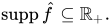
It is called super regressive if and only if the time reversed function f(−t) is progressive, or equivalently, if
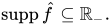
The complex conjugate of a progressive function is regressive, and vice versa.
The space of progressive functions is sometimes denoted , which is known as the Hardy space of the upper half-plane. This is because a progressive function has the Fourier inversion formula

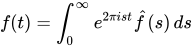
and hence extends to a holomorphic function on the upper half-plane

by the formula

Conversely, every holomorphic function on the upper half-plane which is uniformly square-integrable on every horizontal line will arise in this manner.
Regressive functions are similarly associated with the Hardy space on the lower half-plane .

References
[edit]- ↑ Klees, Roland; Haagmans, Roger (6 March 2000). Wavelets in the Geosciences. Springer Science & Business Media. ISBN 978-3-540-66951-7.
This article incorporates material from progressive function on PlanetMath, which is licensed under the Creative Commons Attribution/Share-Alike License.