


Preparata code
In coding theory, the Preparata codes form a class of non-linear double-error-correcting codes. They are named after Franco P. Preparata who first described them in 1968.
Although non-linear over GF(2) the Preparata codes are linear over Z4 with the Lee distance.
Construction
[edit]Let m be an odd number, and . We first describe the extended Preparata code of length : the Preparata code is then derived by deleting one position. The words of the extended code are regarded as pairs (X, Y) of 2m-tuples, each corresponding to subsets of the finite field GF(2m) in some fixed way.


The extended code contains the words (X, Y) satisfying three conditions
- X, Y each have even weight;
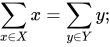
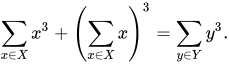
The Preparata code is obtained by deleting the position in X corresponding to 0 in GF(2m).
Properties
[edit]The Preparata code is of length 2m+1 − 1, size 2k where k = 2m + 1 − 2m − 2, and minimum distance 5.
When m = 3, the Preparata code of length 15 is also called the Nordstrom–Robinson code.
References
[edit]- F.P. Preparata (1968). "A class of optimum nonlinear double-error-correcting codes". Information and Control. 13 (4): 378–400. doi:10.1016/S0019-9958(68)90874-7. hdl:2142/74662.
- J.H. van Lint (1992). Introduction to Coding Theory. GTM. Vol. 86 (2nd ed.). Springer-Verlag. pp. 111–113. ISBN 3-540-54894-7.
- http://www.encyclopediaofmath.org/index.php/Preparata_code
- http://www.encyclopediaofmath.org/index.php/Kerdock_and_Preparata_codes