


Power-bounded element
 | This article has multiple issues. Please help improve it or discuss these issues on the talk page. (Learn how and when to remove these messages)
|


A power-bounded element is an element of a topological ring whose powers are bounded. These elements are used in the theory of adic spaces.
Definition
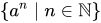
[edit]Let be a topological ring. A subset is called bounded, if, for every neighbourhood of zero, there exists an open neighbourhood of zero such that holds. An element is called power-bounded, if the set is bounded.[1]




Examples
[edit]- An element is power-bounded if and only if .
- More generally, if is a topological commutative ring whose topology is induced by an absolute value, then an element is power-bounded if and only if holds. If the absolute value is non-Archimedean, the power-bounded elements form a subring (a valuation ring), denoted by . This follows from the ultrametric inequality.
- The ring of power-bounded elements in , the p-adic numbers, is .
- Every topologically nilpotent element is power-bounded.[2]


Literature
[edit]- Morel: Adic spaces
- Wedhorn: Adic spaces