


Portal:Electronics/Selected article/2
Joule's laws are a set of two laws concerning the heat produced by a current and the energy dependence of an ideal gas to that of pressure, volume, and temperature, respecetively. Joule's first law, also known as the Joule effect, is a physical law expressing the relationship between the heat generated by the current flowing through a conductor. The heating effect of conductors carrying currents is known as Joule heating, named for James Prescott Joule. It is expressed as:
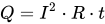
Where Q is the heat generated by a constant current I flowing through a conductor of electrical resistance R, for a time t.
Joule's second law states that the internal energy of an ideal gas is independent of its volume and pressure, depending only its temperature.