


Poisson limit theorem

In probability theory, the law of rare events or Poisson limit theorem states that the Poisson distribution may be used as an approximation to the binomial distribution, under certain conditions.[1] The theorem was named after Siméon Denis Poisson (1781–1840). A generalization of this theorem is Le Cam's theorem.
Theorem
[edit]Let be a sequence of real numbers in such that the sequence converges to a finite limit . Then:

![{\displaystyle [0,1]}](https://wikimedia.org/api/rest_v1/media/math/render/svg/738f7d23bb2d9642bab520020873cccbef49768d)



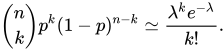
First proof
[edit]Assume (the case is easier). Then



Since

this leaves
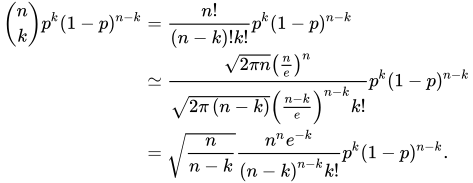
Alternative proof
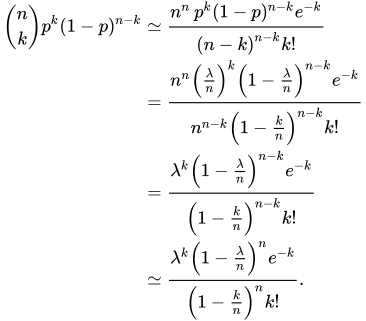
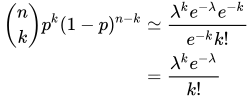
[edit]Using Stirling's approximation, it can be written:
Letting and :


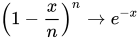
As , so:
Ordinary generating functions
[edit]It is also possible to demonstrate the theorem through the use of ordinary generating functions of the binomial distribution:
![{\displaystyle G_{\operatorname {bin} }(x;p,N)\equiv \sum _{k=0}^{N}\left[{\binom {N}{k}}p^{k}(1-p)^{N-k}\right]x^{k}={\Big [}1+(x-1)p{\Big ]}^{N}}](https://wikimedia.org/api/rest_v1/media/math/render/svg/84f0051a42e4b4e3ad464aa8519f814360e3697c)
by virtue of the binomial theorem. Taking the limit while keeping the product constant, it can be seen:


![{\displaystyle \lim _{N\rightarrow \infty }G_{\operatorname {bin} }(x;p,N)=\lim _{N\rightarrow \infty }\left[1+{\frac {\lambda (x-1)}{N}}\right]^{N}=\mathrm {e} ^{\lambda (x-1)}=\sum _{k=0}^{\infty }\left[{\frac {\mathrm {e} ^{-\lambda }\lambda ^{k}}{k!}}\right]x^{k}}](https://wikimedia.org/api/rest_v1/media/math/render/svg/20230fc7a78091820f40495f377f27f4e36bb848)
which is the OGF for the Poisson distribution. (The second equality holds due to the definition of the exponential function.)
See also
[edit]References
[edit]- ↑ Papoulis, Athanasios; Pillai, S. Unnikrishna. Probability, Random Variables, and Stochastic Processes (4th ed.).