Cloudflare fetched the original article and streamed it through HTMLRewriter to apply an entirely new visual system without rebuilding the source page.
// request.cf · coarse context
A page that knows where it met you.
Only coarse request metadata is shown. This demo does not display or persist visitor IP addresses.
The curved point-normal triangle, in short PN triangle, is an interpolation algorithm to retrieve a cubic Bézier triangle from the vertex coordinates of a triangle (under the usual polygon definition of a triangle) and normal vectors. The PN triangle retains the vertices of the original triangle as well as the corresponding normals. For computer graphics applications, additionally a linear or quadratic interpolant of the normals is created to represent an incorrect but plausible normal when rendering and so giving the impression of smooth transitions between adjacent PN triangles.[1] The usage of the PN triangle enables the visualization of triangle based surfaces in a smoother shape at low cost in terms of rendering complexity and time.
With information of the given vertex positions of a triangle and the according normal vectors at the vertices a cubic Bézier triangle is constructed. Following the notation and nomenclature of G. Farin (2002),[2] one denotes the 10 control points as with the positive indices holding the condition .
The first three control points are equal to the given vertices. Six control points related to the triangle edges, i.e. are computed asThis definition ensures that the original vertex normals are reproduced in the interpolated triangle.
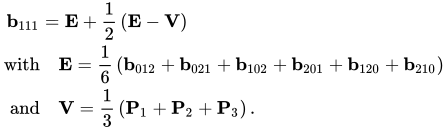
Finally the internal control point is derived from the previously calculated control points as
An alternative interior control point
was suggested in Kato (2002).[3]
↑Farin, Gerald E. (2002). Curves and surfaces for CAGD: a practical guide (5thed.). San Francisco, CA: Morgan Kaufmann. ISBN9780080503547. OCLC181100270.