


Peano kernel theorem
In numerical analysis, the Peano kernel theorem is a general result on error bounds for a wide class of numerical approximations (such as numerical quadratures), defined in terms of linear functionals. It is attributed to Giuseppe Peano.[1]
Statement
[edit]Let be the space of all functions that are differentiable on that are of bounded variation on , and let be a linear functional on . Assume that that annihilates all polynomials of degree , i.e.Suppose further that for any bivariate function with , the following is valid:and define the Peano kernel of asusing the notationThe Peano kernel theorem[1][2] states that, if , then for every function that is times continuously differentiable, we have
![{\displaystyle {\mathcal {V}}[a,b]}](https://wikimedia.org/api/rest_v1/media/math/render/svg/fb6525110708dccb30881fc6f570e52533ceb424)


![{\displaystyle [a,b]}](https://wikimedia.org/api/rest_v1/media/math/render/svg/9c4b788fc5c637e26ee98b45f89a5c08c85f7935)


![{\displaystyle Lp=0,\qquad \forall p\in \mathbb {P} _{\nu }[x].}](https://wikimedia.org/api/rest_v1/media/math/render/svg/b1088ed1492b09db29a571202ae5a889c0aa1f66)

![{\displaystyle g(x,\cdot ),\,g(\cdot ,\theta )\in C^{\nu +1}[a,b]}](https://wikimedia.org/api/rest_v1/media/math/render/svg/60f59d00ed362cd5d387eef0d55afbbd5f563d02)

![{\displaystyle k(\theta )=L[(x-\theta )_{+}^{\nu }],\qquad \theta \in [a,b],}](https://wikimedia.org/api/rest_v1/media/math/render/svg/608a1f43f7369fd3ad50ab9a72466a517e1c040e)

![{\displaystyle k\in {\mathcal {V}}[a,b]}](https://wikimedia.org/api/rest_v1/media/math/render/svg/a64be74ceee3b987b20a49de1fa54912caf17e97)

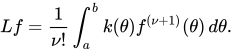
Bounds
[edit]Several bounds on the value of follow from this result:

![{\displaystyle {\begin{aligned}|Lf|&\leq {\frac {1}{\nu !}}\|k\|_{1}\|f^{(\nu +1)}\|_{\infty }\\[5pt]|Lf|&\leq {\frac {1}{\nu !}}\|k\|_{\infty }\|f^{(\nu +1)}\|_{1}\\[5pt]|Lf|&\leq {\frac {1}{\nu !}}\|k\|_{2}\|f^{(\nu +1)}\|_{2}\end{aligned}}}](https://wikimedia.org/api/rest_v1/media/math/render/svg/2764ece246dfc561f08d3443aa1a664a80db8e57)
where , and are the taxicab, Euclidean and maximum norms respectively.[2]


Application
[edit]In practice, the main application of the Peano kernel theorem is to bound the error of an approximation that is exact for all . The theorem above follows from the Taylor polynomial for with integral remainder:

![{\displaystyle {\begin{aligned}f(x)=f(a)+{}&(x-a)f'(a)+{\frac {(x-a)^{2}}{2}}f''(a)+\cdots \\[6pt]&\cdots +{\frac {(x-a)^{\nu }}{\nu !}}f^{(\nu )}(a)+{\frac {1}{\nu !}}\int _{a}^{x}(x-\theta )^{\nu }f^{(\nu +1)}(\theta )\,d\theta ,\end{aligned}}}](https://wikimedia.org/api/rest_v1/media/math/render/svg/409615249d661a640a1ea889a6e9483501388925)
defining as the error of the approximation, using the linearity of together with exactness for to annihilate all but the final term on the right-hand side, and using the notation to remove the -dependence from the integral limits.[3]


See also
[edit]References
[edit]- 1 2 Ridgway Scott, L. (2011). Numerical analysis. Princeton, N.J.: Princeton University Press. pp. 209. ISBN 9780691146867. OCLC 679940621.
- 1 2 Iserles, Arieh (2009). A first course in the numerical analysis of differential equations (2nd ed.). Cambridge: Cambridge University Press. pp. 443–444. ISBN 9780521734905. OCLC 277275036.
- ↑ Iserles, Arieh (1997). "Numerical Analysis" (PDF). Retrieved 2018-08-09.