Cloudflare fetched the original article and streamed it through HTMLRewriter to apply an entirely new visual system without rebuilding the source page.
// request.cf · coarse context
A page that knows where it met you.
Only coarse request metadata is shown. This demo does not display or persist visitor IP addresses.
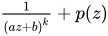
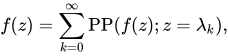
By using polynomial long division and the partial fraction technique from algebra, any rational function can be written as a sum of terms of the form , where and are complex, is an integer, and is a polynomial. Just as polynomial factorization can be generalized to the Weierstrass factorization theorem, there is an analogy to partial fraction expansions for certain meromorphic functions.
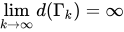
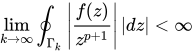
A proper rational function (one for which the degree of the denominator is greater than the degree of the numerator) has a partial fraction expansion with no polynomial terms. Similarly, a meromorphic function for which goes to 0 as goes to infinity at least as quickly as has an expansion with no polynomial terms.
The simplest meromorphic functions with an infinite number of poles are the non-entire trigonometric functions. As an example, is meromorphic with poles at , The contours will be squares with vertices at traversed counterclockwise, , which are easily seen to satisfy the necessary conditions.
On the horizontal sides of ,
so
for all real , which yields
For , is continuous, decreasing, and bounded below by 1, so it follows that on the horizontal sides of , . Similarly, it can be shown that on the vertical sides of .
With this bound on we can see that
That is, the maximum of on occurs at the minimum of , which is .
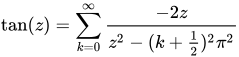
Therefore , and the partial fraction expansion of looks like
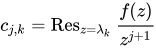
The principal parts and residues are easy enough to calculate, as all the poles of are simple and have residue -1:
We can ignore , since both and are analytic at 0, so there is no contribution to the sum, and ordering the poles so that , etc., gives
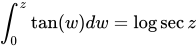
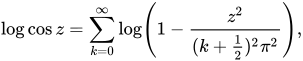
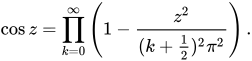
Because the partial fraction expansion often yields sums of , it can be useful in finding a way to write a function as an infinite product; integrating both sides gives a sum of logarithms, and exponentiating gives the desired product:
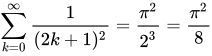
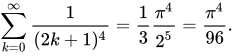
The partial fraction expansion for a function can also be used to find a Laurent series for it by simply replacing the rational functions in the sum with their Laurent series, which are often not difficult to write in closed form. This can also lead to interesting identities if a Laurent series is already known.
Recall that
We can expand the summand using a geometric series:
Substituting back,
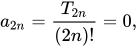
which shows that the coefficients in the Laurent (Taylor) series of about are













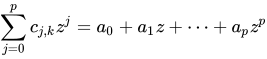


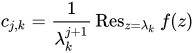
![{\displaystyle \sum _{j=0}^{p}c_{j,k}z^{j}=[\operatorname {Res} _{z=\lambda _{k}}f(z)]\sum _{j=0}^{p}{\frac {1}{\lambda _{k}^{j+1}}}z^{j}}](https://wikimedia.org/api/rest_v1/media/math/render/svg/62c6284c7bc74e6a8b46f1c3cd669d822572ca23)


![{\displaystyle z=t\pm \pi ki,\ \ t\in [-\pi k,\pi k],}](https://wikimedia.org/api/rest_v1/media/math/render/svg/5c110193122a94de152b8b3a78e807c9bebd846b)















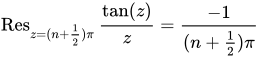


![{\displaystyle \tan(z)=\sum _{k=0}^{\infty }\left[\left({\frac {-1}{z-(k+{\frac {1}{2}})\pi }}-{\frac {1}{(k+{\frac {1}{2}})\pi }}\right)+\left({\frac {-1}{z+(k+{\frac {1}{2}})\pi }}+{\frac {1}{(k+{\frac {1}{2}})\pi }}\right)\right]}](https://wikimedia.org/api/rest_v1/media/math/render/svg/3d4fc5b2892b34d59b63ba9d175a2008ede88804)