


Parker vector
 | This article includes a list of references, related reading, or external links, but its sources remain unclear because it lacks inline citations. (May 2024) |
In mathematics, especially the field of group theory, the Parker vector is an integer vector that describes a permutation group in terms of the cycle structure of its elements, defined by Richard A. Parker.
Definition
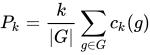
[edit]The Parker vector P of a permutation group G acting on a set of size n, is the vector whose kth component for k = 1, ..., n is given by:
- where ck(g) is the number of k-cycles in the cycle decomposition of g.
Examples
[edit]For the group of even permutations on three elements, the Parker vector is (1,0,2). The group of all permutations on three elements has Parker vector (1,1,1). For any of the subgroups of the above with just two elements, the Parker vector is (2,1,0).The trivial subgroup has Parker vector (3,0,0).
Applications
[edit]
References
[edit]- Peter J. Cameron (1999). Permutation Groups. Cambridge University Press. p. 48. ISBN 0-521-65378-9.
Parker Vector.
- Aart Blokhuis (2001). Finite Geometries: Proceedings of the Fourth Isle of Thorns Conference. Springer. ISBN 0-7923-6994-7.
 | This algebra-related article is a stub. You can help Wikipedia by adding missing information. |