


Parallelization (mathematics)
In mathematics, a parallelization[1] of a manifold of dimension n is a set of n global smooth linearly independent vector fields.

Formal definition
[edit]Given a manifold of dimension n, a parallelization of is a set of n smooth vector fields defined on all of such that for every the set is a basis of , where denotes the fiber over of the tangent vector bundle .
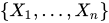


A manifold is called parallelizable whenever it admits a parallelization.
Examples
[edit]- Every Lie group is a parallelizable manifold.
- The product of parallelizable manifolds is parallelizable.
- Every affine space, considered as manifold, is parallelizable.
Properties
[edit]Proposition. A manifold is parallelizable iff there is a diffeomorphism such that the first projection of is and for each the second factor—restricted to —is a linear map .




In other words, is parallelizable if and only if is a trivial bundle. For example, suppose that is an open subset of , i.e., an open submanifold of . Then is equal to , and is clearly parallelizable.[2]


See also
[edit]Notes
[edit]- ↑ Bishop & Goldberg (1968), p. 160
- ↑ Milnor & Stasheff (1974), p. 15.
References
[edit]- Bishop, R.L.; Goldberg, S.I. (1968), Tensor Analysis on Manifolds (First Dover 1980 ed.), The Macmillan Company, ISBN 0-486-64039-6
- Milnor, John W.; Stasheff, James D. (1974). Characteristic Classes. Annals of Mathematics Studies. Vol. 76. Princeton University Press; University of Tokyo Press. ISBN 978-0-691-08122-9. MR 0440554.