


Pairwise error probability
| Part of a series on statistics |
| Probability theory |
|---|
 |
Pairwise error probability is the error probability that for a transmitted signal () its corresponding but distorted version () will be received. This type of probability is called ″pair-wise error probability″ because the probability exists with a pair of signal vectors in a signal constellation.[1] It's mainly used in communication systems.[1]


Expansion of the definition
[edit]In general, the received signal is a distorted version of the transmitted signal. Thus, we introduce the symbol error probability, which is the probability that the demodulator will make a wrong estimation of the transmitted symbol based on the received symbol, which is defined as follows:


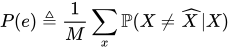
where M is the size of signal constellation.
The pairwise error probability is defined as the probability that, when is transmitted, is received.

- can be expressed as the probability that at least one is closer than to .


Using the upper bound to the probability of a union of events, it can be written:
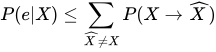
Finally:

Closed form computation
[edit]For the simple case of the additive white Gaussian noise (AWGN) channel:

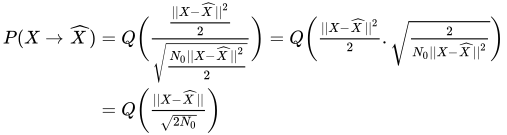
The PEP can be computed in closed form as follows:
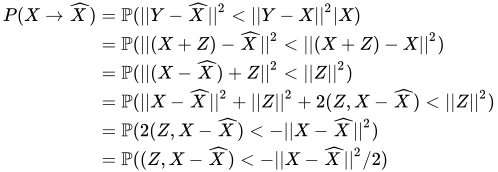
is a Gaussian random variable with mean 0 and variance .

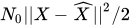
For a zero mean, variance Gaussian random variable:


Hence,
See also
[edit]References
[edit]- 1 2 Stüber, Gordon L. (8 September 2011). Principles of mobile communication (3rd ed.). New York: Springer. p. 281. ISBN 978-1461403647.
Further reading
[edit]- Simon, Marvin K.; Alouini, Mohamed-Slim (2005). Digital Communication over Fading Channels (2. ed.). Hoboken: John Wiley & Sons. ISBN 0471715239.