Cloudflare fetched the original article and streamed it through HTMLRewriter to apply an entirely new visual system without rebuilding the source page.
// request.cf · coarse context
A page that knows where it met you.
Only coarse request metadata is shown. This demo does not display or persist visitor IP addresses.
Geography (from Ancient Greekγεωγραφίαgeōgraphía; combining gê 'Earth' and gráphō 'write', lit. 'Earth writing') is the study of the lands, features, inhabitants, and phenomena of planet Earth. Geography is an all-encompassing discipline that seeks an understanding of Earth and its human and natural complexities—not merely where objects are, but also how they have changed and come to be. While geography is specific to Earth, many concepts can be applied more broadly to other celestial bodies in the field of planetary science. Geography has been called "a bridge between natural science and social science disciplines."
The history of geography as a discipline spans cultures and millennia, having been independently developed by multiple groups and cross-pollinated through trade between them. Geography as a discipline dates back to the earliest attempts to understand the world spatially, with the earliest example of an attempted world map dating to the 9th century BC in ancient Babylon. Origins of many of the concepts in geography can be traced to Greek Eratosthenes of Cyrene, who may have coined the term "geographia" (c.276 BC– c.195/194 BC). The first recorded use of the word γεωγραφία was as the title of a book by Greek scholar Claudius Ptolemy (100 – 170 AD). During the Middle Ages, geography was influenced by Islamic scholars, such as Muhammad al-Idrisi, producing detailed maps of the world. The Age of Discovery was influential in the development of geography, as European explorers mapped the New World. Modern developments include geomatics and geographic information science.
The core concepts of geography that are consistent across all approaches are space, place, time, and scale. Today, geography is an extremely broad discipline with multiple approaches and modalities. The main branches of geography are physical geography, human geography, and technical geography. Physical geography focuses on the natural environment, human geography on how humans interact with the Earth, and technical geography on developing tools for understanding geography. Techniques employed can generally be broken down into quantitative and qualitative approaches, with many studies taking mixed-methods approaches. Common techniques include cartography, remote sensing, interviews, and surveying. (Full article...)
The northern half of the MEVC as seen from the southern end of the Big Raven Plateau. Coffee Crater is at left centre whereas Ice Peak and Mount Edziza itself are at upper right centre and at upper centre, respectively.
The Mount Edziza volcanic complex (/ədˈzaɪzə/əd-ZY-zə; abbreviated MEVC) is a group of volcanoes and associated lava flows in northwestern British Columbia, Canada. Located on the Tahltan Highland, it is 40 kilometres (25 miles) southeast of Telegraph Creek and 85km (53mi) southwest of Dease Lake. The complex encompasses a broad, steep-sided lava plateau that extends over 1,000km2 (390mi2). Its highest summit is 2,786 metres (9,140 feet) in elevation, making the MEVC the highest of four large complexes in an extensive north–south trending volcanic region. It is obscured by an ice cap characterized by several outlet glaciers that stretch out to lower altitudes.
The MEVC consists of several types of volcanoes, including stratovolcanoes, shield volcanoes, cinder cones and lava domes. These volcanoes have formed over the last 7.5million years during five cycles of magmatic activity which spanned four geologic epochs. Volcanic eruptions during these magmatic cycles produced a wide variety of volcanic rocks that compose 13geological formations. The most recent eruptions took place in the last 11,000years but none of them have been precisely dated. Current activity occurs exclusively in the form of hot springs which exist along the western side of the volcanic complex. Future eruptions are likely to impact local streams and cause wildfires. (Full article...)
Image 3
Waterfall in Macleay Park
Balch Creek is a 3.5-mile (5.6km) tributary of the Willamette River in the U.S. state of Oregon. Beginning at the crest of the Tualatin Mountains (West Hills), the creek flows generally east down a canyon along Northwest Cornell Road in unincorporated Multnomah County and through the Macleay Park section of Forest Park, a large municipal park in Portland. At the lower end of the park, the stream enters a pipe and remains underground until reaching the river. Danford Balch, after whom the creek is named, settled a land claim along the creek in the mid-19thcentury. After murdering his son-in-law, he became the first person legally hanged in Oregon.
Basalt, mostly covered by silt in the uplands and sediment in the lowlands, underlies the Balch Creek watershed. The upper part of the watershed includes private residential land, the Audubon Society of Portland nature sanctuary, and part of Forest Park. Mixed conifer forest of Coast Douglas-fir, western redcedar, and western hemlock with a well-developed understory of shrubs and flowering plants is the natural vegetation. Sixty-two species of mammals and more than 112species of birds use Forest Park. A small population of coastal cutthroat trout resides in the stream, which in 2005 was the only major water body in Portland that met state standards for bacteria, temperature, and dissolved oxygen. (Full article...)
Thiruchchirappalli (Tamil pronunciation:[ˈt̪iɾɯtːʃiɾapːaɭːi]ⓘ), also known as Tiruchchi or Trichy or historically known as Trichinopoly, is a major tier II city in the Indian state of Tamil Nadu and the administrative headquarters of Tiruchirappalli district. The city is credited with being the most livable and cleanest city in all of Tamil Nadu, as well as the fifth safest city for women in India. It is the fourth largest urban agglomeration in the state. Located 322 kilometres (200mi) south of Chennai and 374 kilometres (232mi) north of Kanyakumari, Tiruchirappalli sits almost at the geographic centre of Tamil Nadu. The Cauvery Delta begins 16 kilometres (9.9mi) west of the city where the Kaveri river splits into two, forming the island of Srirangam which is now incorporated into the Tiruchirappalli City Municipal Corporation. The city occupies an area of 168.23 square kilometres (64.95sqmi) and had a population of 916,857 in 2011.
The Terra NovaExpedition, officially the British Antarctic Expedition, was an expedition to Antarctica which took place between 1910 and 1913. Led by Captain Robert Falcon Scott, the expedition had various scientific and geographical objectives. Scott wished to continue the scientific work that he had begun when leading the Discovery Expedition from 1901 to 1904, and wanted to be the first to reach the geographic South Pole.
He and four companions attained the pole on 17 January 1912, where they found that a Norwegian team led by Roald Amundsen had preceded them by 34 days. Scott's party of five died on the return journey from the pole; some of their bodies, journals, and photographs were found by a search party eight months later. The expedition, named after its supply ship, was a private venture financed by public contributions and a government grant. It had further backing from the Admiralty, which released experienced seamen to the expedition, and from the Royal Geographical Society. The expedition's team of scientists carried out a comprehensive scientific programme, while other parties explored Victoria Land and the Western Mountains. An attempted landing on and exploration of King Edward VII Land was unsuccessful. A journey to Cape Crozier in June and July 1911 was the first extended sledging journey in the depths of the Antarctic winter. (Full article...)
Image 7
Omayra Sánchez Garzón (August 28, 1972– November 16, 1985) was a Colombian girl trapped and killed by a landslide when she was 13 years old.
The landslide was caused by the 1985 eruption of the volcano Nevado del Ruiz in Armero, Tolima. Volcanic debris mixed with ice to form massive lahars (volcanically induced mudflows, landslides, and debris flows), which rushed into the river valleys below the mountain, killing about 25,000 people and destroying Armero and 13 other villages. (Full article...)
Image 8
Cannon decorate the quayside of Balfour Harbour on Shapinsay, the round tower in the background is The Douche
Shapinsay (/ˈʃæpɪnziː/, Scots: Shapinsee) is one of the Orkney Islands off the north coast of mainland Scotland. With an area of 29.5 square kilometres (11.4sqmi), it is the eighth largest island in the Orkney archipelago. It is low-lying and, with a bedrock formed from Old Red Sandstone overlain by boulder clay, fertile, causing most of the area to be used for farming. Shapinsay has two nature reserves and is notable for its bird life. Balfour Castle, built in the Scottish Baronial style, is one of the island's most prominent features, a reminder of the Balfour family's domination of Shapinsay during the 18th and 19th centuries; the Balfours transformed life on the island by introducing new agricultural techniques. Other landmarks include a standing stone, a broch from the Iron Age, a souterrain and a salt-water shower.
There is one village on the island, Balfour, from which roll-on/roll-off car ferries sail to Kirkwall on the Orkney Mainland. At the 2011 census, Shapinsay had a population of 307. The economy of the island is primarily based on agriculture with the exception of a few small businesses that are largely tourism-related. A community-owned wind turbine was constructed in 2011. The island has a primary school but, in part due to improving transport links with mainland Orkney, no longer has a secondary school. Shapinsay's long history has given rise to various folk tales. (Full article...)
Image 9
The blue whale (Balaenoptera musculus) is a species of baleen whale and the largest marine mammal in the rorqual family Balaenopteridae. Reaching a maximum confirmed length of 29.9–30.5m (98–100ft) and weighing up to 190–200t (190–200 long tons; 210–220 short tons), it is the largest animal known to have ever existed. The blue whale's long and slender body can be of various shades of greyish-blue on its upper surface and somewhat lighter underneath. Four subspecies are recognized: B. m. musculus in the North Atlantic and North Pacific, B. m. intermedia in the Southern Ocean, B. m. brevicauda (the pygmy blue whale) in the Indian Ocean and South Pacific Ocean, and B. m. indica in the Northern Indian Ocean. There is a population in the waters off Chile that may constitute a fifth subspecies.
In general, blue whale populations migrate between their summer feeding areas near the poles and their winter breeding grounds near the tropics. There is also evidence of year-round residencies, and partial or age- and sex-based migration. Blue whales are filter feeders; their diet consists almost exclusively of krill. They are generally solitary or gather in small groups, and have no well-defined social structure other than mother–calf bonds. Blue whales vocalize, with a fundamental frequency ranging from 8 to 25Hz; their vocalizations may vary by region, season, behavior, and time of day. (Full article...)
The original Skegness was situated farther east at the mouth of the Wash. Its Norse name refers to a headland which sat near the settlement. By the 14th century, it was a locally important port for coastal trade. The natural sea defences which protected the harbour eroded in the later Middle Ages, and it was lost to the sea after a storm in the 1520s. Rebuilt along the new shoreline, early modern Skegness was a small fishing and farming village, but from the late 18th century members of the local gentry visited for holidays. The arrival of the railways in 1873 transformed it into a popular seaside resort. This was the intention of The 9th Earl of Scarbrough, who owned most of the land in the vicinity; he built the infrastructure of the town and laid out plots, which he leased to speculative developers. This new Skegness quickly became a popular destination for holiday-makers and day trippers from the East Midlands factory towns. By the interwar years the town was established as one of the most popular seaside resorts in Britain. The layout of the modern seafront dates to this time and holiday camps were built around the town, including the first Butlin's holiday resort which opened in Ingoldmells in 1936. (Full article...)
Image 11
Location in the Marshall Islands
Limalok (formerly known as Harrie or Harriet) is a Cretaceous-Paleoceneguyot/tablemount in the southeastern Marshall Islands, one of a number of seamounts (a type of underwater volcanic mountain) in the Pacific Ocean. It was probably formed by a volcanic hotspot in present-day French Polynesia. Limalok lies southeast of Mili Atoll and Knox Atoll, which rise above sea level, and is joined to each of them through a volcanic ridge. It is located at a depth of 1,255 metres (4,117ft) and has a summit platform with an area of 636 square kilometres (246sqmi).
Limalok is formed by basaltic rocks and was probably a shield volcano at first; the Macdonald, Rarotonga, Rurutu and Society hotspots may have been involved in its formation. After volcanic activity ceased, the volcano was eroded and thereby flattened, and a carbonate platform formed on it during the Paleocene and Eocene. These carbonates were chiefly produced by red algae, forming an atoll or atoll-like structure with reefs. (Full article...)
Aliso Creek flows over highly erosive marine sedimentary rock of late Eocene to Pliocene age. What would become the Aliso Creek watershed originally lay at the bottom of the Pacific Ocean, before being uplifted as recently as 10million years ago. About 1.2 million years ago, the San Joaquin Hills began to uplift in the path of Aliso Creek. Occasionally swollen by wetter climates during glacial periods, the creek carved the deep water gap known today as Aliso Canyon, the main feature of Aliso and Wood Canyons Wilderness Park. (Full article...)
Image 13
CCC-built overlook looking south into Pine Creek Gorge
Colton Point State Park is a 368-acre (149ha) Pennsylvania state park in Tioga County, Pennsylvania, in the United States. It is on the west side of the Pine Creek Gorge, also known as the Grand Canyon of Pennsylvania, which is 800 feet (240m) deep and nearly 4,000 feet (1,200m) across at this location. The park extends from the creek in the bottom of the gorge up to the rim and across part of the plateau to the west. Colton Point State Park is known for its views of the Pine Creek Gorge, and offers opportunities for picnicking, hiking, fishing and hunting, whitewater boating, and camping. Colton Point is surrounded by Tioga State Forest and its sister park, Leonard Harrison State Park, on the east rim. The park is on a state forest road in Shippen Township 5 miles (8km) south of U.S. Route 6.
Located in Del Norte and Humboldt counties, the four parks protect the endangered coast redwood (Sequoia sempervirens)—the tallest, among the oldest, and one of the most massive tree species on Earth—which thrives in the humid temperate rainforest. The park region is highly seismically active and prone to tsunamis. The parks preserve 37 miles (60 km) of pristine coastline, indigenous flora, fauna, grassland prairie, cultural resources, waterways, as well as threatened animal species, such as the Chinook salmon, northern spotted owl, and Steller's sea lion. (Full article...)
Image 15
Launching the James Caird from the shore of Elephant Island, 24 April 1916
In October 1915, pack ice in the Weddell Sea had sunk the main expedition ship Endurance, leaving Shackleton and his 27 companions adrift on a floe. They drifted northward until April 1916, when the floe on which they were camped broke up; they made their way in the ship's boats to Elephant Island. Shackleton decided to sail one of the boats with a small crew to South Georgia to seek help. It was not the closest human settlement but the only one that did not require them to sail into the prevailing westerlies. (Full article...)
A sea is a very large body of salty water. The term has two distinct meanings. The first is the interconnected body of seawater that spans most of Earth, known as the sea or the ocean. The second is a named body of water: usually either a marginal sea (a second-order section of the oceanic sea such as the Mediterranean Sea), or a large, nearly landlocked body of water. (Full article...)
The sinusoidal projection is a pseudocylindrical equal-areamap projection. Used as early as the 16th century, this projection shows distances accurately along the central meridian and the equator; areas furthest from these lines are the most distorted.
The Mollweide projection is an equal-area, pseudocylindrical map projection generally used for global maps of the world or night sky. The projection was first published by mathematician and astronomer Karl Mollweide of Leipzig in 1805 but reinvented and popularized in 1857 by Jacques Babinet. The projection trades accuracy of angle and shape for accuracy of proportions in area, and as such is used where that property is needed, such as maps depicting global distributions.
The General Perspective projection is a map projection used in cartography in which the Earth is depicted as viewed from a finite distance above its surface. If the view precisely faces the center of the Earth, the projection is a vertical perspective projection; otherwise, it is a tilted perspective projection. Here is shown a vertical perspective from an altitude of 35,786km over (0°, 90°W), corresponding to a view from geostationary orbit. Due to the horizon as seen from the viewpoint position, the projection always shows less than half of the Earth's surface: in this case neither of the North and South Poles is visible.
A detailed eighteenth-century map of Scandinavia by J. B. Homann, depicting Denmark, Norway, Sweden, Finland and the Baltic states of Livonia, Latvia and Curlandia. The map notes fortified cities, villages, roads, bridges, forests, castles and topography. The elaborate title cartouche in the upper left quadrant features angels supporting a title curtain and a medallion supporting an alternative title in French, "Les Trois Covronnes du Nord".
Born in 1664, Homann became an engraver and cartographer in the late 17th century, and opened his own publishing house in 1702. In 1715 Emperor Charles VI appointed him Imperial Geographer of the Holy Roman Empire. Homann held the position until his death in 1724.
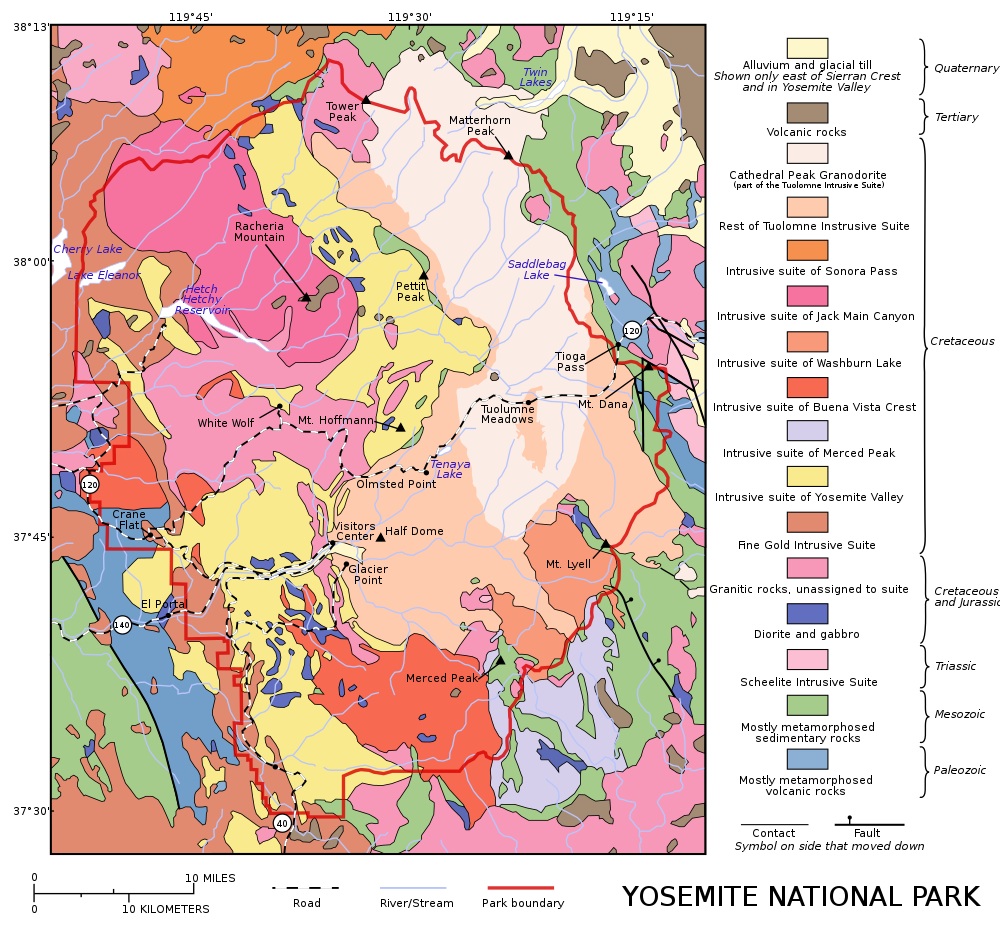
A geological map of Yosemite National Park (full size), showing the Cathedral Peak Granodiorite, the largest unit in the Tuolumne Intrusive Suite, which in turn is the largest granitic suite in the park. Cathedral Peak Granodiorite Rest of the Tuolumne Intrusive Suite
A portolan chart from 1492, the oldest known signed and dated chart of Portuguese origin. Cartography technologies greatly advanced during the Age of Discovery. Iberian mapmakers in particular focused on practical charts to use as navigational aids. Unlike Spanish maps which were regarded as state secrets, Portuguese ones were used by other countries, and Portuguese cartographers drew upon the skill and knowledge of other cultures as well.
The van der Grinten projection is a compromise map projection that is neither equal-area nor conformal. It projects the entire Earth into a circle, though the polar regions are subject to extreme distortion. The projection was the first of four proposed by Alphons J. van der Grinten in 1904, and, unlike perspective projections, is an arbitrary geometric construction on the plane. It was adopted as the National Geographic Society's reference map of the world from 1922 until 1988.
A compass rose, sometimes called a windrose or rose of the winds, is a figure on a compass, map, nautical chart, or monument used to display the orientation of the cardinal directions (north, east, south, and west) and their intermediate points. It is also the term for the graduated markings found on the traditional magnetic compass. Today, a form of compass rose is found on, or featured in, almost all navigation systems, including nautical charts, non-directional beacons, VHF omnidirectional range systems, GPS, and similar equipment.
He led the team that made the first crossing of the Greenland interior in 1888, traversing the island on cross-country skis. He won international fame after reaching a record northern latitude of 86°14′ during his Fram expedition of 1893–1896. Although he retired from exploration after his return to Norway, his techniques of polar travel and his innovations in equipment and clothing influenced a generation of subsequent Arctic and Antarctic expeditions. He was elected an International Member of the American Philosophical Society in 1897. (Full article...)
As of 2026[update], the most populous country in the world is India, followed closely by China, with both exceeding 1.4 billion. (Full article...)
Image 2
Venezuela, officially the Bolivarian Republic of Venezuela, is a country on the northern coast of South America, consisting of a continental landmass and various islands and islets in the Caribbean Sea. It comprises an area of 912,050km2 (352,140sqmi), with a population estimated at 31.8 million in 2025. The capital and largest urban agglomeration is Caracas. The continental territory is bordered on the north by the Caribbean Sea and the Atlantic Ocean, on the west by Colombia, on the south by Brazil, on the east by Guyana, and on the northeast by Trinidad and Tobago. Venezuela consists of 23 states, the Capital District, and the Federal Dependencies covering Venezuela's offshore islands. Venezuela is among the most urbanized countries in Latin America, with an estimated urbanization rate of 88.4% in 2022. The vast majority of Venezuelans live in urban areas in the north, including in the capital. (Full article...)
Image 3
Dymaxion map of the world with the 30 largest countries and territories by area
This is a list of the world's countries and their dependencies, ranked by total area, including land and water. (Full article...)
The United Nations uses three definitions for what constitutes a city, as not all cities in all jurisdictions are classified using the same criteria. Cities may be defined as the cities proper, their metropolitan regions, or the extent of their urban area. A complicating factor is that many large cities in the world have not only homeless or the unhoused, but also vast slum communities. This leads to official census data being less accurate in representing the actual number of residents in a given area. (Full article...)


 Featured article -


_Guyot.png)


 Vital article


 Map credit: Fernão Vaz DouradoA pre-Mercator nautical chart of West Africa from 1571, by Portuguese cartographer Fernão Vaz Dourado. It is done using the so-called "plane chart model", where observed latitudes and magnetic directions were plotted directly into the plane, with a constant scale, as if the Earth were flat.
 Map: Strebe, using GeocartThe sinusoidal projection is a pseudocylindrical equal-area map projection. Used as early as the 16th century, this projection shows distances accurately along the central meridian and the equator; areas furthest from these lines are the most distorted.
 Map: Strebe, using GeocartThe Mollweide projection is an equal-area, pseudocylindrical map projection generally used for global maps of the world or night sky. The projection was first published by mathematician and astronomer Karl Mollweide of Leipzig in 1805 but reinvented and popularized in 1857 by Jacques Babinet. The projection trades accuracy of angle and shape for accuracy of proportions in area, and as such is used where that property is needed, such as maps depicting global distributions.
 Map: Strebe, using the Geocart map projection softwareA map of the world using the Natural Earth projection, a pseudocylindrical projection which is neither conformal nor equal-area. The projection was designed by Tom Patterson, an American cartographer with the National Park Service who has developed several open-source tools and base maps for cartographers.
 Map: Strebe, using GeocartThe Craig retroazimuthal is a modified cylindrical map projection created by James Ireland Craig in 1909. It preserves the direction from any place to one other, predetermined place while avoiding some of the distortion of the Hammer retroazimuthal projection. This projection is sometimes known as the Mecca projection because Craig, who had worked in Egypt as a cartographer, created it to help Muslims find the qibla.
 Credit: Martin WaldseemüllerThe Waldseemüller map is a map drawn by German cartographer Martin Waldseemüller originally published in April 1507. It was one of the first maps to chart latitude and longitude precisely, the first map to use the name "America", and the first to depict the Americas as separate from Asia.
 Map: Strebe, using GeocartThe General Perspective projection is a map projection used in cartography in which the Earth is depicted as viewed from a finite distance above its surface. If the view precisely faces the center of the Earth, the projection is a vertical perspective projection; otherwise, it is a tilted perspective projection. Here is shown a vertical perspective from an altitude of 35,786 km over (0°, 90°W), corresponding to a view from geostationary orbit. Due to the horizon as seen from the viewpoint position, the projection always shows less than half of the Earth's surface: in this case neither of the North and South Poles is visible.
 Map credit: Heinrich C. BerannYellowstone National Park is an American national park located mostly in Wyoming and extending into Montana and Idaho. It was established by the U.S. Congress and signed into law by President Ulysses S. Grant on March 1, 1872. Yellowstone was the first national park in the U.S. and is also widely held to be the first national park in the world. The park is known for its wildlife and its many geothermal features, especially the Old Faithful geyser, one of its most popular landmarks. It has many types of ecosystems, but the subalpine forest is the most abundant. The park is part of the South Central Rockies forests ecoregion. In 1978, Yellowstone was named a World Heritage Site by UNESCO.
 A detailed eighteenth-century map of Scandinavia by J. B. Homann, depicting Denmark, Norway, Sweden, Finland and the Baltic states of Livonia, Latvia and Curlandia. The map notes fortified cities, villages, roads, bridges, forests, castles and topography. The elaborate title cartouche in the upper left quadrant features angels supporting a title curtain and a medallion supporting an alternative title in French, "Les Trois Covronnes du Nord".
 Map: Grandiose, based on a map by the United States Geological SurveyA geological map of Yosemite National Park (full size), showing the Cathedral Peak Granodiorite, the largest unit in the Tuolumne Intrusive Suite, which in turn is the largest granitic suite in the park.
 Map: Strebe, using GeocartThe Tobler hyperelliptical projection is a family of equal-area pseudocylindrical map projections first described by Waldo R. Tobler in 1973. The imagery used for the map is derived from NASA's Blue Marble summer months composite, with oceans lightened to enhance legibility and contrast.
 A map showing the geography of Florida, a state in the United States. Situated on a peninsula between the Gulf of Mexico, the Atlantic Ocean, and the Straits of Florida, Florida has an extensive coastline. Its highest point, Britton Hill, is the lowest highpoint of any U.S. state. Florida is home to over 19 million people, living in 410 municipalities.
 Map: Jorge de AguiarA portolan chart from 1492, the oldest known signed and dated chart of Portuguese origin. Cartography technologies greatly advanced during the Age of Discovery. Iberian mapmakers in particular focused on practical charts to use as navigational aids. Unlike Spanish maps which were regarded as state secrets, Portuguese ones were used by other countries, and Portuguese cartographers drew upon the skill and knowledge of other cultures as well.
 Map: Strebe, using GeocartThe van der Grinten projection is a compromise map projection that is neither equal-area nor conformal. It projects the entire Earth into a circle, though the polar regions are subject to extreme distortion. The projection was the first of four proposed by Alphons J. van der Grinten in 1904, and, unlike perspective projections, is an arbitrary geometric construction on the plane. It was adopted as the National Geographic Society's reference map of the world from 1922 until 1988.
 Illustration credit: Joaquim Alves Gaspar, after Jorge de AguiarA compass rose, sometimes called a windrose or rose of the winds, is a figure on a compass, map, nautical chart, or monument used to display the orientation of the cardinal directions (north, east, south, and west) and their intermediate points. It is also the term for the graduated markings found on the traditional magnetic compass. Today, a form of compass rose is found on, or featured in, almost all navigation systems, including nautical charts, non-directional beacons, VHF omnidirectional range systems, GPS, and similar equipment.


.svg)
.svg)
.jpeg)


 Categories
 Commons
 Wikibooks
 Wikidata
 Wikiquote
 Wikisource
 Wikiversity
 Wikivoyage
 Wiktionary