


Owen's T function
In mathematics, Owen's T function T(h, a), named after statistician Donald Bruce Owen, is defined by

The function was first introduced by Owen in 1956.[1]
Applications
[edit]The function T(h, a) gives the probability of the event (X > h and 0 < Y < aX) where X and Y are independent standard normal random variables.
This function can be used to calculate bivariate normal distribution probabilities[2][3] and, from there, in the calculation of multivariate normal distribution probabilities.[4] It also frequently appears in various integrals involving Gaussian functions.
Computer algorithms for the accurate calculation of this function are available;[5] quadrature having been employed since the 1970s. [6]
Properties
[edit]
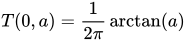





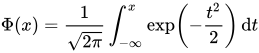
Here Φ(x) is the standard normal cumulative distribution function
More properties can be found in the literature.[7]
References
[edit]- ↑ Owen, D B (1956). "Tables for computing bivariate normal probabilities". Annals of Mathematical Statistics, 27, 1075–1090.
- ↑ Sowden, R R and Ashford, J R (1969). "Computation of the bivariate normal integral". Applied Statististics, 18, 169–180.
- ↑ Donelly, T G (1973). "Algorithm 462. Bivariate normal distribution". Commun. Ass. Comput.Mach., 16, 638.
- ↑ Schervish, M H (1984). "Multivariate normal probabilities with error bound". Applied Statistics, 33, 81–94.
- ↑ Patefield, M. and Tandy, D. (2000) "Fast and accurate Calculation of Owen’s T-Function", Journal of Statistical Software, 5 (5), 1–25.
- ↑ JC Young and Christoph Minder. Algorithm AS 76
- ↑ Owen, D. (1980). "A table of normal integrals". Communications in Statistics: Simulation and Computation. B9 (4): 389–419. doi:10.1080/03610918008812164.
Software
[edit]- Owen's T function (user web site) - offers C++, FORTRAN77, FORTRAN90, and MATLAB libraries released under the LGPL license LGPL
- Owen's T-function is implemented in Mathematica since version 8, as OwenT.
- Owen's T-function is also available as a function in R (https://search.r-project.org/CRAN/refmans/sn/html/T.Owen.html).
External links
[edit]- Why You Should Care about the Obscure (Wolfram blog post)
 | This statistics-related article is a stub. You can help Wikipedia by adding missing information. |